

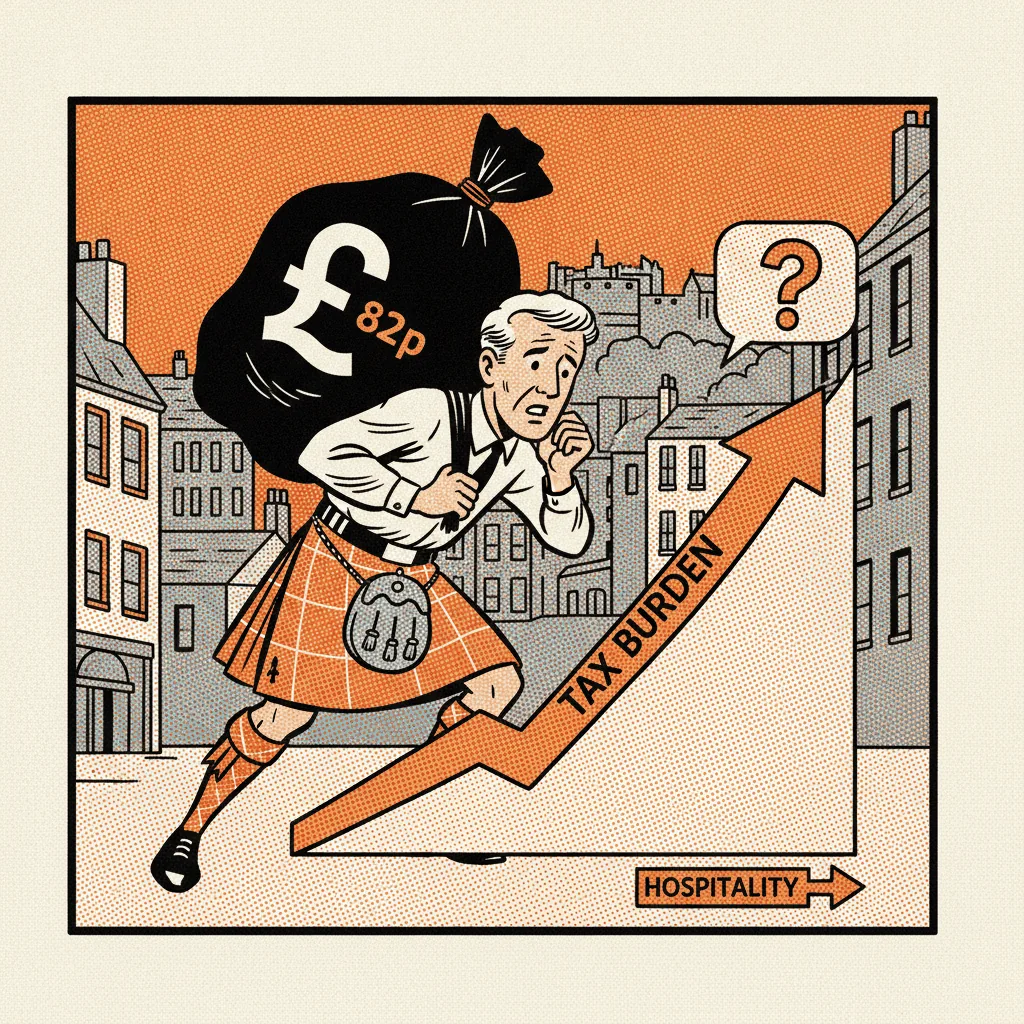
Hospitality businesses across the UK now hand over 82 pence of every pound they generate to tax obligations, making it the most heavily taxed sector in the British economy. That figure, reported by Startups.co.uk and drawing on analysis from trade body UKHospitality, covers the full stack: business rates, VAT, employer National Insurance contributions, alcohol duties, and corporation tax. Stack them together and the margin left for investment, wages, or simply staying solvent is wafer-thin.
For Edinburgh, this is not an abstract Westminster number. The city's hospitality sector is one of its largest employers, running somewhere between 10,000 and 15,000 jobs across food service, accommodation, bars, and events venues, according to Edinburgh Chamber of Commerce estimates. Those businesses are also facing a specific local pressure that operators in Manchester or Bristol are not: the Scottish Government's visitor levy, which passed into law in 2024 and gives councils the power to charge overnight guests a fee on top of accommodation costs. Edinburgh City Council is expected to be among the first to implement it. Operators broadly accept the principle; the timing, layered on top of the UK-wide tax burden, is what stings.
The April 2025 increase in employer National Insurance contributions, from 13.8% to 15%, landed particularly hard on a sector that is structurally labour-intensive and legally required to pay National Living Wage increases simultaneously. UKHospitality's chief executive Kate Nicholls warned before the Budget that combining these measures without an offsetting reduction in business rates would push already-marginal operators over the edge. The Scottish Retail Consortium has echoed those concerns for Scottish operators, noting that high street footfall remains below pre-pandemic levels in most Scottish cities, including Edinburgh's Grassmarket and Leith Walk corridors.
Business rates remain the structural villain of the piece. Hospitality properties are valued on turnover potential, which means a busy Edinburgh restaurant on George Street pays rates calibrated to peak performance even when the kitchen is half-empty in January. England has a 75% retail, hospitality, and leisure relief in place, capped at £110,000 per property. Scotland operates its own rates system, and while the Scottish Government has maintained the Small Business Bonus Scheme, relief for mid-sized hospitality operators above the threshold is limited. The Federation of Small Businesses Scotland has repeatedly called for a fundamental revaluation of how hospitality property is assessed.
There is a practical path through this, even if it is not comfortable. Sector specialists consistently point to three levers: ensuring you are claiming every available relief (many operators are not on the Small Business Bonus Scheme despite qualifying), reviewing your VAT position if turnover has shifted post-pandemic, and stress-testing your pricing model against the real cost of labour including NI. Several Edinburgh hospitality businesses have also started using AI-assisted forecasting tools, including platforms like Rotaready and Fourth, to reduce scheduling waste. Labour is the biggest cost centre and the one with the most room to optimise without compromising service. A one-hour reduction in average weekly overstaffing across a ten-person team compounds into meaningful savings inside a quarter.