

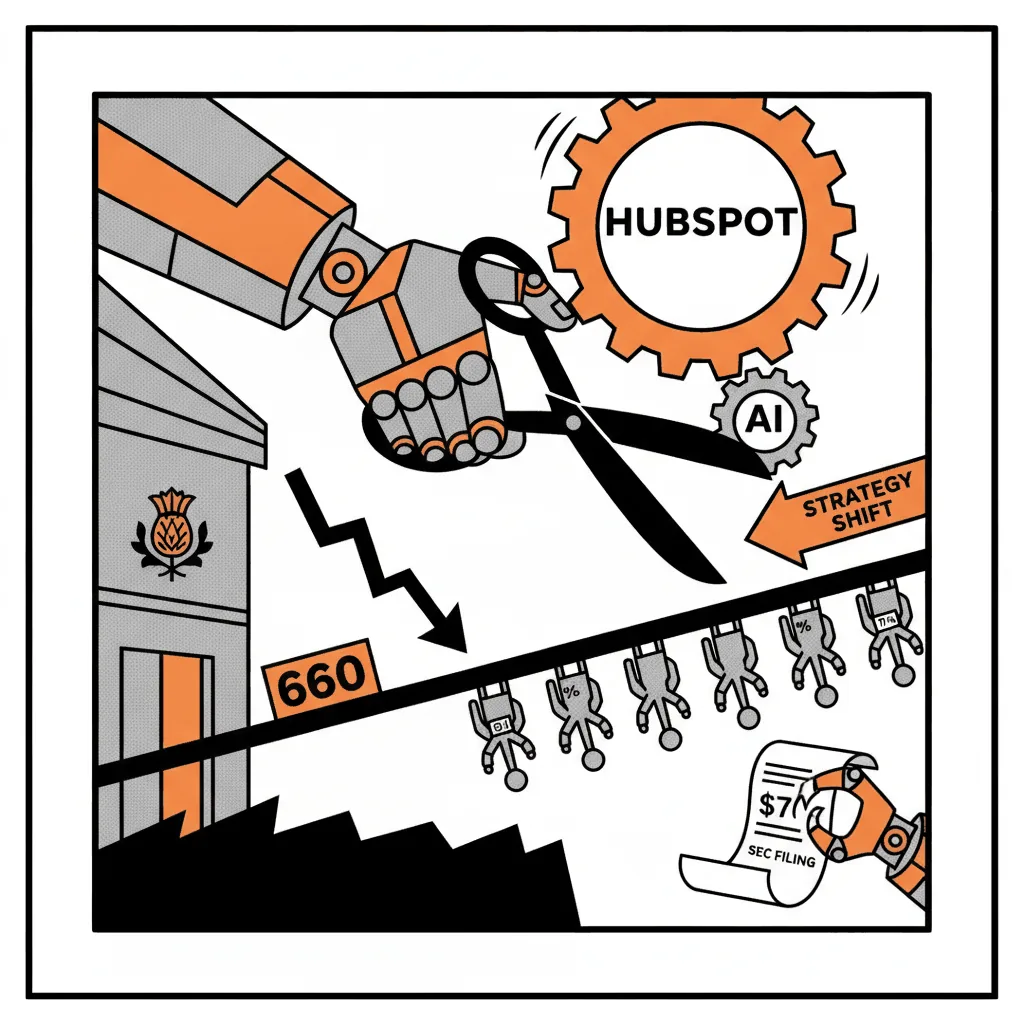
HubSpot is cutting 660 jobs, roughly 7% of its entire workforce, in what its chief executive is calling a strategic pivot toward AI. The announcement, which triggered a statutory 30-day consultation process under Irish employment law for its Dublin operation, landed with a familiar corporate awkwardness: the CEO insisting the restructuring is not about AI replacing people, while the SEC filing describes a company reorganising itself around AI capabilities. Both things cannot be entirely true.
The contradiction is worth sitting with. When a company the size of HubSpot, a firm that has spent years selling SMEs on the promise of smarter, more human marketing, frames mass redundancies as a 'strategy shift' rather than a cost-cutting exercise, it signals something important about how AI is actually being deployed inside large organisations. The McKinsey Global Institute estimated in 2023 that generative AI could automate up to 70% of business processing tasks within a decade. When companies start acting on that estimate ahead of communicating it honestly, the human cost lands hard and fast.
For Scottish businesses, the practical warning here is not about HubSpot specifically. It's about the pattern. Research published by the Chartered Institute of Personnel and Development found that only 22% of UK employers had a formal plan for how AI would change their workforce structure, despite the majority planning to adopt AI tools within two years. That gap between adoption and planning is precisely where the damage happens: you bring in the tools, the tools change what people do, and suddenly you're managing a restructuring you never properly planned for.
The Irish consultation dimension is worth noting for any Scottish SME owner with staff. Under both UK and Irish employment law, if redundancies reach a certain threshold, statutory consultation obligations kick in with real teeth. In Ireland, ignoring the 30-day minimum carries criminal penalties, as HubSpot's own SEC filing acknowledged. In Scotland and across the UK, collective redundancy rules under the Trade Union and Labour Relations (Consolidation) Act 1992 require a minimum 45-day consultation for 100 or more redundancies. Get this wrong and an employment tribunal follows. The Scottish Government's Fair Work Framework, which Scottish Enterprise actively promotes across its business support programmes, also sets a clear expectation that employers engage their workforce before restructuring, not after.
None of this is an argument against using AI. The opposite, in fact. The businesses that will come out ahead are the ones integrating AI as a productivity multiplier for their existing team, not as a replacement mechanism for it. A sole trader using AI to do the admin work of three people, a small clinic using it to clear the coding backlog, a four-person agency using it to deliver at the pace of twelve: that's the model. HubSpot's situation is what happens when a large company bolts AI onto a legacy headcount structure and then has to unpick it publicly, messily, and expensively.