

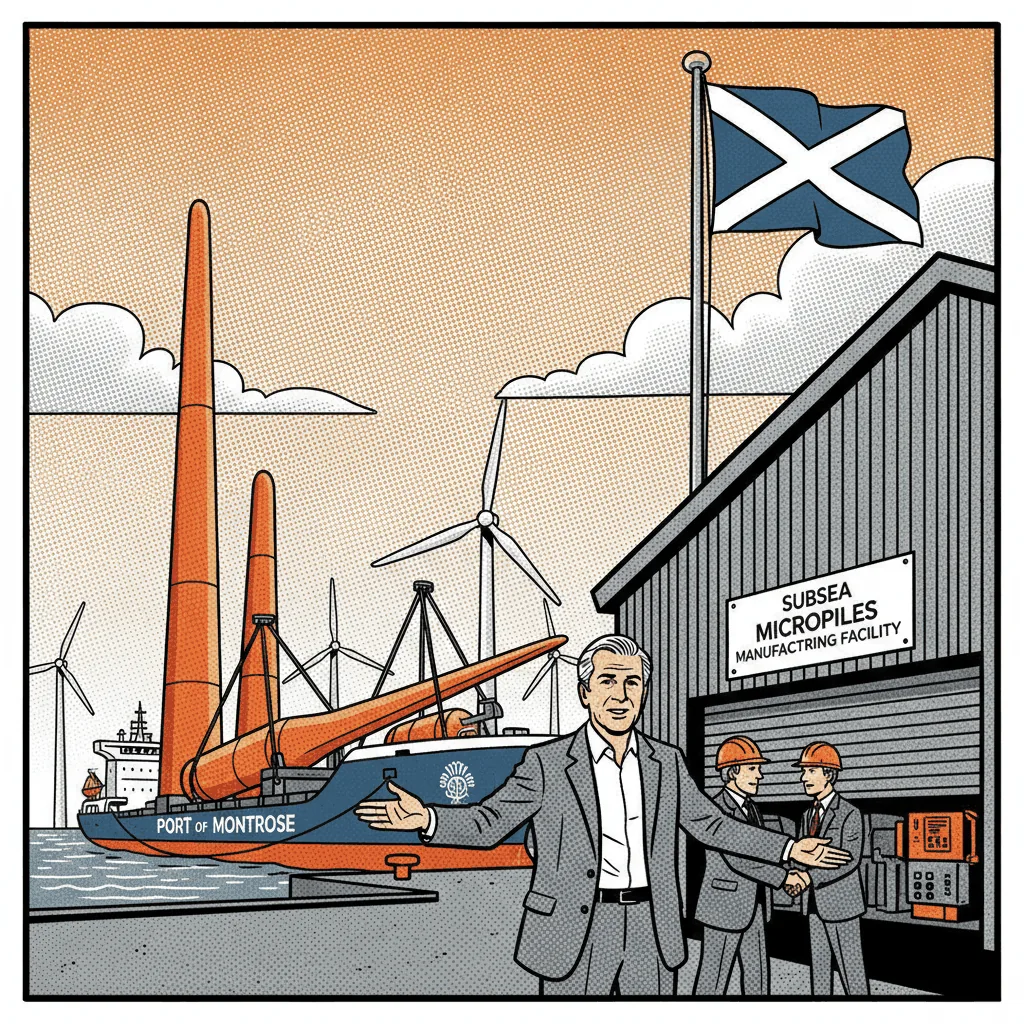
More than £5 million is being invested in a new manufacturing facility at the Port of Montrose by Subsea Micropiles, a specialist in the anchoring systems that hold floating offshore wind turbines in place on the seabed. First Minister John Swinney welcomed the announcement, framing it as evidence that Scotland is becoming a serious manufacturing base for the global floating wind industry, not just a site for turbine installation.
Floating offshore wind is the technology that makes the difference. Fixed-bottom turbines work in shallow coastal waters; floating platforms unlock the deep-water sites where winds are stronger and more consistent. Scotland has an outsized share of those sites. The Crown Estate Scotland's ScotWind leasing round allocated 25 gigawatts of offshore wind capacity, a significant portion of which requires floating foundations. According to Scottish Enterprise, the ScotWind pipeline alone could generate £28 billion in supply chain contracts over the coming decades.
Montrose is not a random choice. The port already handles significant offshore energy traffic and sits within striking distance of Scotland's east-coast energy corridor. Subsea Micropiles will manufacture anchoring components for Scottish projects and export to international markets, which positions Montrose as a production hub rather than a service port. That distinction matters: it means manufacturing jobs, technical skills, and retained economic value stay in Scotland rather than flowing to yards in the Netherlands or South Korea.
The Scottish Government's Energy Strategy and Just Transition Plan sets a target of generating 20 gigawatts of offshore wind capacity by 2030, with floating wind central to hitting those numbers in deeper waters off the north and west coasts. Research from the University of Strathclyde's Energy Systems Research Unit has consistently highlighted that Scotland's renewable geography is a structural competitive advantage, provided the industrial infrastructure exists to support it. A facility like Montrose's is part of building that infrastructure from the ground up.
For Scottish SMEs, the supply chain opportunity is real and immediate. Large-scale energy projects of this type require logistics, precision engineering, coatings, inspection services, environmental monitoring, legal and technical consultancy, and workforce training at every stage. Business Gateway and Scottish Enterprise both run dedicated energy supply chain programmes, and the newly established Global Underwater Hub, based in Aberdeen, exists specifically to connect Scottish subsea capability with international offshore energy contracts. The market is open. The question is whether Scottish businesses move quickly enough to be in the room when contracts are allocated.