

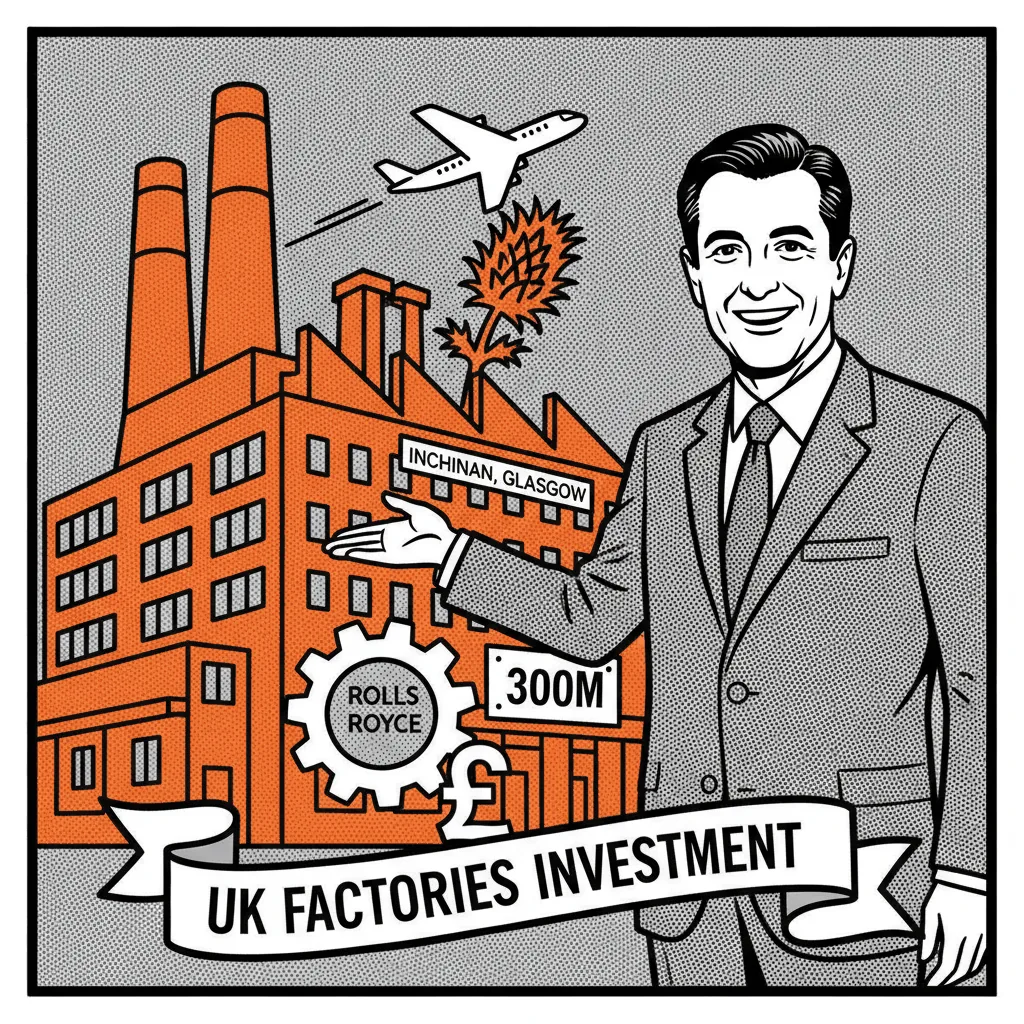
Rolls-Royce has confirmed a £300 million investment across its UK factory network, with its Inchinnan plant in Renfrewshire named as one of the beneficiaries. The announcement came during a speech by Defence Secretary John Healey at the Labour Party Conference in Liverpool, framing the spend as part of a broader commitment to British industrial capacity. The Inchinnan site, which sits close to Glasgow Airport and focuses on the manufacture and overhaul of defence aero-engines, is one of the more strategically significant industrial facilities in the central belt.
The scale of the commitment matters. According to Scottish Enterprise, aerospace and defence together support around 13,000 jobs in Scotland, with a supply chain that stretches across dozens of SMEs providing components, precision engineering, logistics, and specialist services. A capital injection of this size into a anchor facility like Inchinnan does not stay inside the factory gates; it flows outward into that supply chain and the businesses that service it.
Rolls-Royce employs approximately 1,500 people at Inchinnan, making it one of the largest single manufacturing employers in the west of Scotland. The plant has previously been the site of significant engine testing and overhaul work for programmes including the Eurofighter Typhoon. Investment at this level typically signals either capacity expansion, technology upgrades, or both, either way, it creates procurement and contracting opportunities that did not exist before the cheque was written.
The broader context is a UK Government under pressure to demonstrate tangible industrial policy after years of post-Brexit uncertainty about where defence and aerospace contracts would land. The National Audit Office has repeatedly flagged gaps between defence spending commitments and actual delivery. A named, site-specific investment in Scotland, rather than a vague national pledge, is a different kind of statement. It is also worth noting that Scottish Government economic development bodies, including Scottish Enterprise and its aerospace support programmes, have been active in making Inchinnan an attractive proposition for exactly this kind of long-term capital.
For businesses in the central belt and beyond, the question is not whether this is good news, it plainly is, but how quickly the supply chain effects materialise. Rolls-Royce, like most large prime contractors, sources extensively from regional suppliers. Precision engineers, materials specialists, calibration services, facilities management, specialist IT, and technical staffing firms all sit within the orbit of a facility like Inchinnan. If the investment is directed at modernising production lines or expanding capacity, those contracts will come to market. The time to be on the approved supplier list is before they do.