

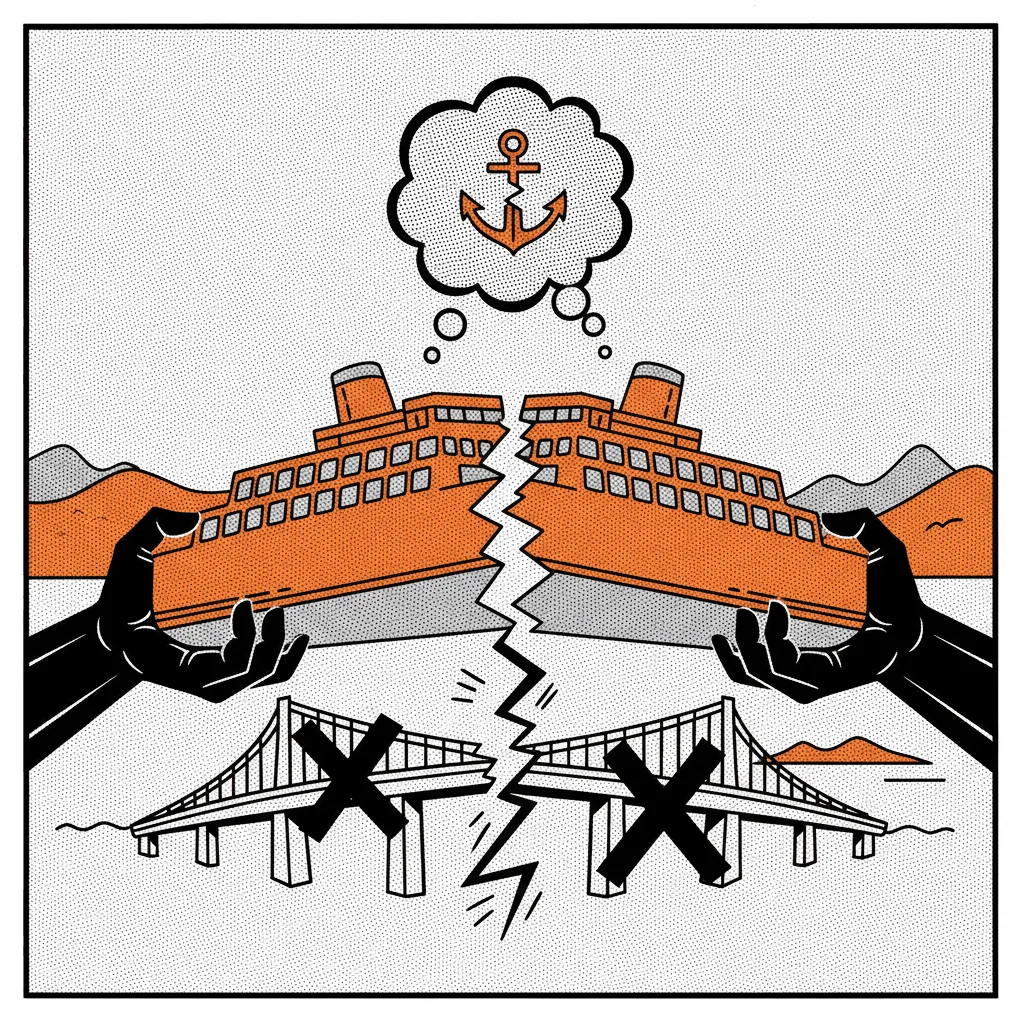
Scotland's only direct sea link to mainland Europe is gone. Forth Ports confirmed it has scrapped plans for the Rosyth-to-Dunkirk ferry route, telling BBC Scotland it had serious doubts about the service's long-term viability. No replacement has been announced. For export-focused Scottish SMEs, that means one fewer option for getting goods to European markets without routing everything through the English landbridge, a chokepoint that became painfully visible during the post-Brexit lorry queues at Dover.
The Rosyth route had a complicated history before this latest chapter. A previous incarnation, operated by Norfolkline, ran between 2002 and 2010 before folding due to weak demand and high operating costs. The revival was positioned as a post-Brexit opportunity: a way for Scottish food producers, manufacturers, and logistics firms to bypass the increasingly friction-heavy English ports and reach France directly. That logic was sound. The economics, apparently, were not.
The timing compounds an already difficult picture for Scottish trade. According to Scottish Government export statistics, Scotland sold £33.8 billion of goods internationally in 2022, with the European Union remaining the single largest market. Food and drink, life sciences, and engineering goods dominate those flows. Any added friction in the route to Europe hits those sectors first. The Scottish Food and Drink Federation has previously flagged that post-Brexit border checks and routing costs have already added between £100 and £400 per consignment for smaller exporters, figures that make a direct ferry link commercially attractive in principle even when it struggles to pencil out in practice.
The structural problem is one of critical mass. Ferry routes require consistent freight volume to cover fixed operating costs, and Scotland's export base, while high in value, is not always high in volume. Industry body Logistics UK has noted that thin freight corridors are particularly vulnerable to fuel price volatility and port handling fee increases, both of which spiked sharply after 2021. Without meaningful public co-investment in route development, the kind of support that helped establish Irish Sea routes as reliable alternatives to Dover, commercial operators face an almost impossible risk calculation on Scotland-to-Europe services.
There is a political dimension worth naming plainly. An independent Scotland with full control over its trade and ports policy could underwrite strategic route development as a national infrastructure investment, the way Ireland has treated its direct European ferry links as economic lifelines rather than purely commercial propositions. Within the current constitutional settlement, those decisions sit with Westminster, which has shown limited appetite for subsidising Scottish freight connectivity. Forth Ports is a private operator making a rational commercial call. The question of who fills the gap is a public policy question, and right now there is no clear answer.
For Scottish SMEs that were banking on this route, the immediate practical reality is a return to landbridge routing through England, or air freight for high-value, time-sensitive goods. That means more cost, more transit time, and more exposure to disruption at Dover and Folkestone. HMRC's own figures show that customs declarations for goods moving from Scotland to the EU via England have increased in complexity since the Trade and Cooperation Agreement came into force. Getting the paperwork right, and building logistics partnerships that can absorb delays, is now more important than ever for any Scottish business that sells into Europe.