

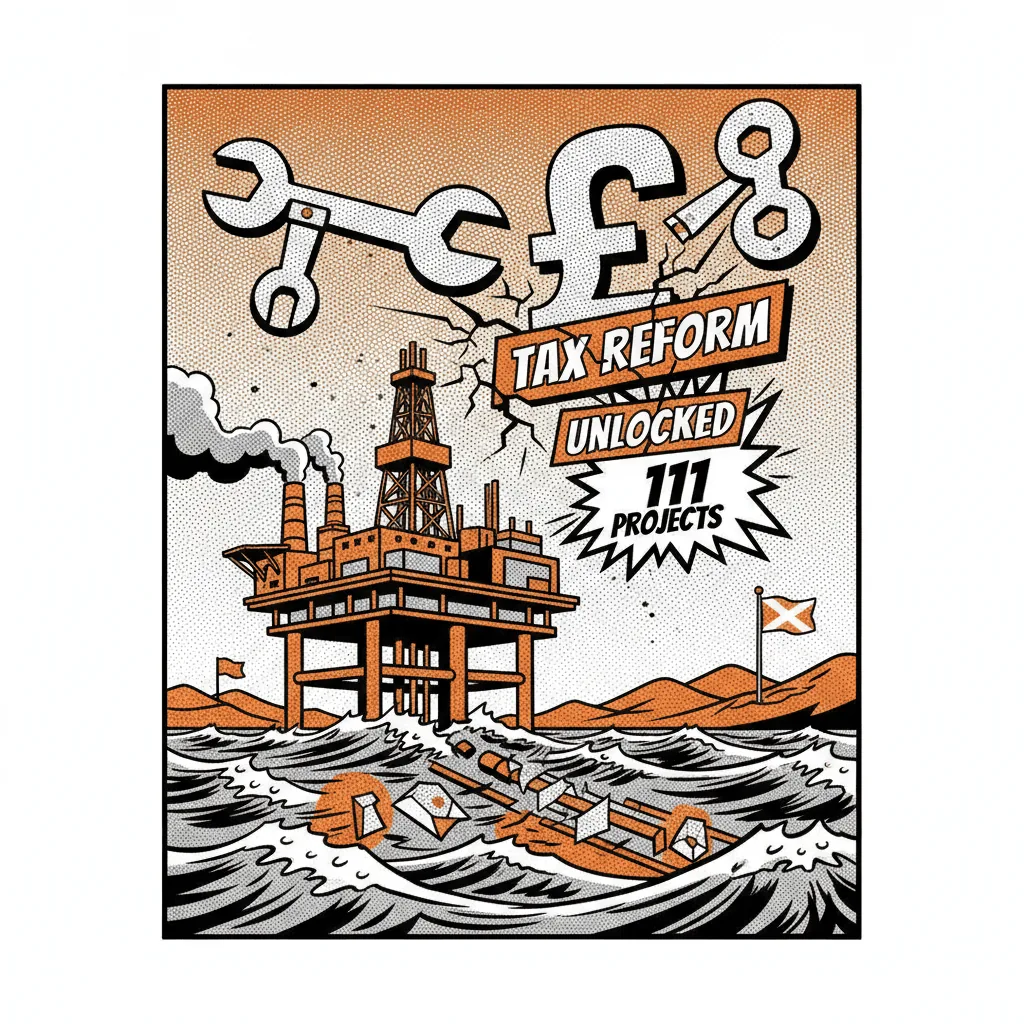
The industry body Offshore Energies UK (OEUK) has put a number on what the North Sea standoff is costing: 111 potential projects, £50 billion in private investment, and 3.25 billion barrels of recoverable resource, all sitting idle while operators wait for a tax environment that makes the maths work. According to OEUK's analysis, those projects could cover roughly half of the UK's total oil and gas demand if brought to production, reducing dependence on imports from Norway, the US, and Qatar.
The Energy Profits Levy, introduced in 2022 and subsequently extended and increased to 38 percent, is the primary obstacle. Combined with the existing ring-fence corporation tax, operators are now facing a headline tax rate of 78 percent on North Sea profits. The UK's own Office for Budget Responsibility noted in its March 2025 forecasts that North Sea revenues are expected to decline sharply over the next five years, partly because investment decisions are being deferred or abandoned altogether. That is not a coincidence; it is causation.
For Aberdeen and the wider Scottish supply chain, the freeze translates directly into order books. Subsea engineering firms, specialist fabricators, logistics operators, and technical consultancies all sit downstream of final investment decisions. When an operator pauses a field development, the contracts that would have flowed to Scottish SMEs pause with it. The Fraser of Allander Institute has previously estimated that upstream oil and gas activity supports around 100,000 jobs across Scotland, many of them in businesses with fewer than 50 employees.
OEUK is calling specifically for the Energy Profits Levy to be abolished and replaced with a stable, long-term fiscal framework that gives operators the certainty needed to commit capital five to ten years out. The argument is not that operators should pay less tax in absolute terms; it is that unpredictable rates make long-cycle investment economically irrational. The industry points to Norway's state-backed Equinor as an example of what a coherent fiscal structure can achieve: sustained investment, a sovereign wealth fund, and an energy sector that has not been hollowed out by short-term revenue grabs.
Scotland's political position adds a further dimension. The Scottish Government has consistently argued that decisions about North Sea taxation and licensing are reserved to Westminster, leaving Holyrood limited leverage over an industry that generates significant Scottish employment and economic activity. That structural disconnect means Scottish businesses bear the consequences of UK Treasury policy without meaningful input into it. If the 111 projects move forward, the economic benefit lands disproportionately in Scotland. If they don't, so does the cost.