

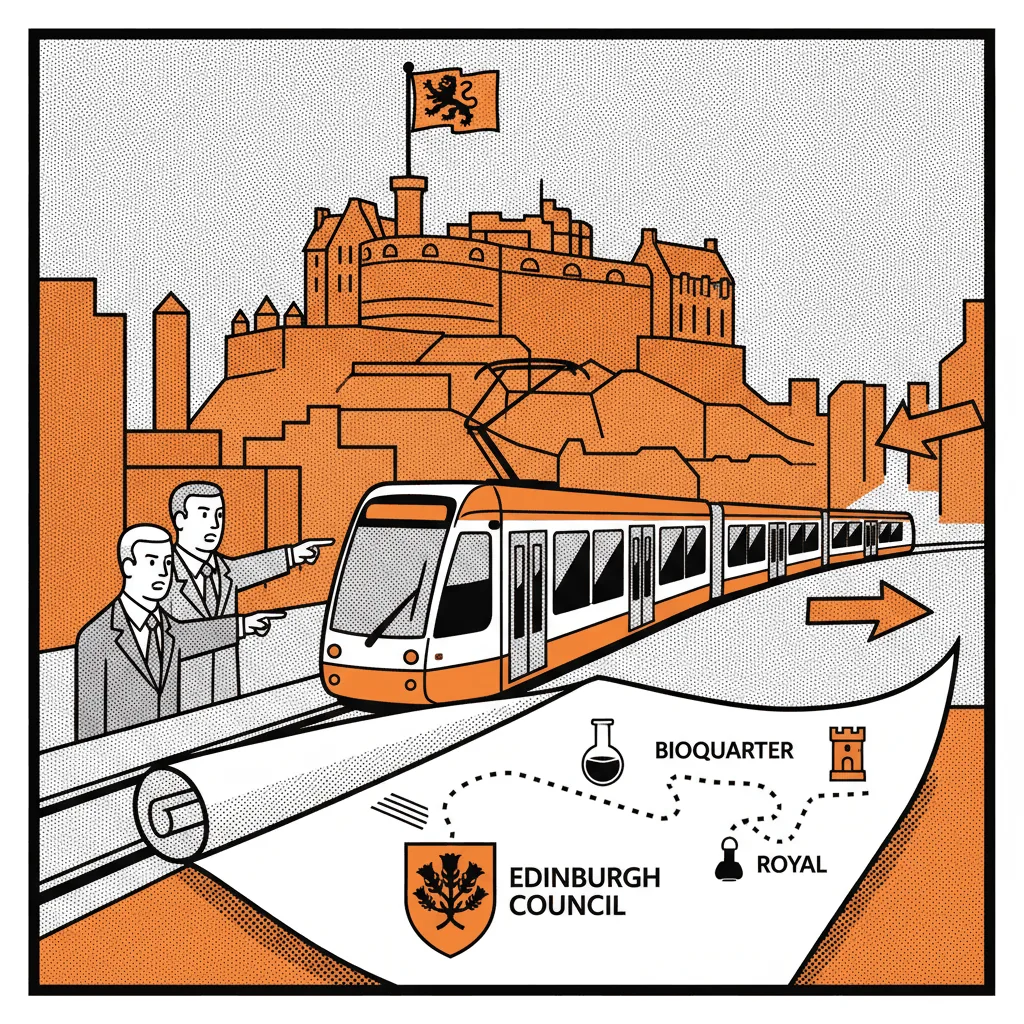
Edinburgh's Transport and Environment Committee has given the green light to the next formal stage of planning for a southern tram extension, with the proposed route running from the city centre through to Edinburgh BioQuarter and the Royal Infirmary of Edinburgh at Little France. The approval of a Strategic Business Case is not a groundbreaking moment, but it is the point at which a proposal stops being a conversation and starts being a project. That distinction matters for every business owner operating in south Edinburgh today.
Edinburgh BioQuarter is already one of the most significant life sciences clusters in the UK, housing more than 100 organisations and generating an estimated £1 billion in annual economic activity, according to Edinburgh BioQuarter's own published figures. A dedicated tram connection would do what all serious transport infrastructure does: reduce friction, raise footfall, and make the surrounding area more commercially attractive almost immediately. Property values along Edinburgh's existing tram corridor rose measurably after the line opened. The pattern tends to repeat.
The Royal Infirmary link is the other half of this story. The ERI is one of Edinburgh's largest single employers, with NHS Lothian running one of Scotland's biggest health boards from that campus. Getting staff, patients, and suppliers in and out of Little France more efficiently is not a minor convenience; it is an operational improvement at scale. According to Transport Scotland's published guidance on strategic transport appraisal, improved connectivity to major healthcare and research sites is weighted heavily in infrastructure prioritisation precisely because the knock-on economic effects are so well evidenced.
For SME owners, the immediate question is where the route actually runs. The Strategic Business Case will now inform a more detailed Outline Business Case, which is where corridor alignment, stop locations, and construction phasing get pinned down. That is the document to watch. Businesses on or near the likely southern corridor, broadly the route through Newington, Dalkeith Road, and out towards Little France, should be monitoring the consultation process closely. Tram construction brings disruption before it brings opportunity, and the businesses that fared worst during the original tram build were often the ones who had not planned for it.
The wider context here is the Scottish Government's commitment to modal shift: getting more people out of cars and onto public transport as part of its net zero targets. Edinburgh's tram network, which opened in 2014 after a famously difficult delivery, now carries around 7.5 million passengers a year, according to Transport for Edinburgh data. A southern extension, if delivered on time and on budget, would add a substantial catchment to that number and give the BioQuarter the kind of connectivity that serious international life sciences investment expects to see before committing. Cities that want to attract research capital have to look like they are building for it.