

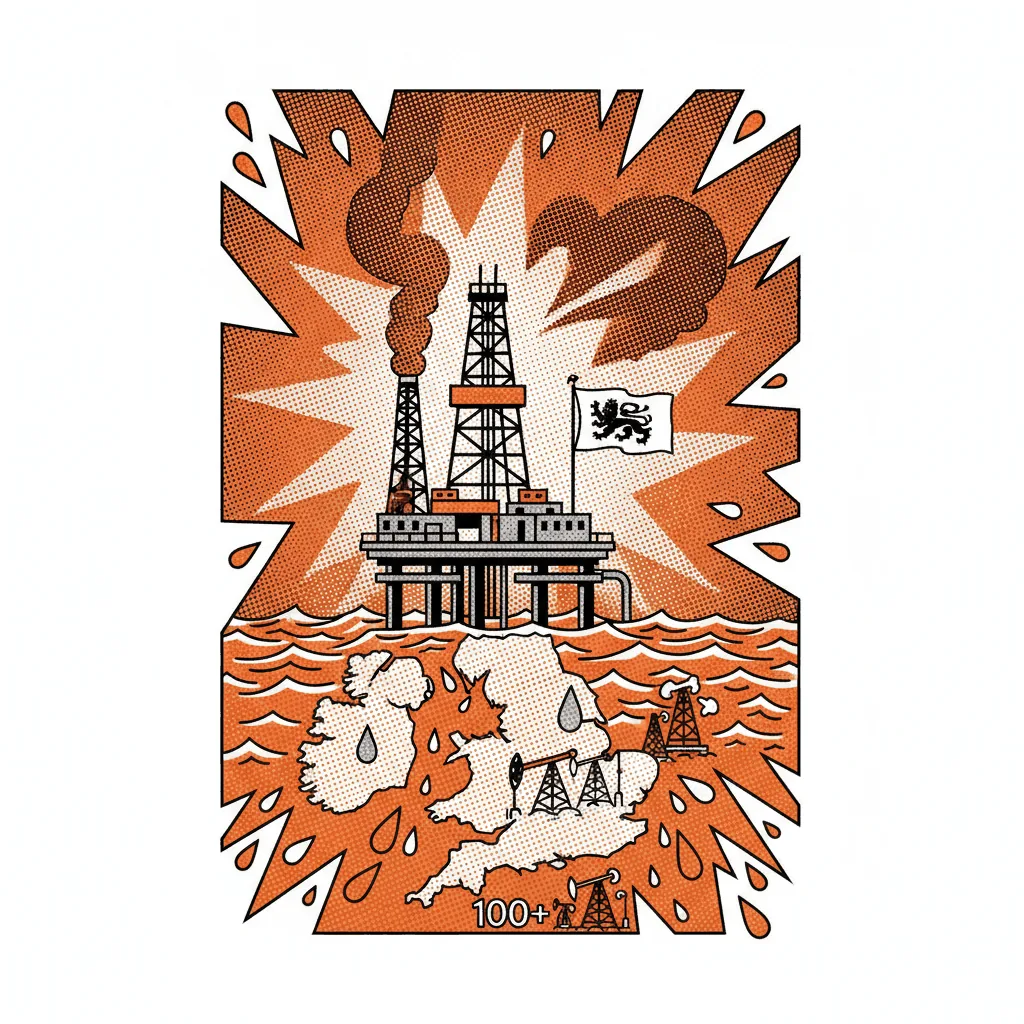
Offshore Energies UK (OEUK), the industry body representing the North Sea sector, has published analysis showing that 100 additional oil and gas projects could be unlocked on the UK Continental Shelf if the government adopted a more supportive licensing and fiscal stance. Brought online, those projects would, according to OEUK, cover approximately half of the UK's total oil and gas consumption from domestic production, reducing the need for imports that currently make up a significant and growing share of supply.
The context matters. The UK already imports around half its gas, much of it as liquefied natural gas shipped from the United States, Qatar, and Norway. Every unit of that imported energy carries a price premium over domestically produced equivalent supply, and that premium flows directly into the energy bills of Scottish businesses, hospitals, schools, and households. According to the North Sea Transition Authority's own production data, UK offshore output has been declining steadily since its 2000 peak, and the pipeline of approved new projects has thinned sharply since the Energy Profits Levy, the so-called windfall tax, was introduced in 2022 and subsequently extended.
OEUK's argument is straightforward: the resource is there, the engineering capacity is there, but the fiscal and regulatory environment has made too many projects marginal. The levy, which taxes North Sea profits at an effective rate of 78%, has been cited repeatedly by operators as the reason capital has been redirected to projects in Norway, Guyana, and the Gulf of Mexico instead. Aberdeen and Grampian Chamber of Commerce research published earlier this year found that a meaningful proportion of Scottish energy supply chain companies had seen contract pipelines shrink as a direct result of deferred or cancelled upstream projects.
The wider Scottish supply chain consequence is substantial. The North Sea supports around 200,000 jobs across the UK, with a significant concentration in Aberdeen, the Central Belt, and the Northern Isles. Those jobs are not just roughnecks offshore; they are engineers, software developers, logistics operators, welders, caterers, and training providers. A frozen project pipeline doesn't just affect the operator; it ripples into every SME holding a service contract. Skills group OPITO has warned separately that if activity doesn't recover, the skills base required for both oil and gas and the offshore wind transition will erode faster than the industry can rebuild it.
There is a legitimate tension here, and The Loop won't pretend otherwise. Scotland's own climate commitments, and the Scottish Government's ambition for a just transition, require that new fossil fuel development is weighed against long-term decarbonisation targets. But the practical reality, acknowledged by a broad range of voices including the Climate Change Committee, is that oil and gas will remain part of the UK energy mix well into the 2030s. The question is whether that supply comes from a regulated, high-standard Scottish basin or from imported sources with lower environmental oversight and a longer transport carbon footprint. OEUK's report frames it as a supply security and domestic industry argument; the Scottish Government's position has been to support a managed, worker-led transition rather than an abrupt shutdown. Both of those views leave room for a sensible conversation about which projects proceed and on what terms, a conversation that currently isn't happening at the pace the sector needs.
For Scottish SMEs in the energy supply chain, the immediate ask is visibility. The uncertainty itself is a business killer. Companies cannot invest in people, equipment, or training when they cannot see whether the contracts that would justify that investment will materialise. OEUK is calling for a clear, stable fiscal framework; the Scottish Chambers of Commerce has made similar representations to both Holyrood and Westminster. Until that clarity arrives, the 100 projects on OEUK's list remain potential rather than revenue.