

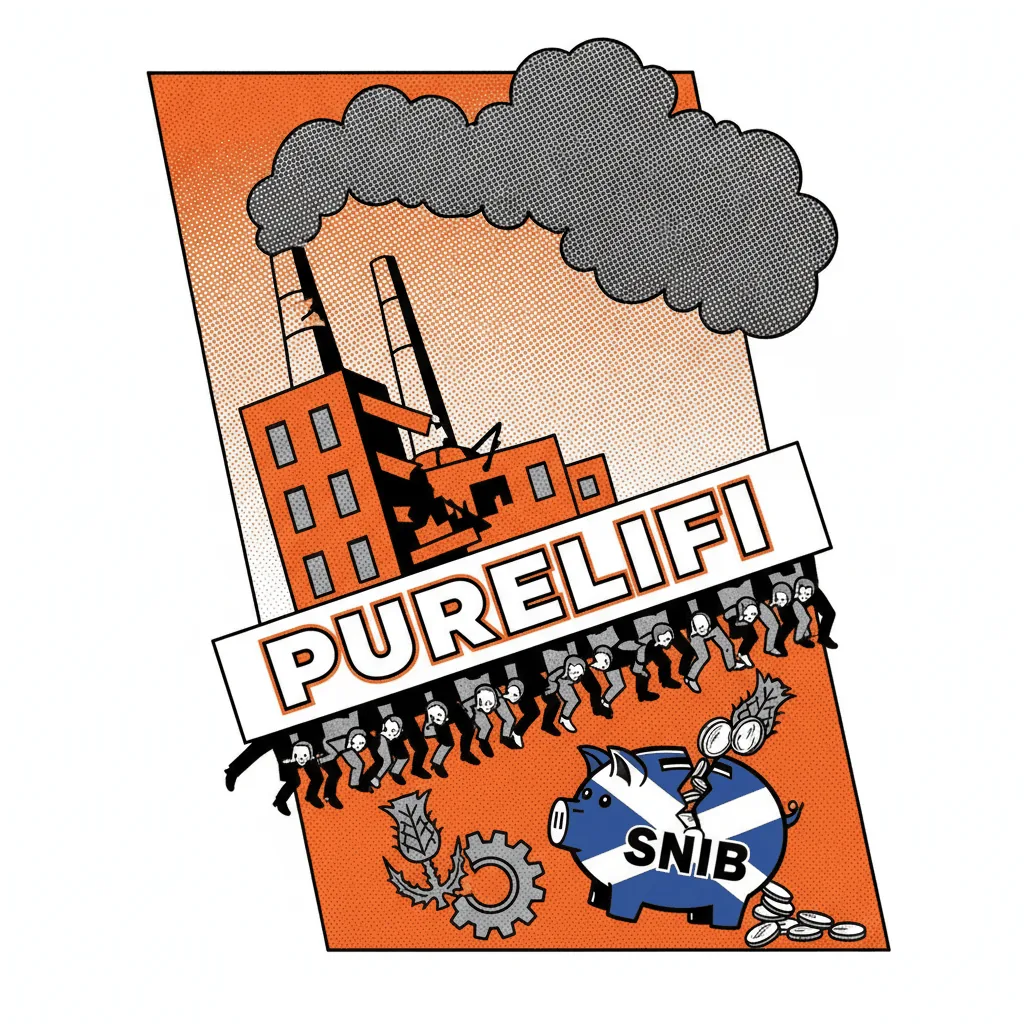
PureLiFi is gone. The Edinburgh firm, which spent more than a decade building technology that transmits data through light rather than radio waves, has failed, 42 people out of work, and a significant chunk of Scottish National Investment Bank (SNIB) funding written off alongside it. The collapse lands at an uncomfortable moment for Scotland's startup ecosystem, which has been making a credible case that patient, mission-led public investment can back the kind of bold, long-cycle innovation that private venture capital too often ignores.
PureLiFi was not a frivolous bet. LiFi, which uses visible light spectrum to carry data at speeds that can outperform conventional Wi-Fi in dense or secure environments, is a real and recognised technology. The Institute of Electrical and Electronics Engineers (IEEE) ratified the first international LiFi standard, 802.11bb, in 2023, a milestone PureLiFi's own founders helped push toward. The company held serious patents, had attracted international attention, and was seen by many in the sector as a legitimate contender for a share of the next generation of connectivity infrastructure.
The Scottish National Investment Bank, established in 2020 with a remit to invest in businesses that deliver economic and social impact across Scotland, had backed PureLiFi as part of that mission. SNIB operates on a patient capital model, deliberately taking on earlier-stage risk than commercial lenders will touch. That is the point of it. According to SNIB's own published investment principles, the bank expects some of its portfolio companies to fail, that is an accepted feature of any serious innovation fund, not a scandal in itself. The question worth asking is whether the due diligence, staging of capital, and exit planning held up.
What makes this harder to absorb is the timing. Scotland's tech sector has been working to shake off a persistent perception that it punches below its weight compared to London, Cambridge, or even Dublin. Scottish Enterprise data shows the country has seen consistent growth in tech employment and venture activity over the past five years, and bodies like Highlands and Islands Enterprise and Scottish EDGE have helped build a genuine pipeline of early-stage companies. A high-profile failure at the deep-tech end of that pipeline will invite scrutiny, some of it fair, some of it opportunistic, and the ecosystem needs to be ready for that conversation rather than defensive about it.
For the 42 people who have lost their jobs, the immediate picture is blunt. Many will have deep expertise in photonics, wireless systems, and hardware engineering, specialisms that are genuinely scarce and genuinely in demand. Scotland's universities, particularly the University of Edinburgh and the University of Strathclyde, continue to produce strong graduates in these areas, and the photonics sector more broadly remains active. Interface, the body that connects Scottish businesses with academic research expertise, and Skills Development Scotland both run active programmes to help technically skilled workers transition. Those are the doors worth knocking on first.
The broader takeaway for the Scottish startup ecosystem is not that deep tech is too risky to back. It's that the model for backing it needs to be continuously honest about timelines, capital requirements, and the gap between technical proof-of-concept and commercial scale. PureLiFi proved the technology worked. Bridging that proof to a sustainable revenue model in a market still dominated by Wi-Fi incumbents and 5G infrastructure spend was, in the end, a gap it could not close. That is a commercial failure, not a scientific one, and the distinction matters when deciding what to fund next.