
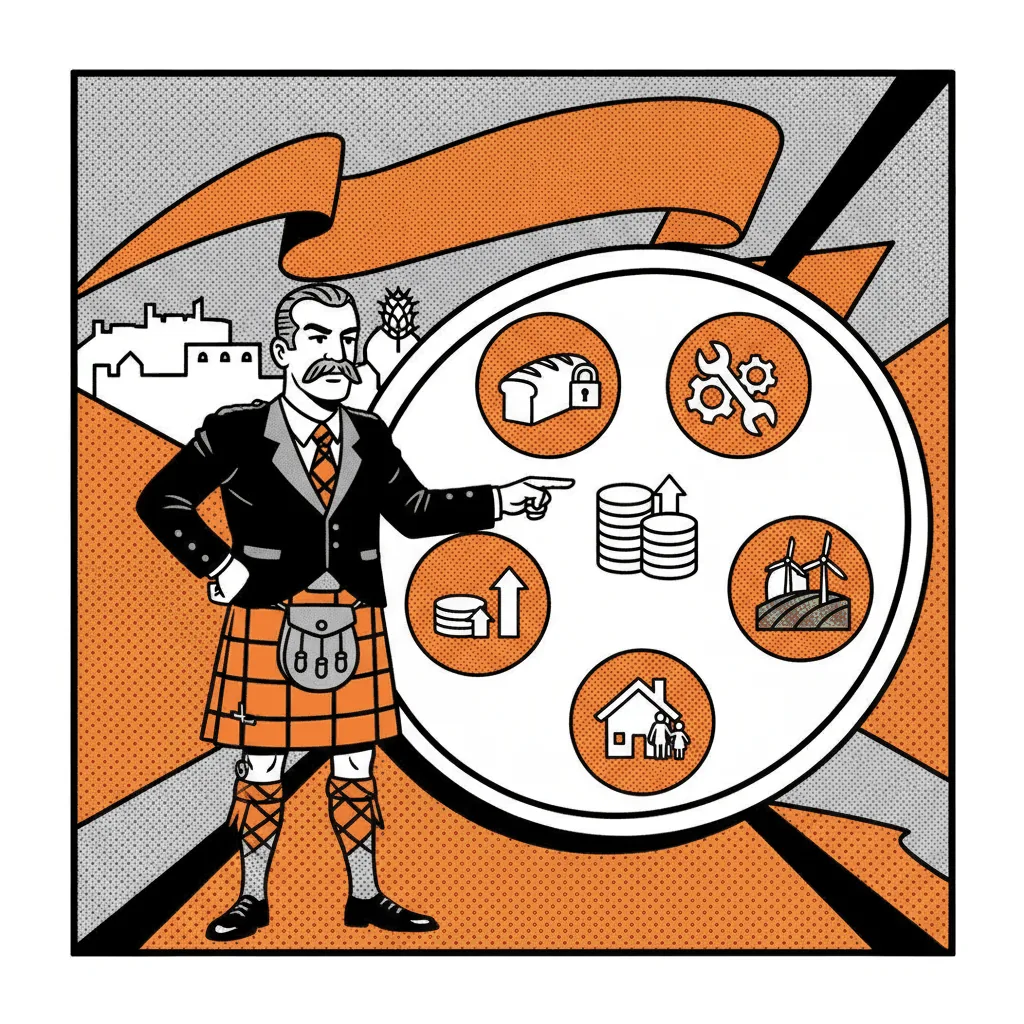
The headline policy is the most politically visible: a proposed cap on the price of essential food items. The Scottish Government intends to legislate to limit what retailers can charge for a basket of staple goods, a direct response to the sustained cost-of-living pressure that has seen UK food inflation run well above wage growth since 2022. According to the Office for National Statistics, food and non-alcoholic drink prices rose by over 25% between early 2022 and mid-2024. Swinney's argument is that retailers can absorb more of that pressure at the margin. Whether that argument survives contact with the grocery sector's lawyers is another matter.
For SME owners, the food price cap carries a second-order effect worth tracking. If households in Edinburgh and across Scotland genuinely see relief at the checkout, disposable income edges upward. That is good news for independent restaurants, hospitality businesses, and retailers operating outside the capped category. It is a demand stimulus wearing the clothes of a regulatory intervention. Watch how consumers respond before dismissing this as pure symbolism.
The bus fare cap is the more immediately operational announcement. The Scottish Government confirmed it will extend and expand the £2 bus fare cap across Scotland, a policy already running in England under the previous Westminster administration and now a permanent fixture north of the border. For businesses with staff commuting into Edinburgh city centre, this reduces a friction point in hiring and retention. The Federation of Small Businesses Scotland has consistently flagged transport costs as a barrier to filling entry-level roles in urban areas. A capped fare removes one line from the affordability calculation for workers weighing up whether a job in Leith or Morningside is worth the commute.
NHS restructuring is the most complex thread in the programme. Swinney announced plans to reform the management structure of NHS Scotland, reducing administrative layers and redirecting resource toward frontline delivery. The Scottish Government's own figures show that NHS Scotland employs over 180,000 people, making it the country's largest single employer. Any structural reform at that scale creates workforce movement. For SMEs supplying services to health boards, including IT, facilities, catering, and clinical consumables, a reorganisation means procurement contacts will change, frameworks may be retendered, and decision-making will shift. This is both a risk and an opening. New structures create new supplier relationships.
The broader public sector reform agenda runs underneath all five announcements. Swinney was explicit that Scotland cannot continue to expand public expenditure at the rate of the past decade without a corresponding improvement in productivity. According to the Fraser of Allander Institute, Scotland's devolved budget faces a structural gap that grows year on year without either additional revenue or reduced demand on services. The reform programme is the Scottish Government's answer to that pressure. For the SME community, this matters because public sector contracts represent a significant share of revenue for many Scottish businesses, and a leaner, more digitally capable public sector will procure differently, faster, and with a higher bar for supplier performance.
Taken together, the programme signals a Scottish Government that is governing under fiscal constraint but choosing to absorb that constraint through structural reform rather than visible cuts. That is a political choice, and it is one that Edinburgh's business community should engage with directly. Business Gateway Scotland and Scottish Enterprise both offer dedicated account management for businesses looking to understand how policy changes affect their planning. The Scottish Government's full Programme for Government document is available at gov.scot and runs to considerably more than five bullet points.