

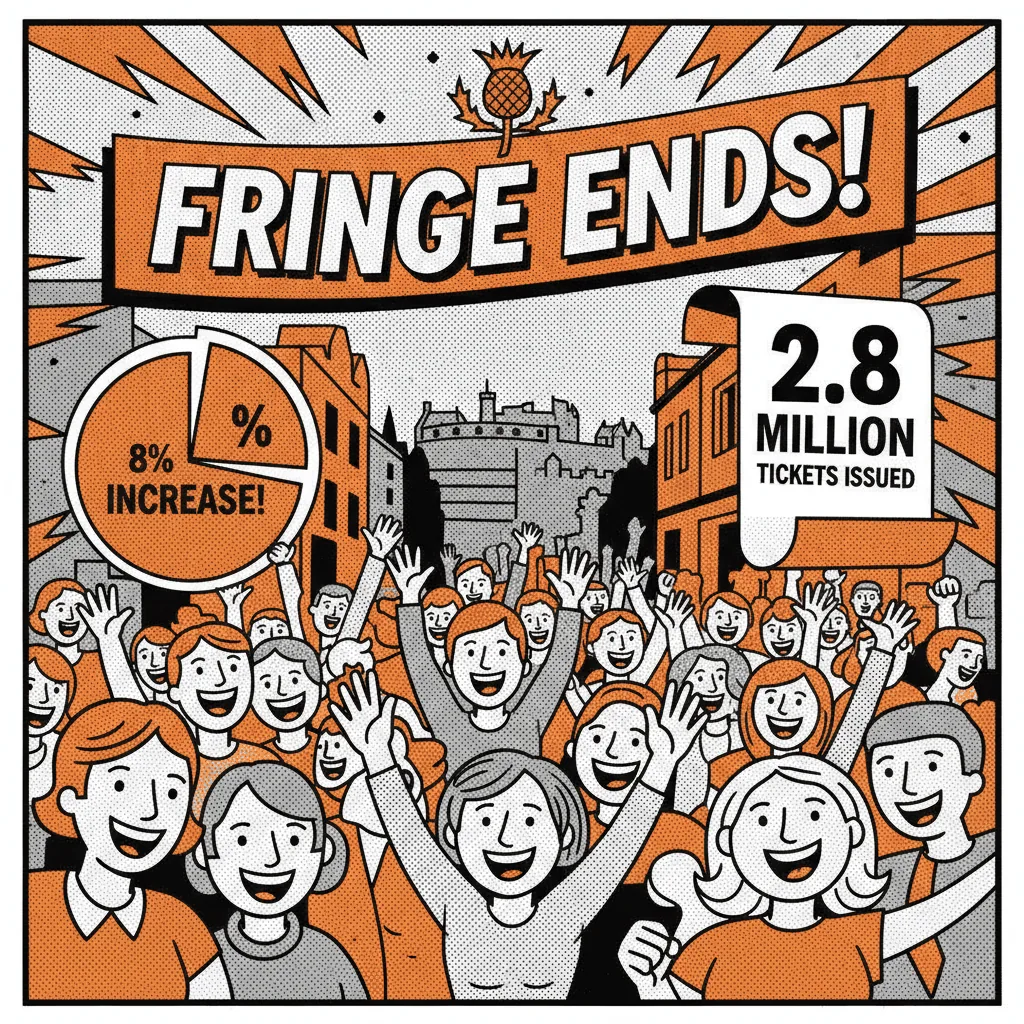
The headline number is 2.8 million tickets issued across the 2024 Edinburgh Festival Fringe, up 8% on the previous year's total. The Fringe Society, which oversees the world's largest arts festival, also confirmed a new single-day record: more than 164,000 tickets on the second Saturday in August. That is not a crowd. That is a city inside a city, and every one of those people needed somewhere to eat, sleep, drink, and spend.
Context matters here. The Fringe has not had a straightforward decade. The Covid shutdowns of 2020 and 2021 wiped out two full festivals, and the 2022 and 2023 editions were recovery years, complicated by cost pressures on both performers and punters. An 8% rise on 2023, arriving in a year when consumer spending across the UK has remained under pressure, is a genuinely strong signal. According to the Edinburgh Festival City research published by EventScotland and Edinburgh Council, the wider festival season typically generates over £300 million for the Edinburgh economy annually. The 2024 ticket data suggests that ceiling is being pushed upward.
For Scottish SMEs, the Fringe is not just a cultural event, it is one of the most concentrated footfall events on the European calendar. The Scottish Government's own tourism data, published through VisitScotland, consistently identifies August in Edinburgh as the single highest-value month for the hospitality and retail sectors across the entire country. Accommodation, food and drink, transport, and retail all see compounding demand across the same three-week window. A record single day of 164,000 tickets means venues, bars, and businesses in the Old Town, Cowgate, Grassmarket, and Leith Walk corridors face genuine capacity questions, and genuine opportunity.
The Fringe Society operates the festival on an uncurated model: any performer can register a show, which keeps the programme vast and genuinely unpredictable. That same model makes forward planning difficult for businesses. Footfall spikes are not evenly distributed across the three weeks. The record single-day figure landing on the second Saturday is consistent with historical Fringe patterns, weeks one and three are softer, week two peaks hard. Businesses that staff and stock for a flat August will leave money on the table. Businesses that model for a bell curve, peaking around day ten, are closer to the reality this data describes.
The growth trajectory also matters for investment decisions beyond August. A Fringe that draws 2.8 million tickets in 2024, after years of post-pandemic rebuilding, points toward a festival that may realistically target three million within two or three years. For anyone considering a lease, a new venue, or an expansion of capacity in central Edinburgh, this trend line is part of the due diligence. The Scottish Enterprise Business Gateway service offers free planning and financial modelling support for exactly these kinds of growth decisions, it is worth a conversation if the Fringe is a meaningful chunk of your annual revenue and you have not stress-tested your capacity assumptions recently.