

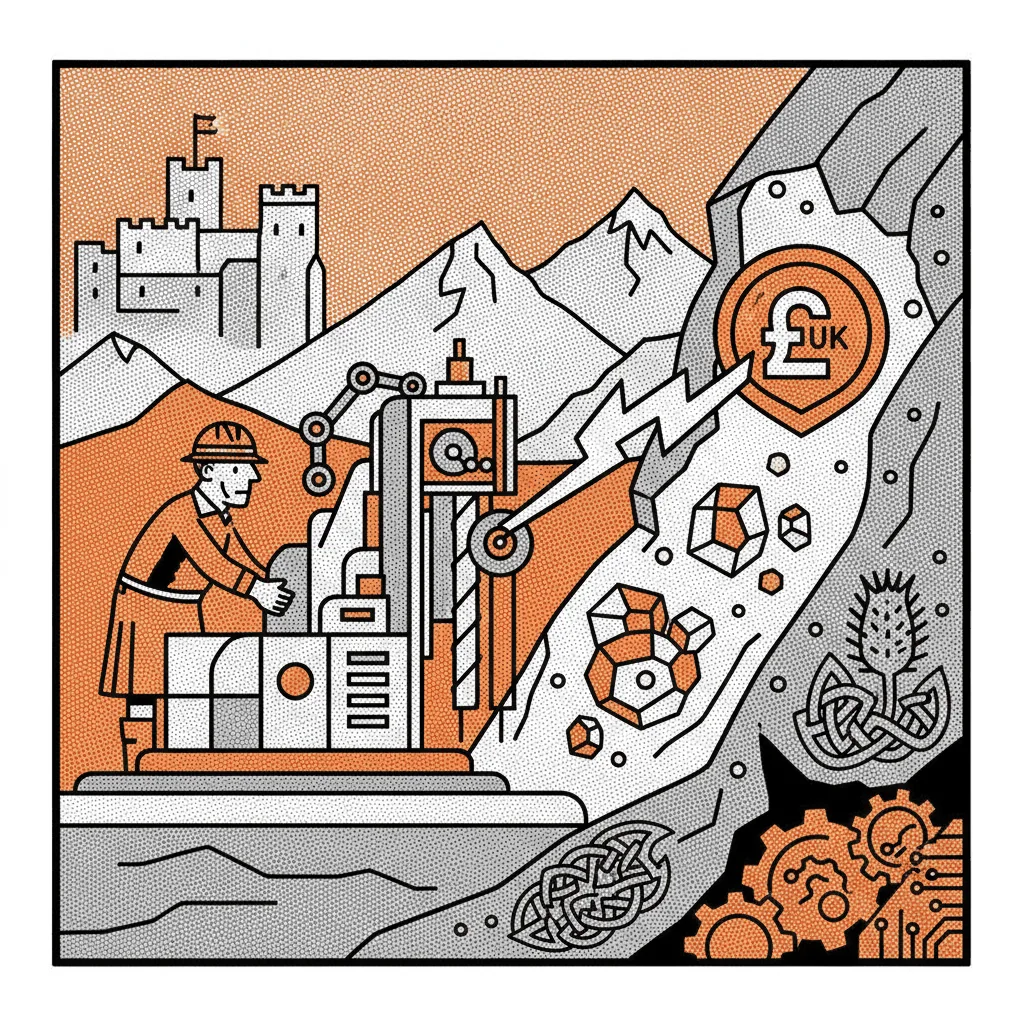
The UK Government's Department for Business and Trade has launched the Critical Minerals Accelerator, a funded support programme for UK-based projects that strengthen critical mineral supply chains or develop innovative capabilities across the sector. Applications are open now, and the opportunity is more relevant to Scotland than the Whitehall branding might suggest.
Critical minerals, lithium, cobalt, rare earth elements, graphite, nickel, and around 30 others flagged by the British Geological Survey as high-supply-risk, are the physical backbone of the clean energy transition. Wind turbines need rare earth magnets. Battery storage needs lithium and cobalt. Semiconductors need gallium and germanium. Scotland's push to become a net-zero energy exporter by 2045, as set out in the Scottish Government's Energy Strategy, depends on these materials being available, affordable, and domestically secured.
The accelerator is designed to fund projects at any stage of the supply chain: extraction and processing, recycling and recovery, substitution research, and supply chain mapping and resilience tools. According to the British Geological Survey's 2023 criticality assessment, the UK currently imports the vast majority of its critical minerals with almost no domestic processing capacity. That is a strategic gap, and the accelerator is one attempt to close it.
For Scottish businesses, the angles are concrete. Deep-tech firms working on mineral processing or battery materials, several of which are active through Scottish Enterprise's network and the University of Edinburgh's materials science programmes, are obvious candidates. So are companies building digital tools for supply chain visibility, traceability, or provenance verification, which are increasingly required by both UK buyers and European Union battery regulation. Highland landowners and geological survey firms sitting on potential extraction sites may also qualify for feasibility and capability-building support.
The timing matters beyond the grant itself. The US Inflation Reduction Act and the EU's Critical Raw Materials Act have both triggered significant subsidy races for mineral supply chain investment. Research from the Faraday Institution, the UK's battery research body, has warned that without domestic critical mineral capacity, the UK risks becoming a net importer of clean energy technology at the very moment it should be exporting it. Scottish businesses that build credentials in this space now are positioning for a market that will be worth billions in a decade.
Business Gateway and Scottish Enterprise both offer pre-application support for grant programmes of this type. If your business touches energy storage, recycling, mining technology, geoscience data, or supply chain software, it is worth a conversation with your regional adviser before committing time to a full application. Deadlines and eligibility criteria are published at the UK Government link below.