

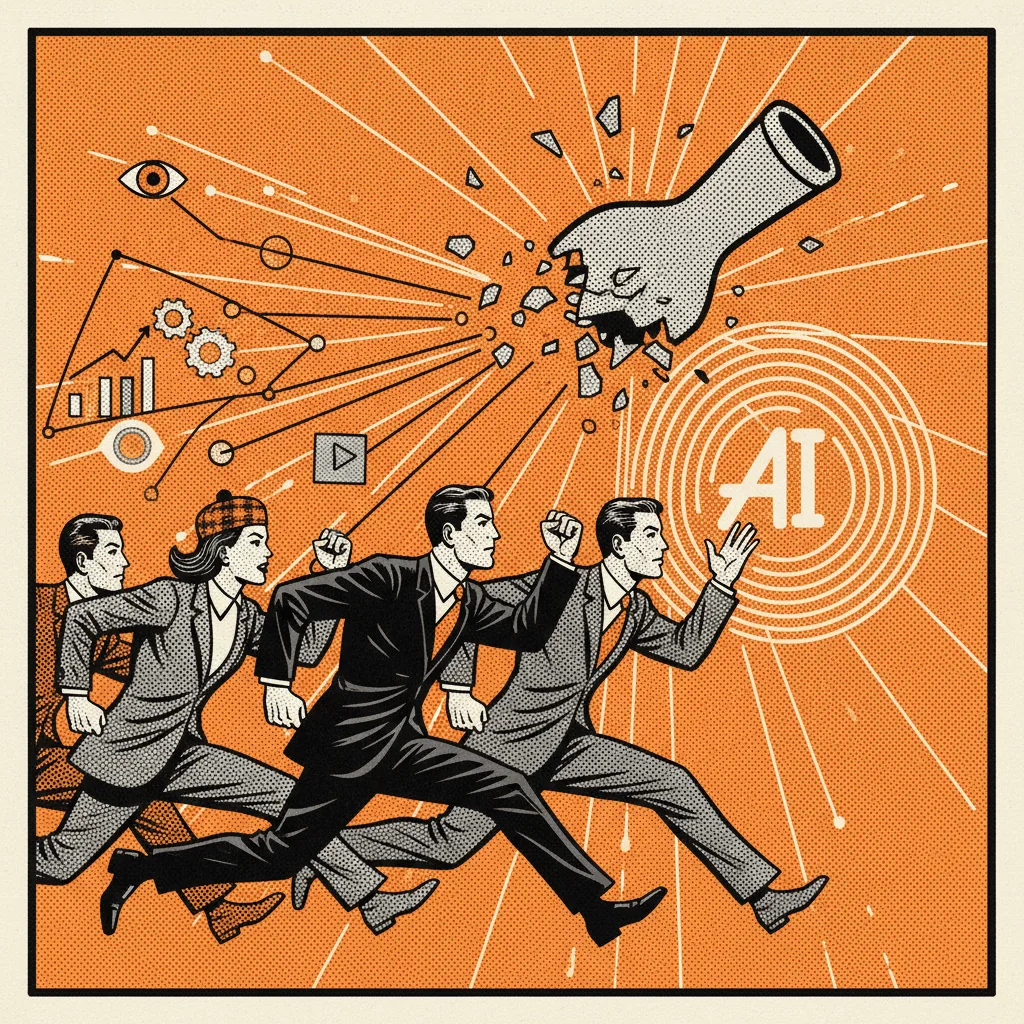
There is a point in almost every small business where the owner stops being the engine and starts being the brake. Decisions queue up. Projects stall waiting for a sign-off. Staff go quiet because asking feels like adding to the pile. Research from Gallup consistently shows that manager bandwidth, not strategy, not capital, is the single biggest constraint on growing organisations. In Scottish SMEs, where one person often holds operations, finance, sales, and HR in their head simultaneously, that bottleneck is felt harder than most.
The emerging argument from business leaders who are actually using AI daily is that the real opportunity is not automating tasks. It is recovering attention. According to a 2024 report from McKinsey Global Institute, knowledge workers lose between 20 and 30 percent of their working week to information-gathering and status-checking activities, the kind of work that keeps a founder in their inbox rather than making calls. AI changes that equation. A founder who once needed to personally review five reports, chase four updates, and sit in three meetings can now get a synthesised picture in minutes, redirect their attention to the decisions only they can make, and move on.
The practical mechanism is straightforward. AI tools, used well, act as continuous monitors across your business. They surface anomalies, flag delays, and summarise the state of play without you having to pull it together manually. Think of it as having a chief of staff who never sleeps and never tires of admin. Business Gateway Scotland and several accelerator programmes have begun incorporating AI workflow training into their SME support offer precisely because this is where founders are feeling the drag most acutely. The tools exist. The bottleneck is knowing where to start.
The leaders pulling ahead are not just using AI to send emails faster or generate marketing copy. They are using it to run what some researchers are calling 'parallel leadership': the ability to actively direct multiple workstreams at once without losing depth on any of them. A founder in Edinburgh running a twelve-person team can now get a weekly AI-generated digest of project status, cash flow movements, customer feedback themes, and team blockers, all from data that already exists in their tools, without commissioning a single report. The University of Edinburgh's research into digital transformation in SMEs has noted that the businesses seeing the steepest productivity gains are those treating AI as a strategic layer, not a productivity shortcut.
The honest caveat is this: AI multiplies attention, but it does not replace judgment. The decisions that require experience, relationship, or moral weight still land with you. What AI does is clear the runway so those decisions get the focus they deserve. If you are currently the person who has to personally touch everything before it moves, that is not a sign of strong leadership. It is a structural problem. AI is currently the cheapest and most accessible solution to that problem that has ever existed. For a Scottish SME owner with ten things on the go and one pair of eyes, that is not a small thing.