

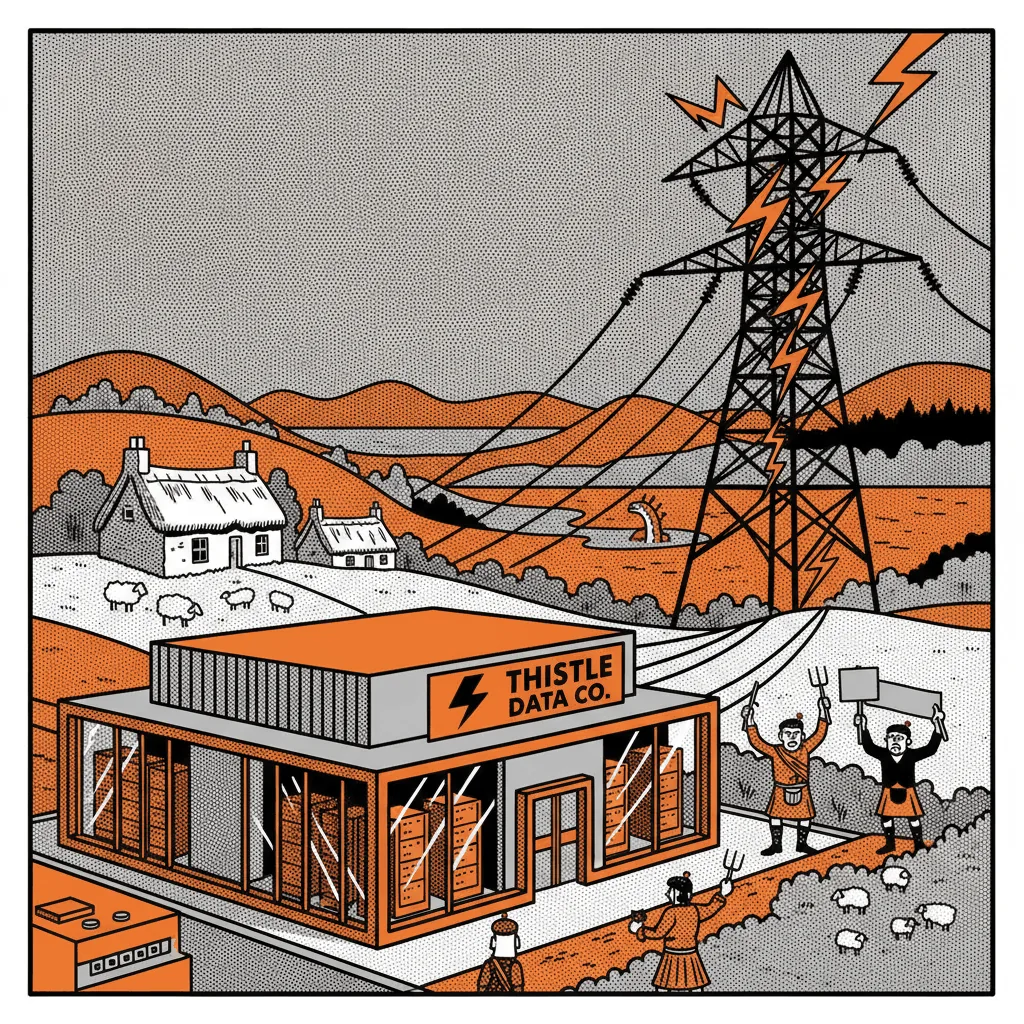
Scotland is experiencing the fastest rate of data centre planning applications in its history. Operators from across Europe and North America are eyeing sites in Aberdeenshire, the Central Belt, and the Highlands, attracted by Scotland's renewable energy surplus, its natural cooling climate, and land costs that make the Home Counties look absurd. The Scottish Government's own Digital Strategy identifies data infrastructure as a national economic priority, and Scottish Enterprise has been actively pitching inward investment in this sector for the better part of three years.
The problem is the grid. SP Energy Networks and SSEN, the two distribution operators covering most of Scotland, have both flagged significant connection backlogs. In some rural areas, new grid connections for large industrial users are being quoted lead times of seven to ten years. That is not a typo. Community groups in Moray, Perthshire, and the Highland Council area have formally objected to planning applications on the grounds that data centre demand will crowd out local businesses and homes seeking grid upgrades of their own. According to Ofgem's most recent connections reform consultation, the problem is national in scope but disproportionately acute in Scotland, where the renewable buildout has already strained transmission infrastructure.
Rural business owners have legitimate cause for concern. A farm diversifying into EV charging, a distillery adding production capacity, a rural GP surgery upgrading its electrical systems, all of these compete for the same constrained grid headroom as a 50-megawatt hyperscale facility backed by a US private equity fund. The contest is not a fair one. Large operators have dedicated connection teams, specialist consultants, and the ability to absorb multi-year delays. Small Scottish businesses, by and large, do not. The Federation of Small Businesses Scotland has previously raised grid access as a barrier to rural economic development, and this new wave of data centre demand sharpens that tension considerably.
Here is where it gets interesting, and where Scotland is missing an enormous opportunity. Every data centre generates heat as a direct by-product of computation. In most facilities, that heat is simply vented into the atmosphere via cooling towers, wasted, entirely, at scale. The Danish city of Odense has been heating tens of thousands of homes using waste heat from a single Meta data centre since 2023. Stockholm has run district heating from server farms for over a decade. According to research published by the International Energy Agency, waste heat recovery from data centres could supply up to 40% of the space heating demand in northern European cities by 2030, at a fraction of the cost of conventional heat networks. Scotland, with its cold climate, its dense district heating ambitions in cities like Edinburgh and Glasgow, and its existing renewable energy base, is the ideal candidate for exactly this model. The infrastructure is being built anyway. The heat is being produced anyway. The only missing ingredient is policy joined-up enough to capture it.
That policy gap has a shape. The UK Government's data centre planning reforms, accelerated under the previous administration and largely continued since, have prioritised speed of build and investor certainty. What they have not done is mandate or incentivise waste heat recovery as a condition of planning consent. Industry sources point to sustained lobbying from conventional energy suppliers, for whom widespread adoption of waste heat networks represents a direct threat to gas and electricity revenue from domestic heating. The conflict of interest is structural and it is costing Scottish communities real money. The Scottish Government has powers over planning and district heating policy that Westminster does not control. Using them, specifically, requiring waste heat recovery assessments as part of major data centre planning applications, would cost nothing and could transform the economics of rural heating for a generation. Edinburgh City Council's own heat network ambitions, outlined in its City Mobility and Heat Network strategies, are shovel-ready for exactly this kind of supply.