

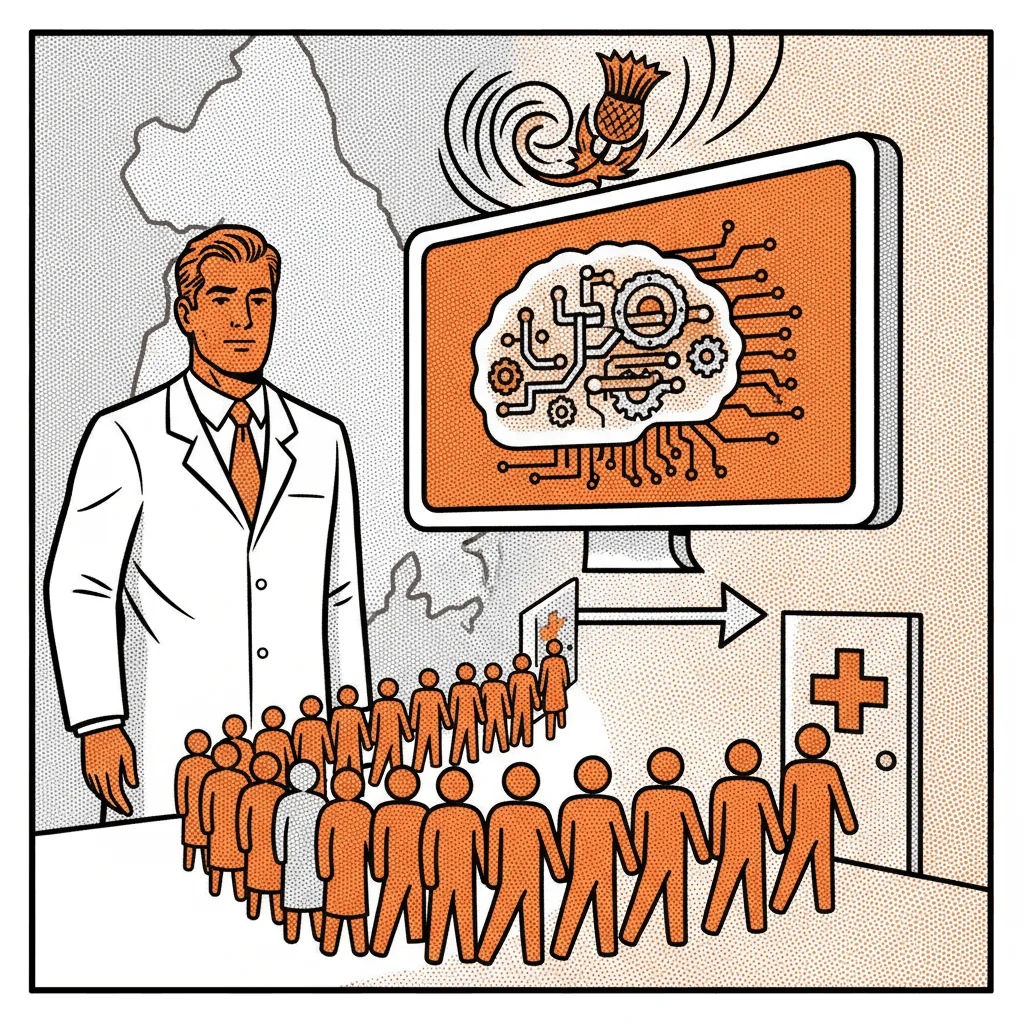
The NHS waiting list crisis is not primarily a clinical problem. It is a logistics problem. Patients sit in queues not because there are too few doctors, but because the system around those doctors moves slowly, leaks appointments, and buries staff in admin. An AI application being rolled out across West Midlands NHS trusts is attacking exactly that layer, automating triage support, appointment routing, and follow-up communications in ways that are already showing measurable reductions in wait times.
The scale of the problem this is trying to solve is significant. According to NHS England's latest performance data, over 7.5 million people were waiting for elective treatment as of early 2025. In Scotland, NHS Scotland's own waiting times statistics, published by Public Health Scotland, show tens of thousands of patients waiting beyond the 12-week treatment time guarantee across key specialties. These are not abstract numbers. They are staff time, patient anxiety, and economic cost borne by every business whose employees spend months waiting for a procedure that keeps them off work.
The West Midlands application works by sitting between the patient and the appointment system, gathering structured information before a consultation, flagging urgent cases automatically, and reducing the volume of phone calls and clerical tasks that currently eat into clinical capacity. Rather than replacing the GP or the consultant, it does the paperwork that was slowing them down. Think of it as a very good practice manager who never sleeps and never takes a lunch break.
Scotland has the infrastructure to do this at scale. The Scottish Government's Digital Health and Care Strategy has committed to embedding technology across NHS Scotland, and bodies like Digital Health and Care Innovation Centre (DHI) in Glasgow exist precisely to pilot and scale tools like this. Research from the University of Edinburgh's Usher Institute consistently identifies administrative burden as one of the primary drivers of clinician burnout and delayed care. The technology is not the barrier. Procurement and trust-building are. The West Midlands rollout offers a working proof of concept that Scottish health boards could reference directly when building business cases for similar tools.
For Scottish SME owners, this matters beyond the abstract. Your staff use the NHS. You use the NHS. Faster triage, smarter appointment routing, and reduced administrative drag means faster return-to-work, fewer sick days spent waiting on phone queues, and a workforce that spends less time managing their own healthcare admin on company time. When the NHS moves faster, small businesses benefit directly. And if NHS Scotland moves on tools like this in the next two years, the Scottish health tech market opens up too, because someone will build, adapt, and support these systems locally. That opportunity sits squarely with Scottish founders and developers right now.