

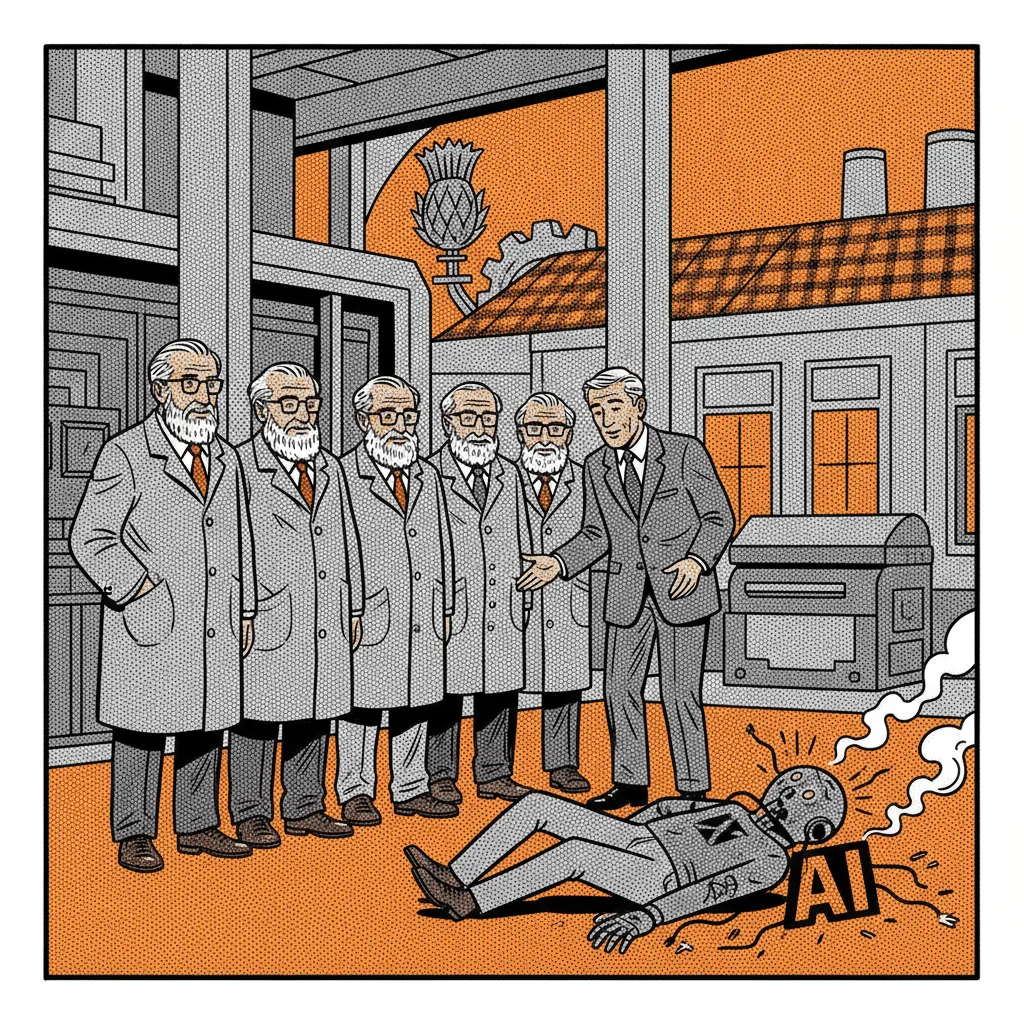
Ford Motor Company has rehired a cohort of experienced, older engineers, internally referred to as "gray beards", after discovering that deploying AI tools without sufficient human expertise in the loop produced worse outcomes, not better ones. A senior figure inside the company put it plainly: "Mistakenly we thought that by just introducing artificial intelligence... that would produce a high-quality product." It didn't. The institutional knowledge those engineers carried in their heads turned out to be precisely what the AI needed to be useful.
This is not an anti-AI story. It is a story about sequencing. AI tools, whether you are designing engines in Detroit or writing patient letters in Dundee, perform best when they work alongside people who deeply understand the domain. Without that, even sophisticated models produce output that looks credible but misses the mark in ways that only an experienced eye would catch. Ford learned this at scale. The lesson is available to Scottish SMEs for free.
According to research from MIT Sloan Management Review, firms that achieve the strongest productivity gains from AI are those that pair automation with what researchers call "tacit knowledge", the unwritten, experience-built understanding of how a job actually works, as opposed to how it looks on a process document. That knowledge lives in people. It cannot be scraped from a manual or trained into a model overnight. Scottish businesses that have spent years building genuine craft and domain expertise hold an asset that should be treated as infrastructure, not overhead.
The McKinsey Global Institute's 2024 analysis of AI adoption across industries found that the highest failure rates in AI deployment occurred in organisations that attempted wholesale replacement of skilled roles rather than augmentation of them. Ford's situation fits that pattern precisely. The companies seeing the best returns are using AI to extend what experienced people can do, not to substitute for their presence entirely. A one-person accountancy practice in Edinburgh or a small engineering firm in Aberdeen with twenty years of client knowledge is already sitting on exactly the kind of foundation that makes AI genuinely powerful.
For Scottish SMEs, the practical implication is this: your most experienced people are your AI's best asset, not its competition. The temptation when adopting new tools is to streamline headcount at the same moment. Ford's example suggests that impulse should be resisted. A better model is to identify where your experienced team members spend time on repetitive, low-value tasks, and use AI to free them up for the judgment-heavy work only they can do. That is the configuration that wins. The gray beard and the model, working together, is a formidable combination. The model alone is not.