

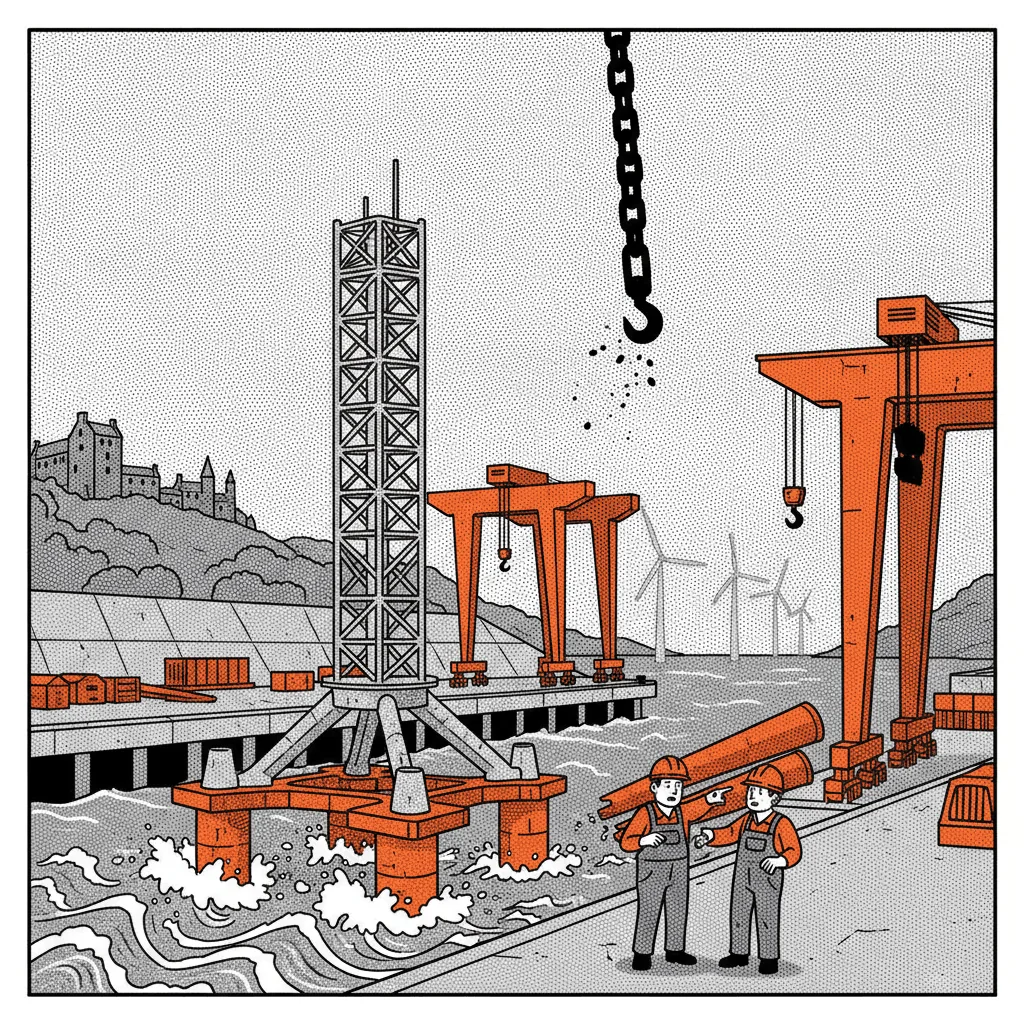
Scotland's ports are sitting on upgraded quaysides, deepened berths, and heavy-lift infrastructure built specifically to service a floating offshore wind industry that has, so far, largely failed to show up with orders. The Scotsman reports that concerns are mounting across the sector that without a significant acceleration in contract awards, several Scottish port facilities risk becoming stranded assets, expensive, underutilised infrastructure that generates costs without the commercial throughput to justify them.
The problem is structural. Floating offshore wind, unlike the fixed-bottom turbines Scotland has already deployed at scale in the North Sea, is still an emerging technology globally. Projects are more expensive, technically complex, and heavily dependent on a supply chain that doesn't fully exist yet. Crown Estate Scotland has leased development zones, the Scottish Government has championed the sector as a cornerstone of its net zero strategy, and ports including Nigg Energy Park, Ardersier, and Kishorn have invested accordingly. But leases and ambitions are not the same thing as fabrication contracts, and right now the gap between the two is uncomfortably wide.
Scottish Renewables, the industry body representing clean energy businesses in Scotland, has consistently flagged that the pace of project development must be matched by policy certainty and grid connection commitments if the supply chain is to remain viable. Without firm project timelines, port operators and the SMEs clustered around them face a brutal calculus: carry the fixed costs of specialist infrastructure while waiting for orders that may be years away, or scale back and risk losing position when the market does arrive. According to analysis from the Global Wind Energy Council, the floating wind sector globally needs to reach around 6GW of installed capacity by 2030 to establish a self-sustaining commercial supply chain. Scotland is well placed geographically and industrially, but well placed is not the same as winning.
The political dimension here is not subtle. The Scottish Government has staked significant credibility on floating wind as an economic development story, particularly for communities on the Cromarty Firth and along the west coast that have seen traditional industries decline. Westminster's Contracts for Difference auction regime, which sets the strike prices that make offshore wind commercially viable, has repeatedly failed to reflect the higher costs of floating technology. Round 6 of the CfD process is expected later this year, and the floating wind sector will be watching the allocation results very carefully. A weak round will not just slow project development; it will force painful decisions at port level about whether expensive infrastructure can be maintained while the market matures.
For the businesses who have built their forward planning around the floating wind supply chain, this is not an abstract policy debate. Fabricators, engineering firms, logistics operators, and specialist service companies across the Highlands and east coast have hired, invested, and structured their operations around a pipeline that is currently moving more slowly than almost anyone predicted three years ago. The University of Strathclyde's Energy Systems Research Unit has noted in previous analysis that Scotland's offshore wind supply chain opportunity is real but highly contingent on investment timing aligning with policy signals. Right now, that alignment is off. The signals exist. The investment is partially in place. The orders are not.
None of this means the sector is finished. Floating offshore wind remains one of the most significant industrial opportunities Scotland has seen in a generation, and Scotland's combination of deep-water sites, renewable grid capacity, and existing engineering expertise gives it a genuine competitive position globally. But the window in which that position converts into commercial reality is not unlimited. Port operators carry ongoing costs regardless of throughput, and supply chain SMEs cannot sustain skilled workforces indefinitely on expectation alone. If the order pipeline does not accelerate materially in the next twelve to eighteen months, some of that infrastructure and some of those skilled teams will find other purposes, and they will not easily come back.