

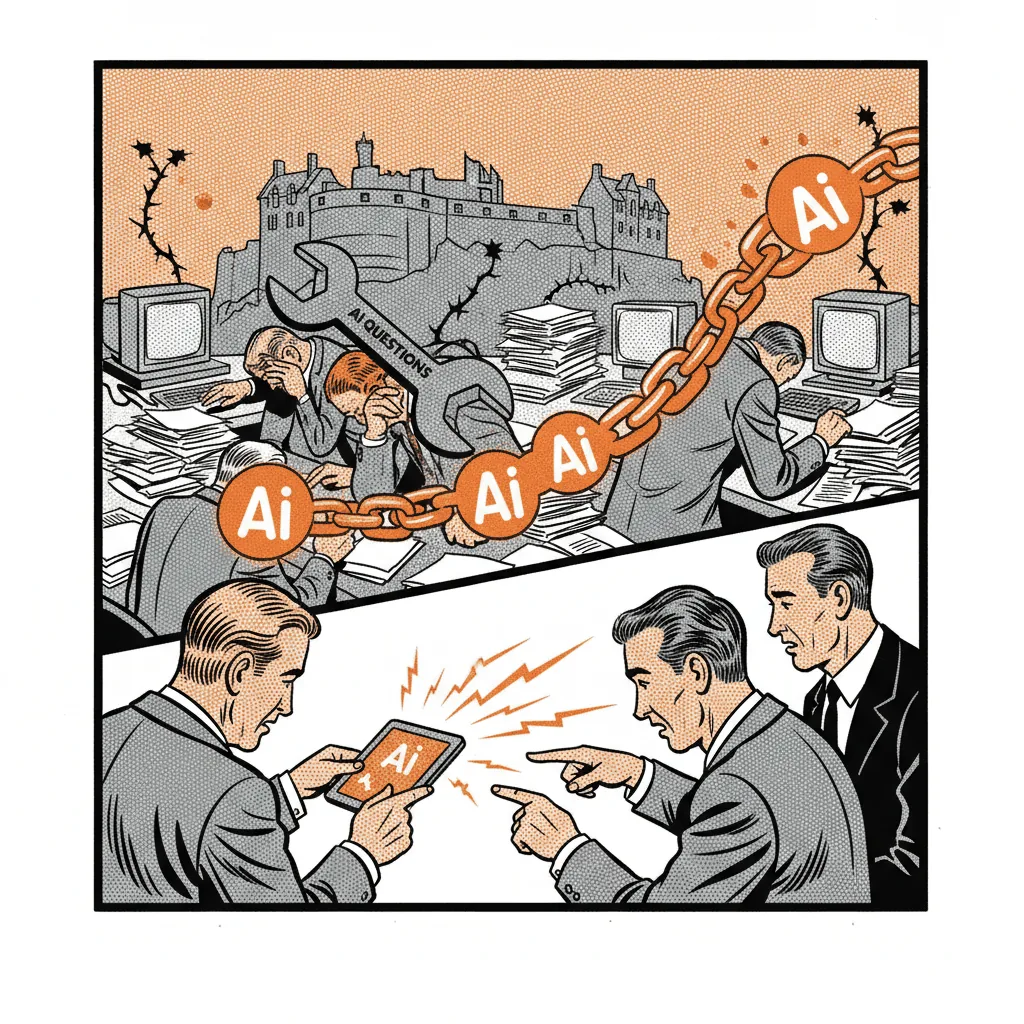
Civil servants at the Scottish Government are reportedly being overwhelmed by a surge in parliamentary questions from MSPs, with some politicians using AI tools to submit batches of up to 20 questions at a time. The Scotsman reports that senior officials have described the situation as "crippling", with the volume of queries outstripping the administrative capacity built to handle them. It is, in short, the first visible collision between AI-assisted politics and an analogue public sector infrastructure.
The mechanics are straightforward. AI tools let an MSP draft, vary, and submit multiple written questions in the time it would previously have taken to write one carefully. That is not inherently wrong, scrutiny is the job, and better-informed questions can produce better accountability. But when the volume spikes without any corresponding increase in civil service resource, the queue lengthens. Responses slow. And the businesses, charities, and public bodies waiting on answers from ministers find themselves stuck behind a growing pile of AI-generated scrutiny.
This is a structural problem, not a political one. The Scottish Parliament's own research has noted that the volume of written questions has risen sharply over the past decade, well before AI entered the picture. According to the Scottish Parliament Information Centre (SPICe), written questions submitted per session have increased significantly since devolution, with the current parliamentary term already running at a pace that strains departmental response teams. AI has not created the pressure, it has compressed the timeline and concentrated it.
For Scottish SMEs, the practical risk is real. Businesses that rely on the Scottish Government for regulatory guidance, grant decisions, procurement responses, or policy clarification are downstream of this bottleneck. If civil servant capacity is being consumed by answering batches of AI-generated parliamentary questions, the knock-on effect is slower decisions on everything else. Research from the Institute for Government has consistently shown that policy capacity and ministerial responsiveness are directly linked to civil service workload, when one spikes, the other suffers.
There is an irony here worth naming cleanly. AI is the right tool for small operators who want to move fast and compete above their weight. But the same tools, used without any agreed framework in a parliamentary context, can create bureaucratic drag that lands hardest on the people with the least time and resource to wait. The answer is not to ban MSPs from using AI, that ship has sailed and frankly it was never seaworthy. The answer is for Holyrood and the Scottish Government to work out, quickly, what a sensible AI usage framework for parliamentary business actually looks like. Other legislatures will face the same question. Scotland has an opportunity to set the standard.