

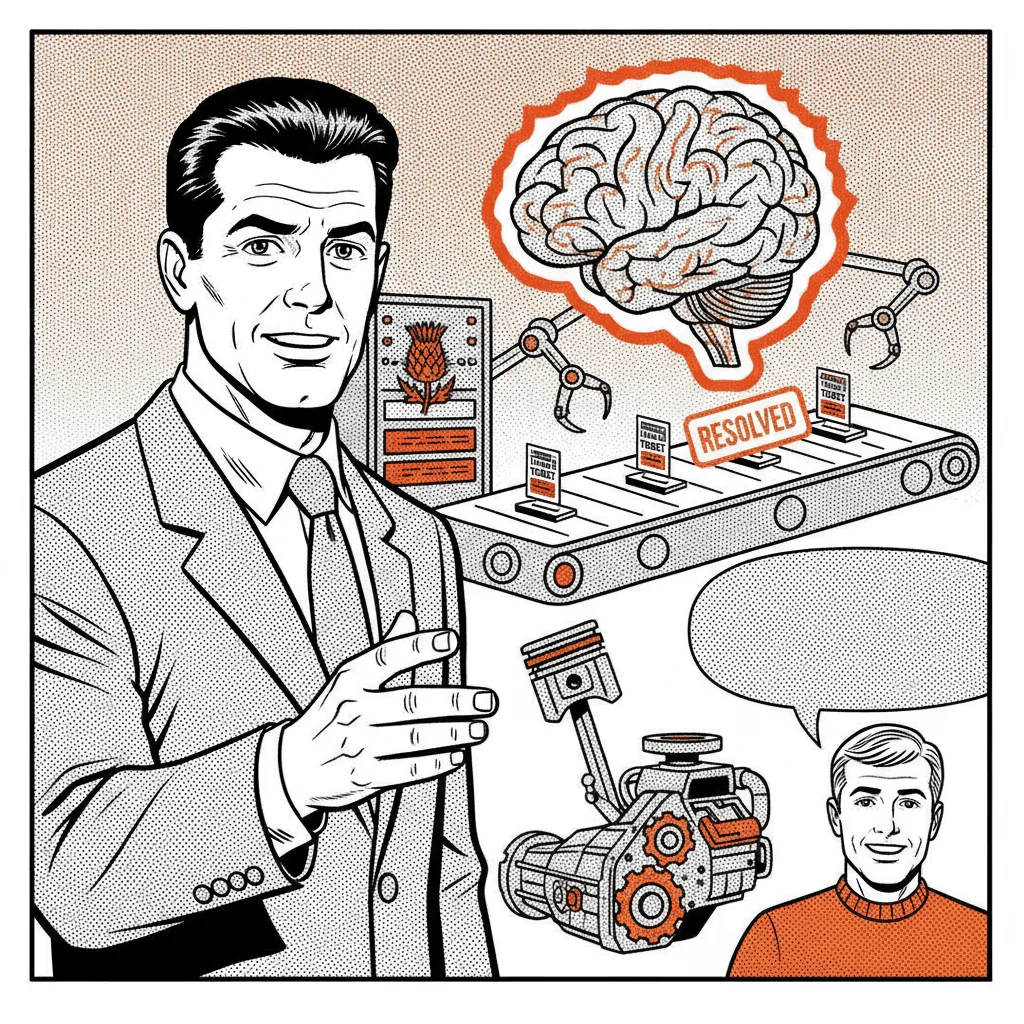
HPE's head of networking has told The Register that within two years, AI agents will handle every IT trouble ticket without human intervention. Not most tickets. All of them. The analogy he used is worth sitting with: you don't think twice about an automatic gearbox doing what a skilled driver used to do manually. In two years, he says, you'll feel the same way about AI resolving your network outage at 11pm on a Friday.
This is a credible voice making a specific claim. HPE is one of the largest enterprise networking vendors on the planet, and its Aruba networking division already uses AI to predict and remediate faults before users notice them. According to Gartner's 2024 IT automation research, organisations that have deployed AIOps platforms have cut mean-time-to-resolution for network incidents by up to 50 percent. HPE's prediction is that this trajectory completes fully, and soon.
For Scottish SMEs, the implications run in two directions at once. The obvious one: if you currently pay for a managed IT support contract, a part-time IT manager, or an outsourced helpdesk, the cost of that service is about to fall sharply. Vendors competing on AI-automated support will undercut those built on human labour. That is good news for your margins. According to the Federation of Small Businesses Scotland, IT costs remain one of the top five operational expenses cited by SMEs with fewer than 50 staff. Automation compresses that line.
The less obvious implication is about trust and transition. The automatic gearbox metaphor is doing real work here. Most drivers who learned on a manual car were sceptical. Then they drove an automatic once and never looked back. The HPE argument is that AI-resolved tickets will build the same quiet confidence, not because anyone mandated it, but because it will simply work. Scottish businesses that get comfortable with AI-managed infrastructure now, before it becomes the default, will move faster and waste less when the switch happens. The University of Edinburgh's Bayes Centre has been tracking AI adoption curves in SME operations, and early adopters consistently report a compounding advantage: each automation win funds the next.
The Scottish Government's AI Strategy, published via the Digital Directorate, explicitly identifies IT productivity as a priority sector for AI investment, and Business Gateway currently offers digital transformation support to help smaller businesses assess and adopt automation tools. If you have not had that conversation with a Business Gateway adviser yet, the two-year clock HPE just started is a reasonable prompt to book it. The window between "early adopter" and "late majority" in enterprise IT has historically been about 18 to 24 months. That window is now open.