

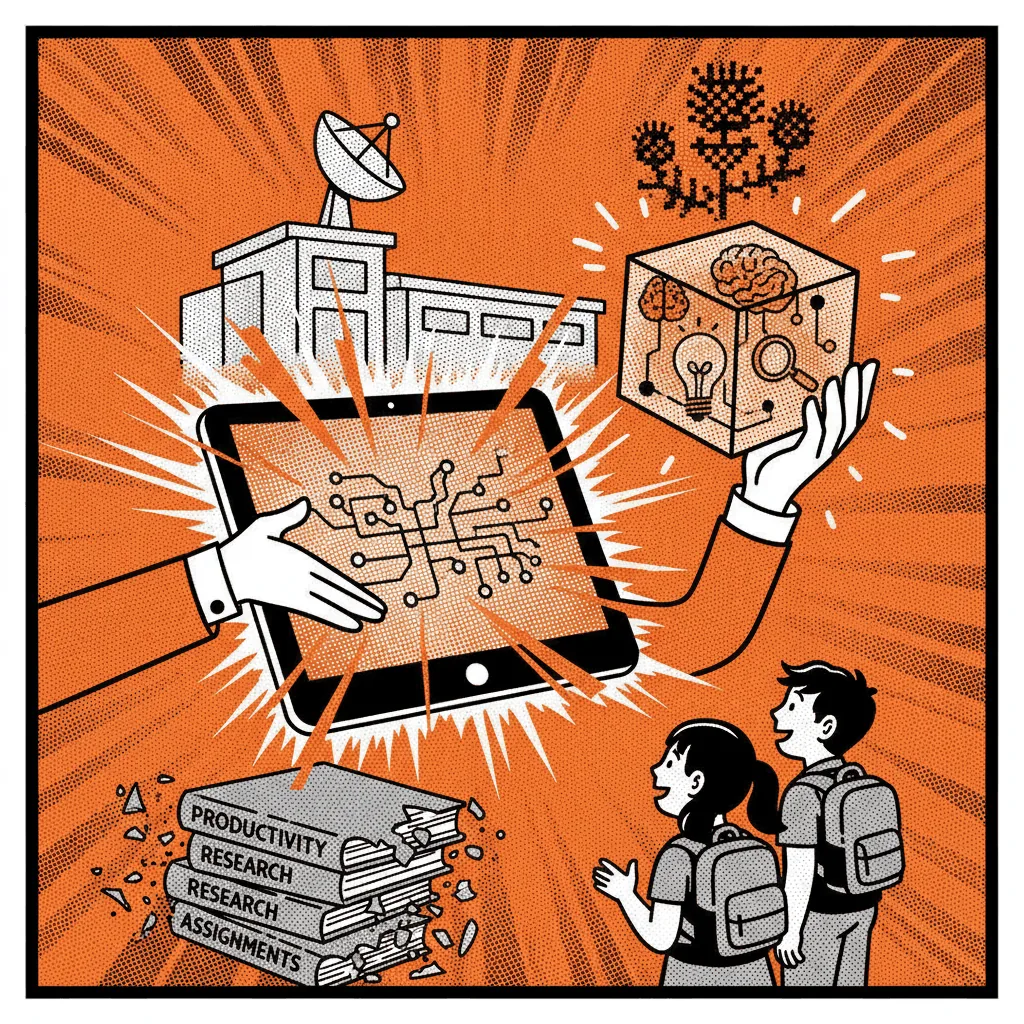
The humble school laptop has had the same job description since the late 1990s: run a browser, open a document, submit an assignment. That job description just changed. According to EdTech Magazine's latest analysis of K,12 device deployment across the United States, AI is now embedded at the device level, generating instructional material in real time, guiding individual students through problems step by step, and stitching classroom workflows together in ways that used to require a full IT department and a curriculum team working in tandem.
The shift matters because it moves AI from something teachers choose to use into something that is simply part of the device. Microsoft's Copilot features are already baked into Windows 11 Education editions. Google's Gemini tools are threading through Chromebook environments used in thousands of schools. According to research from the Education Endowment Foundation, schools that embed AI support tools at the point of learning, rather than bolting them on afterwards, see measurably stronger outcomes for pupils with additional support needs. That is a finding with direct weight for Scotland, where closing the attainment gap sits at the centre of the Scottish Government's education agenda.
Scotland's national curriculum, Curriculum for Excellence, already encourages self-directed learning and personalised progression. The problem, as teachers across Edinburgh and the Lothians will tell you without much prompting, is that personalising learning for thirty pupils at once is structurally impossible without support. AI-powered devices begin to close that gap. A device that can detect where a S2 student is struggling with algebraic reasoning and adjust its explanations accordingly is not a gimmick; it is the kind of differentiation that secondary teachers have wanted for decades and never had the hours to deliver.
The Scottish Government's Digital Learning and Teaching Strategy has committed to ensuring every learner has access to appropriate technology, but the strategy was written before AI became a device-level feature rather than a specialist application. Audit Scotland's 2023 review of digital inclusion in Scottish schools noted persistent gaps in both device quality and teacher digital confidence. The risk now is that schools procuring new hardware on the basis of old criteria, processing power, battery life, screen resolution, end up with devices that are technically adequate but AI-blind. The question is no longer whether the device can run the apps. It is whether the device can think alongside the student.
For Scottish local authorities and school leadership teams currently in procurement cycles, the practical implication is this: the device specification conversation needs a new row in the spreadsheet. AI capability, on-device processing power for local AI inference, and compatibility with the platforms teachers actually use are now baseline requirements, not premium options. Early adopters in the US are already reporting that AI-assisted devices are reducing the administrative load on teachers by automating feedback on routine tasks, freeing classroom time for the work that only a human teacher can do: relationship, mentorship, and the kind of teaching that does not fit a rubric.