

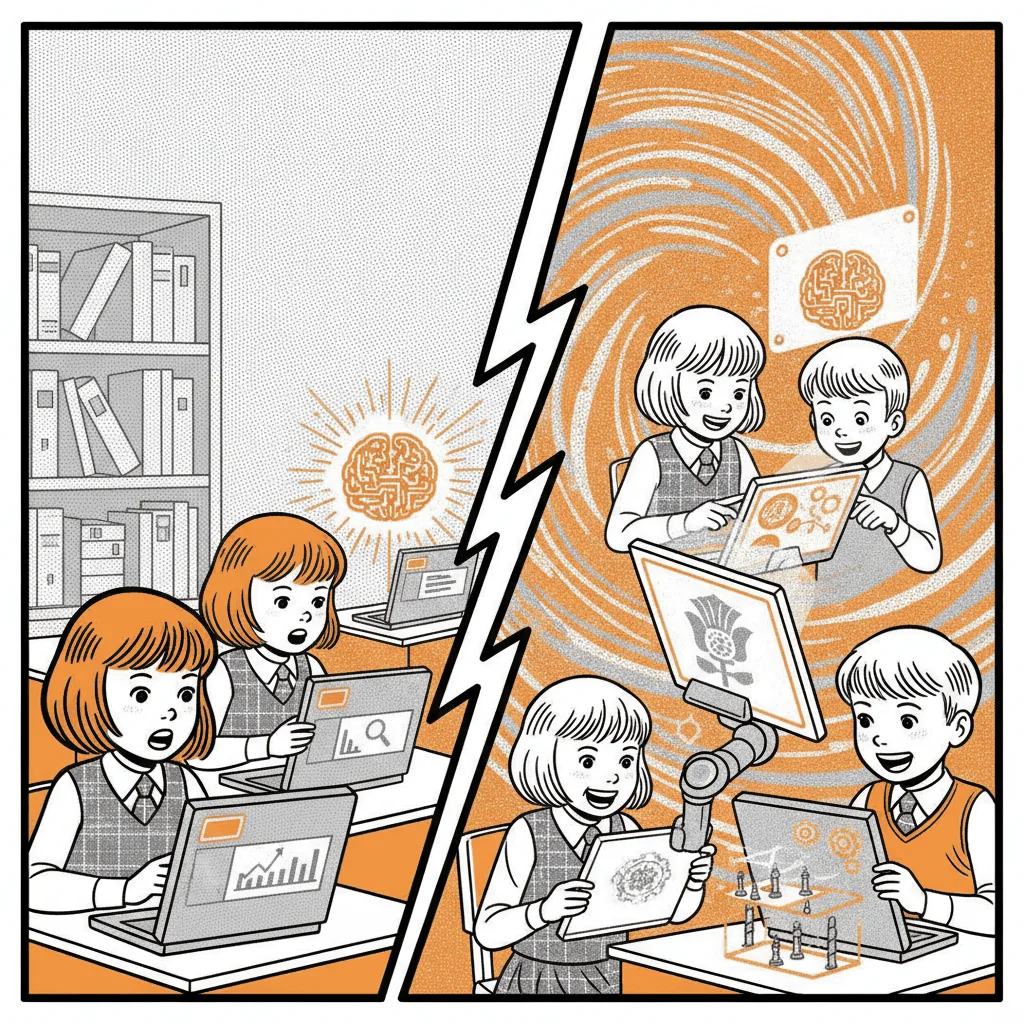
The classroom device has done one job for twenty years: give students access to things. Word processors, websites, digital worksheets. Passive tools for passive consumption. That model is collapsing. AI-enabled software is turning the same hardware into something that generates instructional content, responds to where a student is stuck, and adapts in real time to how they learn. According to EdTech Magazine's latest analysis of K,12 device deployment, the procurement question has fundamentally shifted: it is no longer about processing power or app compatibility, but about how deeply a device can participate in the learning itself.
This matters enormously for Scotland. The Scottish Government's National Improvement Framework has named closing the attainment gap as its central educational mission, and the evidence is clear that personalised learning is one of the most effective levers available. Research from the Education Endowment Foundation puts high-quality feedback and tailored instruction among the highest-impact, lowest-cost interventions a school can make. AI-driven devices can deliver both, at scale, without requiring a one-to-one teacher ratio that no council budget could sustain.
Tools already in classrooms, including Microsoft Copilot integrated into the Microsoft 365 Education suite and Google's Gemini features baked into Workspace for Education, can now generate practice problems pitched at a specific student's level, explain concepts in alternative ways when the first explanation doesn't land, and flag patterns of misunderstanding to the teacher before they harden into gaps. Some early adopters in English local authorities have reported teachers recovering hours per week previously spent on differentiation planning. Those hours go back to the students who need direct attention most.
The University of Edinburgh's Moray House School of Education has been tracking AI integration in Scottish classrooms as part of its broader digital pedagogy research. The consistent finding is that the technology works best when teachers are trained to use AI outputs as a starting point, not an endpoint. The risk is not that AI replaces teachers; it is that schools deploy the tools without the professional development to make them land properly. A device that can tutor a child is useless if the teacher has never been shown how to read what it is telling them.
Scottish schools are not starting from zero. The Scottish Government's Connecting Scotland programme has placed devices in the hands of pupils who previously had none, and local authorities from Highland to South Lanarkshire have active digital learning strategies in place. The infrastructure exists. What is shifting now is what that infrastructure can do. A Chromebook issued to a pupil in Drumchapel or Dingwall that actively tutors, explains, and adapts is a fundamentally different tool from the one issued three years ago. The attainment gap has geography baked into it. AI-enabled devices are one of the few interventions that can reach every postcode simultaneously.