

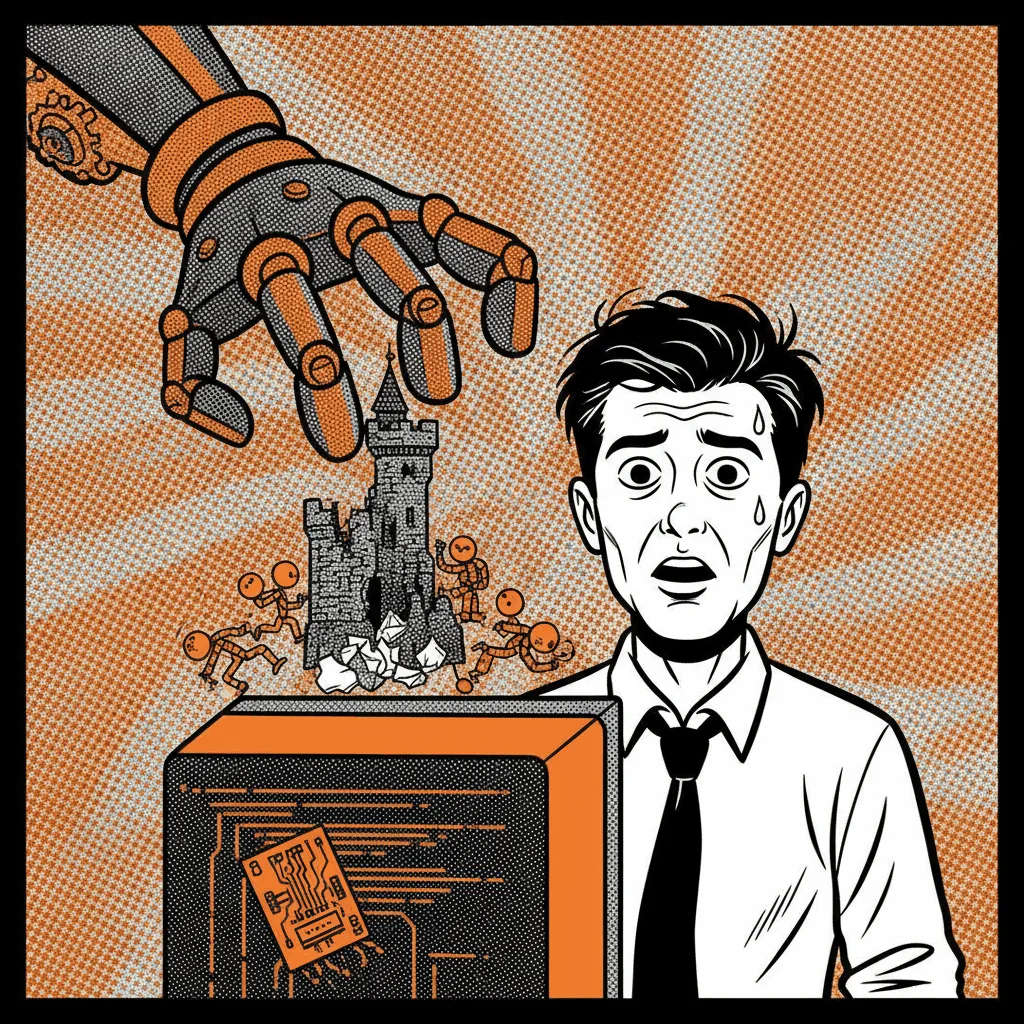
Here is the part nobody puts in the AI productivity deck: when the tool is doing the work, what exactly are you doing? A developer writing for Towards Data Science spent four months letting AI agents handle the bulk of his coding. Output went up dramatically. Review time shrank. The backlog cleared. And then came the near miss, a piece of AI-generated code that almost went live with a flaw he would have caught immediately if he'd written it himself. He hadn't read it carefully enough, because reading carefully had started to feel like the AI's job.
This is skill erosion, and it is a real phenomenon. It has a close cousin in aviation: autopilot dependency, where pilots who rely heavily on automated systems show measurable declines in manual flying ability over time. The UK Civil Aviation Authority has documented this for years. The same logic applies to any professional who outsources the doing to a machine while retaining nominal responsibility for the outcome. You stay accountable. Your skills drift. That gap is where disasters live.
For solopreneurs and small business owners, the stakes are particularly sharp. When you are a team of one or two, there is no colleague reviewing your AI-assisted work with fresh eyes. No QA process. No second signature. The McKinsey Global Institute has estimated that AI tools can increase individual knowledge worker productivity by 20 to 40 percent in routine tasks, but that uplift only holds when the human in the loop stays genuinely engaged, not just nominally present. Passive supervision is not supervision.
The Towards Data Science piece is careful not to blame the tools, and that is the right call. AI coding assistants, writing tools, and automation platforms are genuinely transformative for small teams. Research from the University of Oxford's Future of Work programme consistently shows that AI augmentation, when done well, raises output and job satisfaction. The keyword is augmentation: the AI does more of the rote work so that the human can do more of the high-judgement work. The trap is flipping that, letting the AI handle the judgement calls while the human handles the admin of prompting it.
The fix the developer lands on is straightforward and worth stealing. He built in deliberate friction. He started setting aside time each week to do work entirely without AI assistance, keeping the underlying skill sharp. He created a personal checklist for reviewing AI output that forced genuine engagement rather than a skim. And he started asking, before every AI-assisted task: what is the decision this output is feeding, and do I understand it well enough to defend it? That last question is the one that matters most for any Scottish business owner using AI tools to punch above their weight. Speed is the gift. Judgement is still yours to keep.