

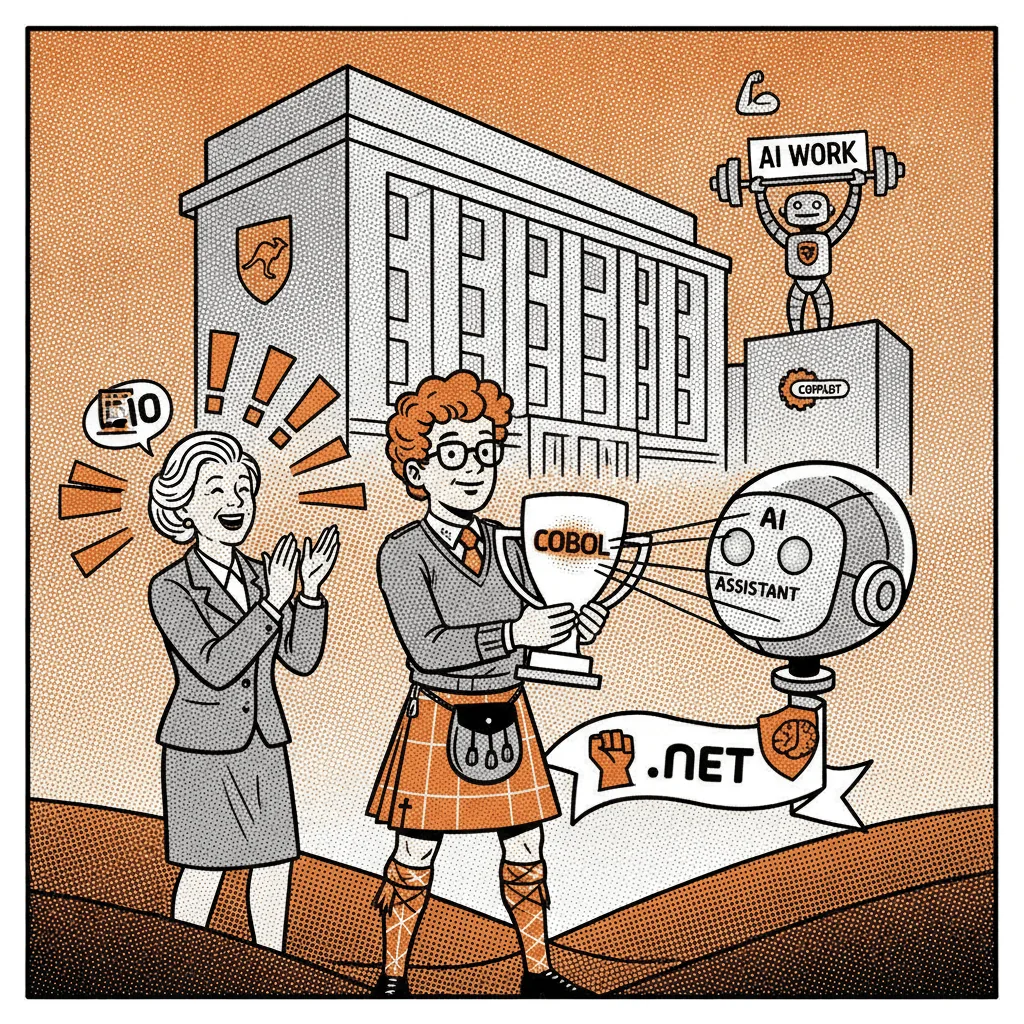
The Australia Taxation Office is not a startup. It runs on COBOL, the programming language that has been quietly keeping the world's financial systems alive since 1959. So when one of its veteran COBOL developers entered an internal .Net hackathon, the sensible money was not on them. They won. With help from GitHub Copilot, an AI coding assistant, a developer fluent in one language crossed into another and beat colleagues who'd been writing modern code for years.
The ATO's Chief Information Officer has been open about why this matters beyond the trophy. According to reporting in The Register, the organisation sees these internal AI experiments as a way to build what they call "muscles" for the more serious AI work ahead. The logic is straightforward: you don't get good at using AI tools in production by reading about them in a strategy document. You get good by doing something low-stakes, learning what the tool can and can't do, and arriving at the serious problems already warmed up.
This is the part most businesses miss. Research from McKinsey's 2024 State of AI report found that firms seeing the strongest returns from AI were not the ones who spent longest planning adoption; they were the ones who ran fast, small experiments and built internal confidence. Hackathons, internal challenges, and sandbox projects are the mechanism. The ATO's CIO buy-in is not incidental; it's the whole point. AI upskilling stalls when leadership treats it as an IT project. It accelerates when a senior person says publicly, "this is how we learn, and we celebrate the trying."
For Scottish SME owners, the gap between "we should probably look at AI" and "we actually use AI" is rarely about the technology. It's about confidence and permission. A sole trader in Leith or a ten-person consultancy in the New Town doesn't need a hackathon with a trophy and a catered lunch. It needs one person to pick up a tool and use it badly for a week, then better the week after. According to the Scottish Government's AI Strategy, Scotland has committed to supporting businesses in building exactly this kind of practical digital capability, with Business Gateway and Scottish Enterprise both running AI readiness programmes that are free to access today.
The deeper message from the ATO story is that existing knowledge is an asset, not a liability, when you pair it with AI. The COBOL developer didn't win despite decades of legacy experience. They won because of it. They understood the problem deeply; Copilot helped them execute in unfamiliar territory. That is the pattern worth copying: domain expertise plus AI assistance equals output that a junior generalist cannot match. For a Scottish GP practice using AI to reduce admin load, a marketing consultant using it to draft briefs, or an independent accountant using it to interrogate spreadsheets, the formula is identical. You already know your field. The tool handles the rest.