

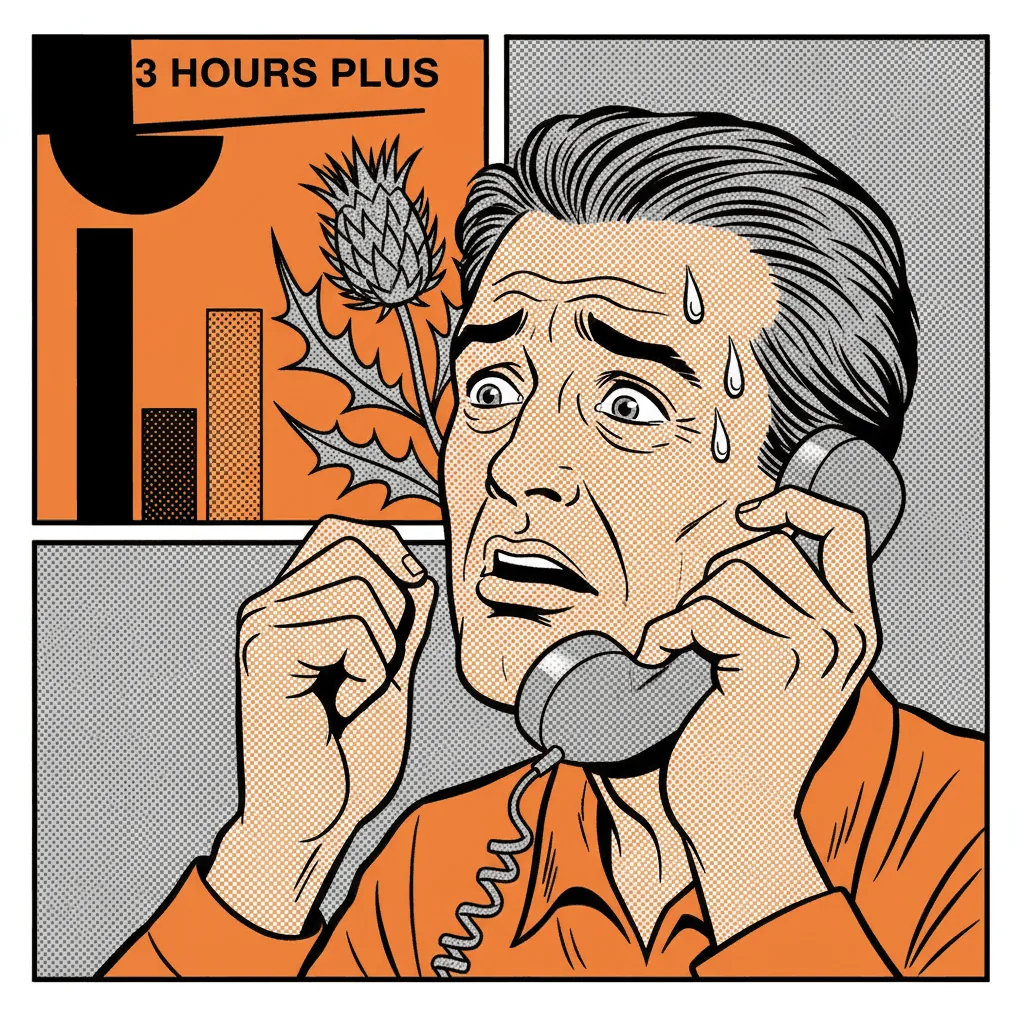
The numbers are blunt. According to figures reported by STV News, NHS 24 is currently abandoning 17% of incoming calls with no answer at all. The longest recorded wait in October 2025 was three hours and 39 minutes. A second caller waited three hours and 25 minutes. These are not edge cases, they are the shape of a service under sustained, structural pressure, and the human cost is real: patients sitting with chest pain, worried parents holding sick children, older adults with no one else to call, all of them waiting in silence.
NHS 24 handles roughly 4.5 million contacts per year across phone, digital, and app channels, according to the service's own published performance data. The demand has grown significantly since the pandemic, while recruitment into clinical telephone roles remains difficult across the entire NHS. The Royal College of Nursing Scotland has repeatedly flagged workforce shortages as a critical constraint on safe care delivery. You cannot simply staff your way out of a crisis when there are not enough trained nurses to hire.
That is precisely where AI enters the picture, not as a replacement for clinical judgement, but as the filter that should sit in front of it. AI-powered triage tools, already deployed in parts of the NHS in England and in several Scandinavian health systems, can take a patient's initial symptoms, ask structured follow-up questions, assess urgency, and route them to the right level of care in minutes rather than hours. Babylon Health's early triage models, Infermedica's symptom-checking API, and NHS England's 111 online tool all demonstrate that this is not speculative technology. It exists. It works. It reduces the volume of calls requiring a human clinician to handle from scratch.
Scotland's Digital Health and Care Strategy, published by the Scottish Government and updated in 2023, explicitly identifies AI and digital tools as central to reducing pressure on frontline services. The ambition is there in writing. The gap is between strategy and deployment, and that gap is currently being measured in abandoned calls and three-hour waits. A well-configured AI triage layer on the NHS 24 front end would not close that gap overnight, but it would immediately deflect a meaningful proportion of lower-acuity contacts, freeing human clinicians to focus on the calls that genuinely need them.
For Scottish healthcare professionals reading this: the conversation about AI in your sector is not coming. It is already here, and the data from NHS 24 is making the argument louder by the month. For SME owners and employers across Edinburgh, this has a direct workplace dimension too. Delayed access to out-of-hours advice means employees making costly A&E visits for problems that could have been triaged remotely. It means sick days that stretch longer than necessary. It means staff anxiety about whether they can get help when they need it. The health of your team and the efficiency of Scotland's healthcare system are not separate problems.