

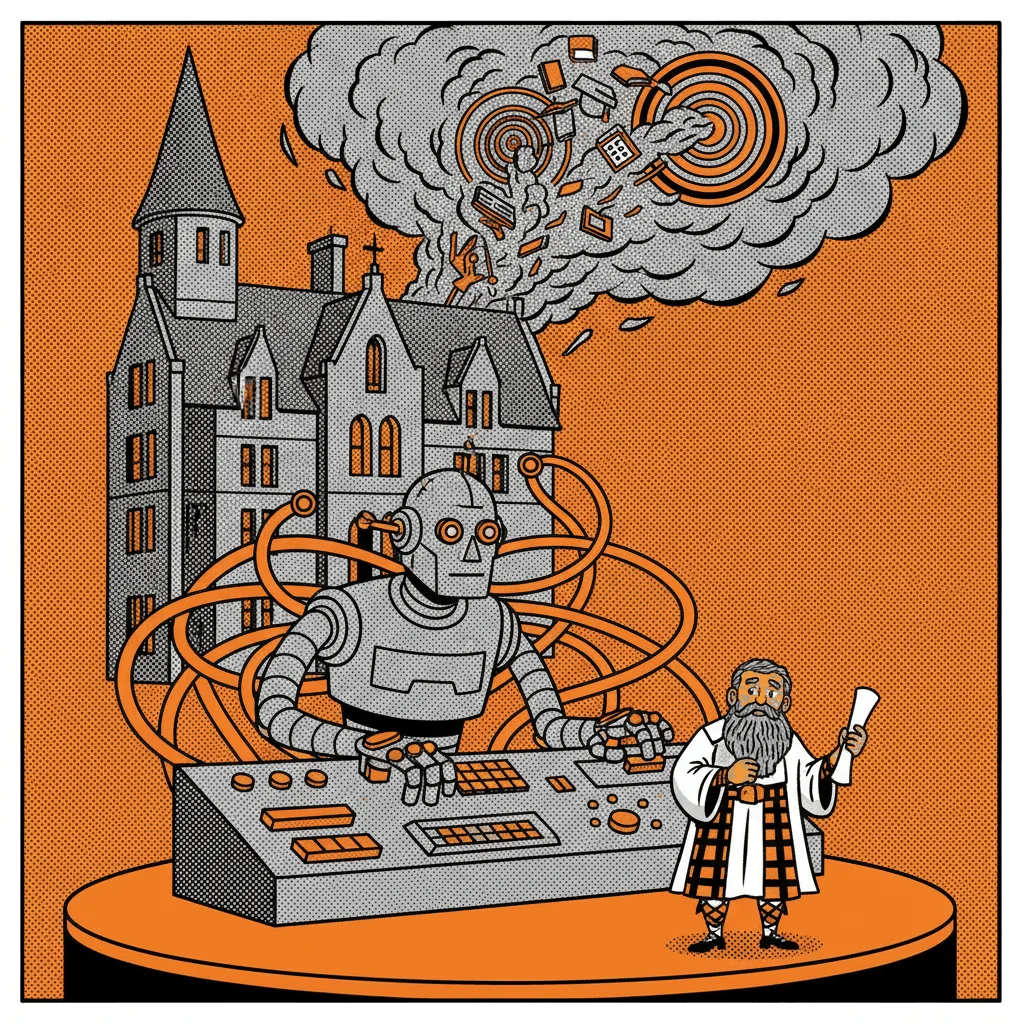
Let's start with the uncomfortable fact. A first-year student arriving at Edinburgh, St Andrews, or Strathclyde this September has never written an essay without access to a large language model. That is not a problem to be solved with a tougher plagiarism policy. It is a structural shift in what learning, writing, and thinking look like, and Scottish universities are now scrambling to build policy for a world that already arrived.
Ian Ritchie, writing for the Daily Business Group, frames the challenge with the clarity you'd expect from someone who has spent decades at the intersection of technology and Scottish enterprise. AI is not arriving. It is here. And universities face a dual pressure that most institutions are poorly designed to handle at speed: they must update what they teach, and simultaneously update how they teach, at the same time as their students are already using the tools unsupervised. According to the Office for Students, more than 60 per cent of UK undergraduates report using generative AI in their studies, yet fewer than a third say their institution has given them clear guidance on how to do so appropriately. That gap is where reputations get damaged.
The University of Edinburgh's own AI strategy, published in 2024, acknowledges the tension directly, committing to both responsible AI adoption across teaching and research, and the development of AI literacy as a graduate attribute. That is the right language. The question is pace. Research from JISC, the UK's digital education body, found that most UK universities are still in the policy-formation stage rather than the implementation stage, a distinction that matters enormously when the technology is moving on a quarterly cycle rather than an academic one.
The opportunity here is not being discussed loudly enough. Scottish universities sit inside one of the most robust publicly funded research ecosystems in Europe, with institutions like the Alan Turing Institute, the Edinburgh Futures Institute, and the National Robotarium at Heriot-Watt positioned to generate genuine AI innovation in education, not just consume it. Scotland's AI Strategy, backed by the Scottish Government, explicitly identifies education as a priority sector for AI deployment. That gives Scottish institutions a policy tailwind that universities in other parts of the UK do not have to the same degree. The question is whether vice-chancellors treat that as a competitive advantage or as a committee agenda item.
For the educators reading this, the practical frame is straightforward. AI does not replace the seminar, the clinical placement, the dissertation, or the lab. It replaces the drudgery around them: the literature searches that took three days, the draft structures that took a morning, the feedback on a first draft that a tutor never had time to give. A GP registrar at NHS Lothian who uses AI to pre-summarise patient notes before a clinic is not cutting corners. They are arriving better prepared. The same logic applies to a history student who uses AI to map secondary sources before forming their own argument. The skill being taught is not the search. It is the judgement. Universities that understand this distinction will redesign their curricula accordingly. The ones that treat AI as a cheat code will spend the next decade playing whack-a-mole with their own students.
The commercial dimension matters too, and it is worth stating plainly for anyone who runs a business that recruits from Scottish universities. Graduates who arrive AI-literate, who know how to prompt well, evaluate critically, and deploy responsibly, are worth more on day one than graduates who have been shielded from the tools they will use from Monday morning. Scottish SMEs, many of whom cannot afford long induction periods, need universities to send them people who are already comfortable in this environment. That is not a request. It is a market signal universities should be reading clearly.