

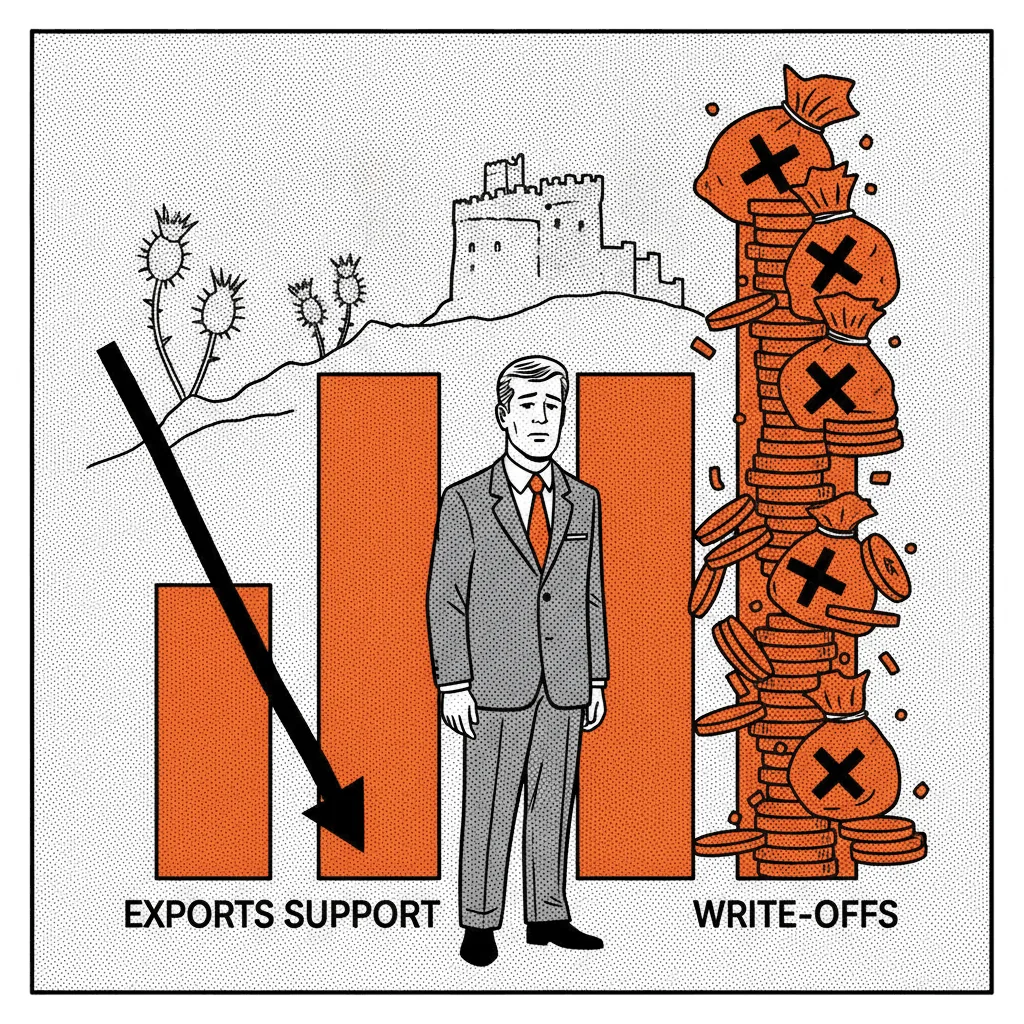
Scottish Enterprise helped ambitious Scottish businesses generate £2.15 billion in exports in the year to March 2026, according to figures published by the agency this week. That sounds impressive until you set it against the prior year's £2.46 billion, a fall of more than £310 million, or roughly 13 percent, in a single annual cycle. For an agency whose core mission is economic growth through trade, that is a number worth sitting with.
The write-off figure is the other headline. SE was forced to write off more than £21 million invested in failed early-stage companies over the same period. Investment in pre-revenue and early-stage businesses is inherently risky, and no serious development agency expects every bet to pay out, but £21 million in a single year is a significant sum of public money, and Scottish SME owners have every right to understand what accountability looks like around those decisions.
To put the write-off figure in context: the British Business Bank, which publishes annual data on its own portfolio performance, consistently reports that early-stage venture investment carries a failure rate of between 50 and 70 percent across any given cohort. That is the nature of the asset class. Scottish Enterprise is not alone in absorbing losses at this stage of the funding pipeline. What matters is whether the agency is learning from those failures and whether the companies that do succeed are creating durable Scottish jobs and supply chains.
The export slide is a separate concern. The Scottish Government's National Strategy for Economic Transformation, published in 2022, set an explicit ambition to grow exports as a share of GDP. A fall of this size, even in one year, moves Scotland in the wrong direction on that target. Global headwinds, energy costs, post-Brexit trade friction, and a difficult year for Sterling-denominated goods in key markets, will all have played a role. But headwinds are also when development agency support is supposed to matter most.
Scottish Enterprise has consistently been one of the more transparent development agencies in the UK, publishing performance data that most equivalents bury. That transparency is worth acknowledging. The question for SME owners reading these figures is a practical one: if export support is contracting and early-stage investment is carrying more risk, are the programmes still reaching the businesses that need them? According to the Fraser of Allander Institute, which tracks Scottish economic performance closely, SMEs account for more than 99 percent of all Scottish businesses and around half of private sector employment. If SE's resources are tightening, the distribution of what remains matters enormously.
None of this should put Scottish founders off engaging with Scottish Enterprise. The agency still deployed hundreds of millions in business support, and its account managers, international trade advisers, and sector specialists remain among the most accessible business development resources available to a Scottish SME outside of a major city accelerator. What these figures suggest is that the pipeline needs scrutiny, not abandonment.