

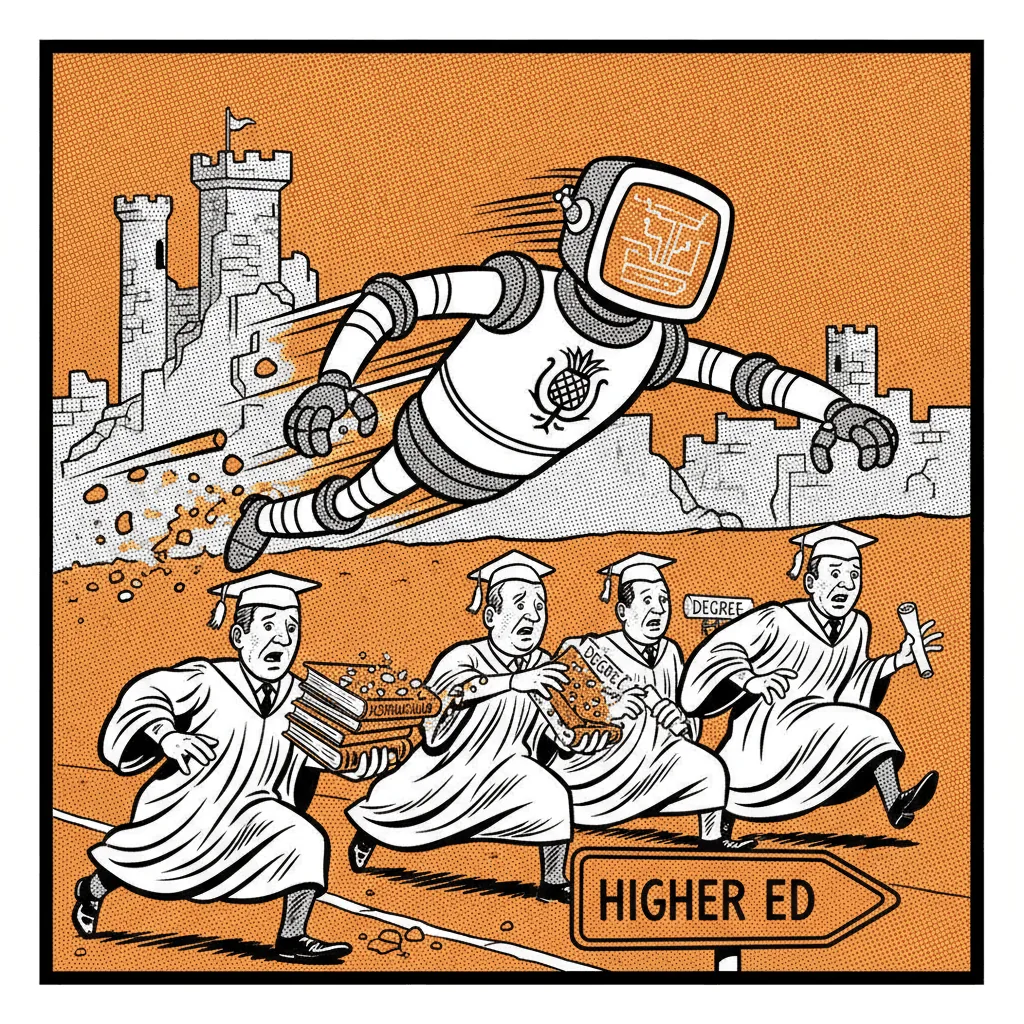
Here is the uncomfortable truth sitting beneath the graduate recruitment cycle: a significant portion of what a 2025 degree certifies was already being automated while the student was still in second year. Research published by the World Economic Forum in its Future of Jobs Report 2025 found that 39% of existing skill sets will be disrupted by technology within five years. That is not a distant forecast. That is your next hire walking through the door.
The problem is structural, not personal. Universities run on long cycles. A curriculum reform that begins today takes two to four years to embed. By the time a revised module reaches students, the AI capability it was designed to address has already moved on. As Entrepreneur.com reported, the half-life of a certified skill is now measured in years rather than decades, and no policy process moves fast enough to close that distance. The University of Edinburgh's own AI strategy acknowledges this tension directly, flagging the need for continuous curriculum evolution in response to rapidly shifting industry needs. Acknowledging the problem and solving it are two different things.
Scotland's colleges and universities are not standing still. Skills Development Scotland has been expanding its Upskilling Fund and digital skills programmes specifically to address AI literacy gaps, and some further education colleges are moving faster than their university counterparts precisely because their course cycles are shorter. But the honest assessment is that the burden of closing this gap is falling on employers, not educators. If you wait for graduates to arrive AI-ready, you will wait a long time.
The smart response from Scottish SME owners is not to stop hiring graduates. It is to stop treating the degree as a proxy for current capability. What matters now is learning velocity: how fast does this person pick up new tools, adopt new workflows, and rebuild their own skill set when the ground shifts? That is the hire. A candidate who taught themselves to use AI research tools, automated a side project, or rebuilt a process during their studies is telling you something a transcript cannot. The Institute for Employment Studies has noted a marked shift among UK employers toward skills-based hiring criteria over credential-based ones, a trend accelerating sharply since 2023.
For small teams, this is actually an advantage. A sole trader or a five-person operation can reskill faster than a 500-person company with a training calendar locked in for the next eighteen months. Tools like Coursera for Business, LinkedIn Learning, and sector-specific AI platforms from providers like Jisc, which supports UK education and research institutions, give Scottish SME owners access to training that costs a fraction of what it would have done five years ago. The gap between what higher education is producing and what your business needs is real. But it is also a gap you can close yourself, on your own terms, without waiting for anyone's permission.