

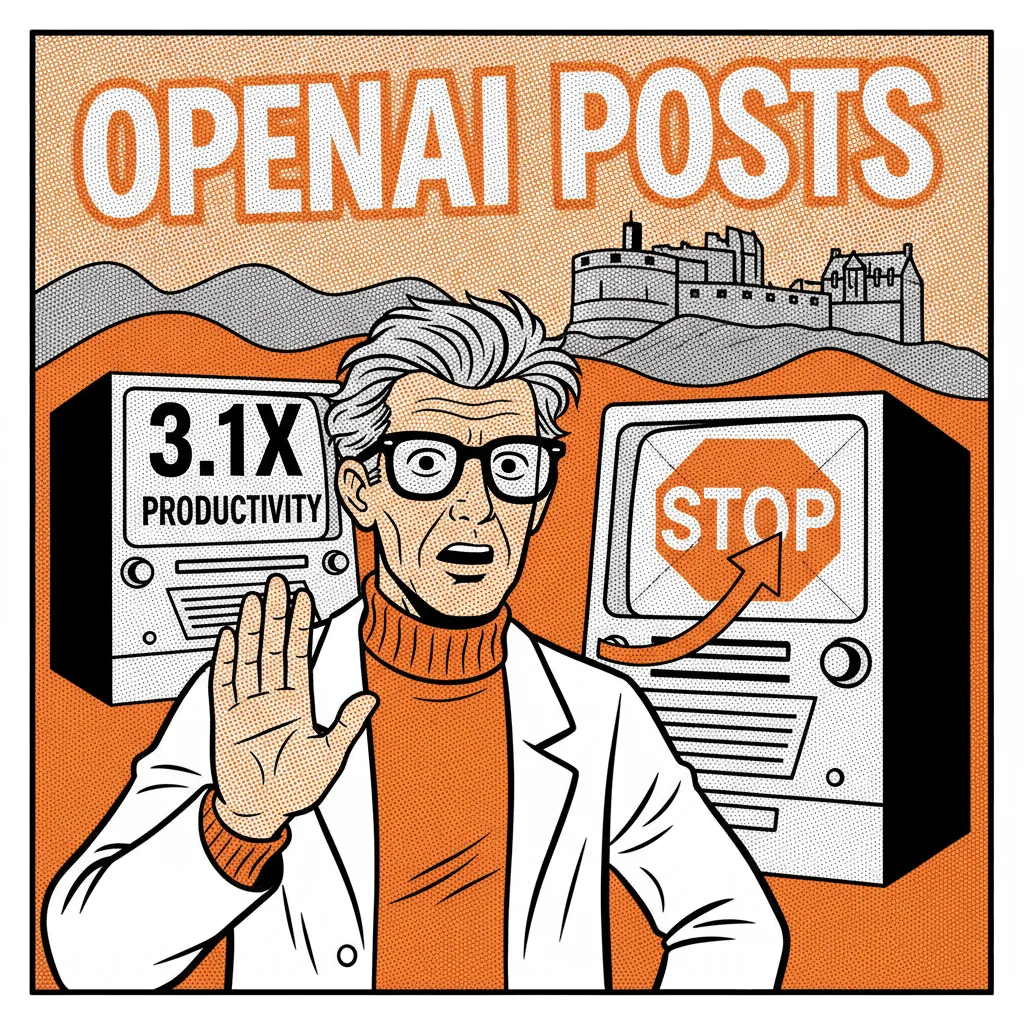
On 6 September, three days after shipping GPT-6 Astra, OpenAI published two posts that contradict each other in the most instructive way possible. The first revealed that the company's own researchers now generate 3.1 days of machine work for every single day of human effort they put in. The second, written by chief scientist Jakub Pachocki, argued that no AI lab should be scaling at maximum speed. Both are live on OpenAI's own site. Draw your own conclusions about the tension there, but do not miss the number buried in post one.
A 3.1x productivity multiplier is not a forecast or a marketing claim. It is a measured, internal benchmark from the organisation building the most widely used AI systems on the planet. According to The Next Web's reporting on both posts, the figure comes from OpenAI's own research operations, where AI is now doing the computational heavy lifting that previously ate human hours wholesale. That is the context. The implication for anyone running a small business or working independently is blunt: this ratio is already filtering down into the tools you can use today.
The McKinsey Global Institute's 2024 productivity research estimated that generative AI could add between £2.6 trillion and £4.4 trillion annually to the global economy, with small and medium enterprises positioned to capture a disproportionate share of the early gains precisely because they carry less legacy infrastructure than large corporations. The tools are the same. The overhead is not. A sole trader in Edinburgh using AI-assisted drafting, scheduling, research, and client communications is playing with the same underlying technology as an OpenAI researcher, just pointed at a different problem.
Pachocki's caution is worth taking seriously on its own terms. His argument, as reported, is that the pace of development is outrunning the field's ability to understand what it is building. He used the phrase "alien mind" to describe the trajectory of current models, which is either alarming or clarifying depending on your temperament. What it signals for Scottish SME owners is this: the competitive window for early adopters is real and finite. The tools will get more powerful. The gap between businesses that are already embedding AI into their workflows and those still debating whether to bother is widening every quarter.
The Scottish Government's AI Strategy, published through the Digital Directorate, explicitly frames AI adoption as a priority for economic inclusion, meaning the expectation is that support structures, from Business Gateway to Scottish Enterprise programmes, will increasingly point SMEs toward practical AI integration rather than theoretical readiness. That backing matters. It means training, funding pathways, and sector-specific guidance are coming. But none of that will close the gap if individual business owners are waiting for permission to start. The 3.1x number is the permission. Someone at a well-resourced AI lab put a figure on what this technology actually delivers when it is woven into daily work. That figure is now in the public domain. Use it.