

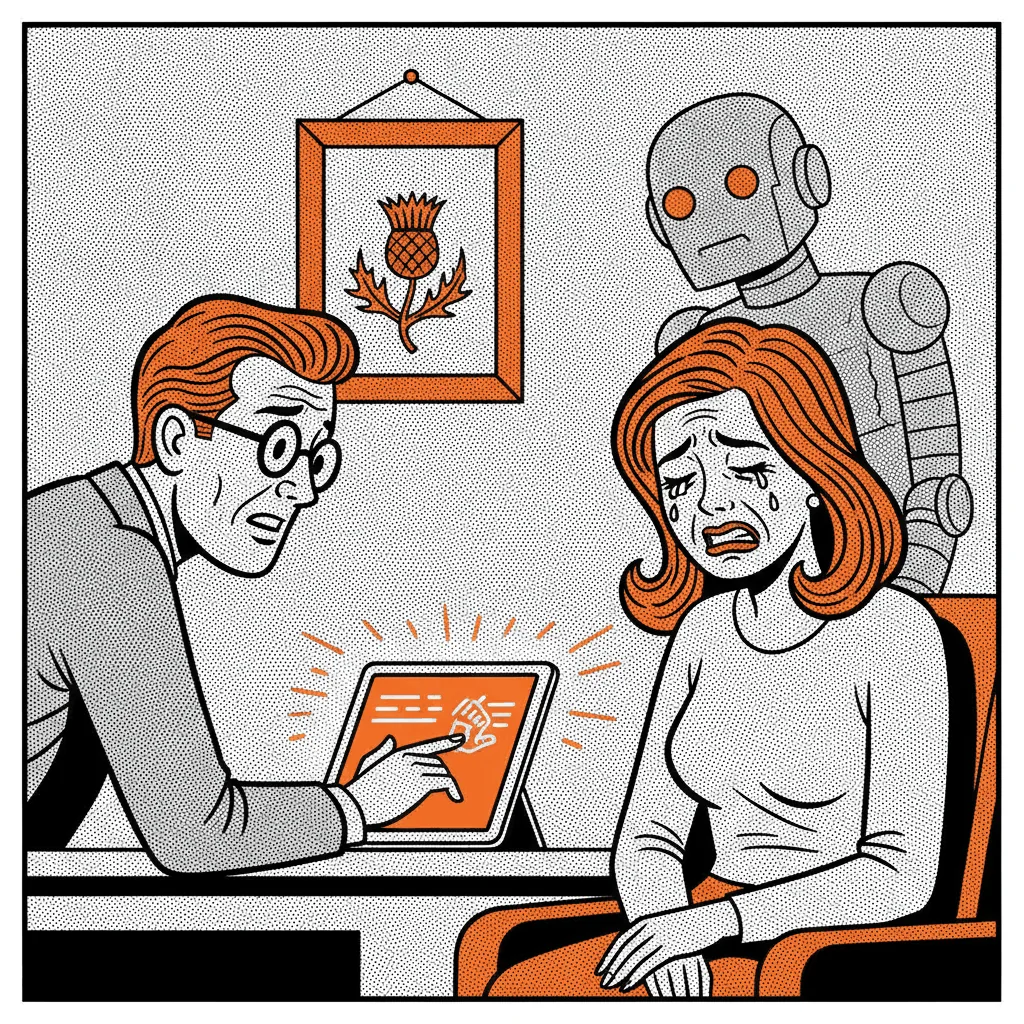
Researchers examining AI-assisted consultation tools, which record and transcribe GP appointments in real time, have found a consistent blind spot: the tools capture what is said, but not what is shown. Facial expressions, emotional affect, body language, the particular flatness in someone's voice when they're not telling the whole story, none of that makes it into the transcript. For a GP, that missing layer is often the whole point of the consultation.
The study, covered by BBC Scotland, adds academic weight to what many clinicians have said privately since these tools began rolling out across NHS practices. The technology is genuinely useful for reducing administrative burden. Doctors spend an estimated two hours on paperwork for every hour of patient contact, according to the British Medical Association, and AI transcription tools directly attack that problem. But a transcript of spoken words is not the same as a clinical record of a consultation, and confusing the two creates risk.
The University of Edinburgh's Usher Institute, which has been active in researching digital health tools in Scottish primary care, has consistently highlighted the importance of contextualising AI outputs within clinical workflows rather than treating them as standalone solutions. That framing matters here. The failure mode being described is not the AI doing something wrong, it is clinicians or systems treating AI output as complete when it is, by design, partial. The tool records audio. It was never going to record empathy.
For NHS Scotland, which is under sustained pressure to reduce GP workload and improve access, the implication is practical rather than alarming. These tools belong in the consultation room, but as one layer of a clinical record, not as a replacement for clinical judgement. The Scottish Government's digital health strategy explicitly frames AI adoption in healthcare as augmentation, not substitution, and that distinction is exactly what this research is stress-testing in real-world conditions. The question for health boards is not whether to use these tools, but whether the training and governance around them keeps pace with the deployment.
There is a broader lesson here that applies well beyond GP surgeries. Any business or organisation adopting AI automation tools, whether for note-taking, customer service, or internal process management, is making the same kind of trade-off: speed and consistency in exchange for some loss of nuance. The answer is not to avoid the trade-off. It is to know exactly what you are trading, design your workflow around that knowledge, and ensure the human in the loop is still doing the thing only humans can do. In a GP's case, that is reading the room. In your business, figure out what the equivalent is.