

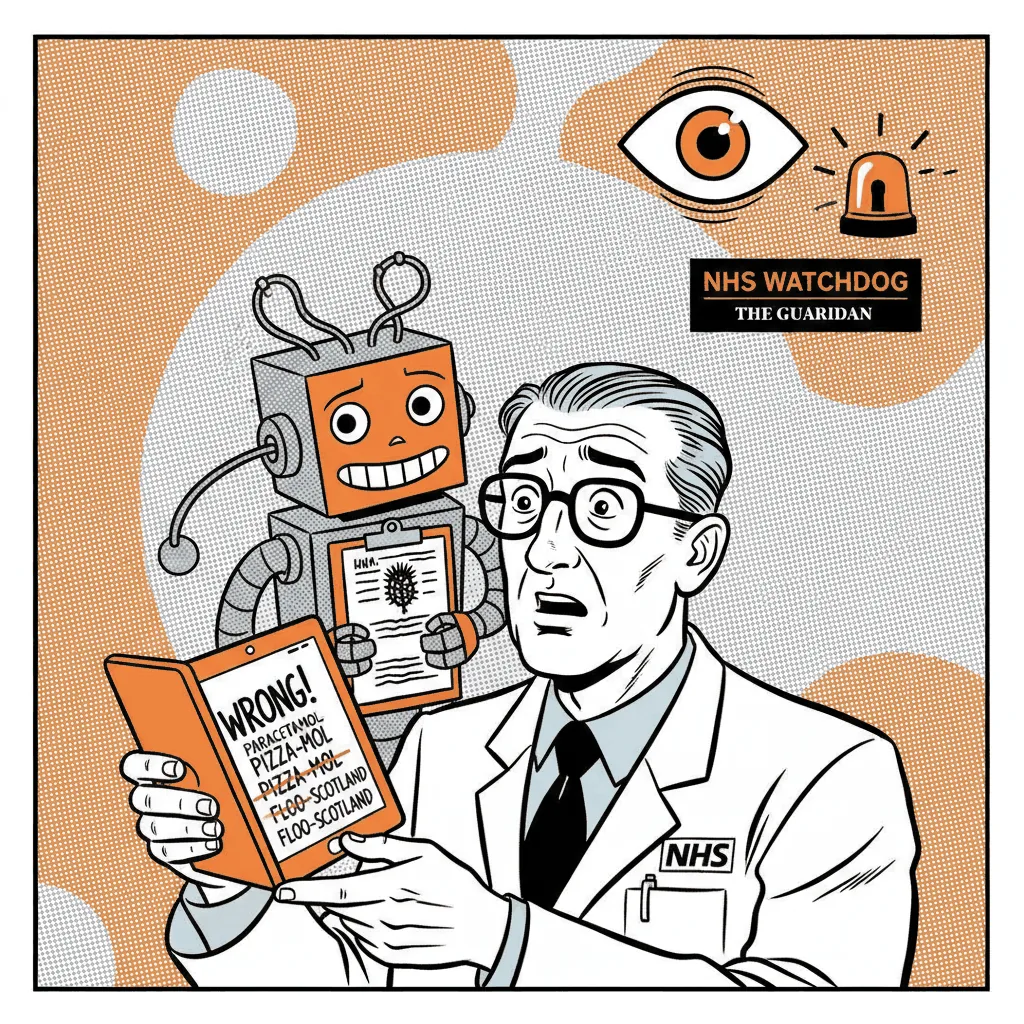
The NHS England Patient Safety Commissioner has issued a formal warning that AI scribes used by doctors during consultations are producing errors in drug names, dosages, and clinical diagnoses. The tools, which listen to doctor-patient conversations and automatically generate clinical notes, are being adopted at pace across the NHS, including in Scottish primary care settings, without consistent governance frameworks in place to catch mistakes before they enter patient records.
The concern is not that AI scribes are inherently dangerous. It is that they are being used without sufficient human verification at the point of output. According to the Guardian's reporting on the watchdog's findings, errors have included plausible-sounding but incorrect medication names, a particularly serious failure class in clinical documentation where a wrong drug name in a record can cascade into harm downstream. The NHS AI Lab, which is overseeing broader AI adoption across the health service, has acknowledged that deployment has outpaced formal evaluation in some trusts and health boards.
For Scottish GPs and NHS Highland, NHS Lothian, and NHS Greater Glasgow and Clyde staff already trialling ambient AI scribing tools, the watchdog's alert should trigger an immediate review of verification workflows, not a withdrawal of the technology. The Academy of Medical Royal Colleges, which represents clinicians across the UK including Scotland, has previously published guidance stating that AI-generated clinical notes must be treated as a first draft requiring active clinician sign-off, not a finished document. That principle is clearly not being applied consistently everywhere.
The upside of AI scribing in clinical settings remains substantial and well-evidenced. A 2023 study published in npj Digital Medicine found that ambient AI scribing tools reduced documentation time for GPs by an average of 40 percent per consultation, freeing clinicians for more patient-facing time. NHS Scotland's own Digital Health and Care Strategy identifies AI-assisted administration as a priority investment area precisely because of the administrative burden crushing frontline staff. The technology works. The governance around it needs to catch up.
The practical lesson here applies well beyond clinical settings. Any organisation, whether a GP surgery, a small healthcare consultancy, or an allied health practice, that is using AI to generate documents, summaries, or records with real-world consequences needs a human in the loop at the verification stage. AI scribes are powerful precisely because they move fast. That speed only pays off if the output is checked before it becomes the record of truth. Scottish health boards have an opportunity to set the standard here: build the review step into the workflow from day one, and the productivity gains are real and safe.