

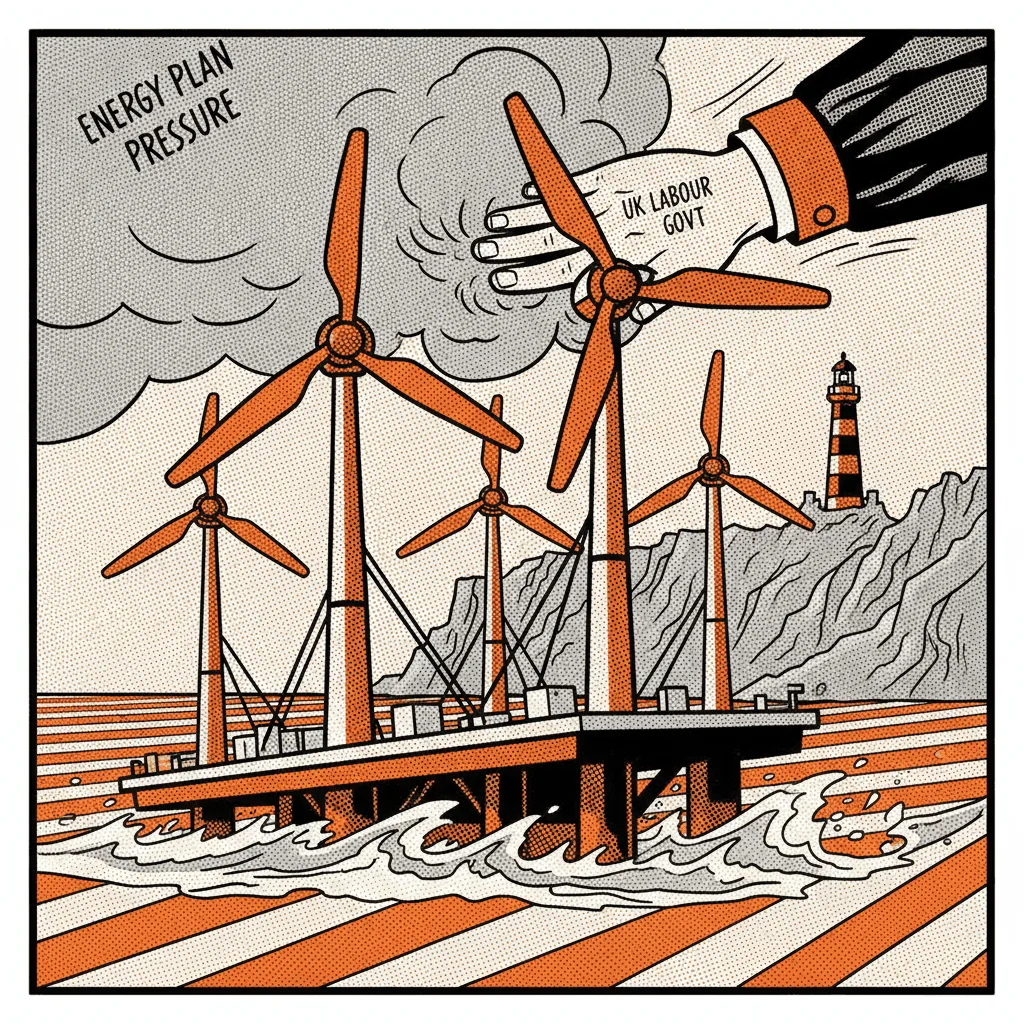
Scotland holds some of the best floating offshore wind conditions anywhere on the planet. Water depth, wind resource, existing port infrastructure at Aberdeen and Dundee, a workforce with transferable skills from oil and gas, the raw ingredients are all here. What is not guaranteed is that Westminster will plan around them. The UK Labour Government's forthcoming Strategic Spatial Energy Plan (SSEP) is the mechanism that will decide where offshore wind capacity is allocated across British waters, and right now, industry insiders are not confident it will prioritise the deep-water sites off Scotland's north and west coasts.
Scottish Renewables, the industry body representing the sector, has warned explicitly that floating wind projects risk being "delayed or cancelled" if the SSEP fails to carve out adequate allocation for Scottish waters. The concern is structural. The SSEP is a centrally designed plan, drawn up in London, for a grid and energy market that has historically underweighted Scottish geography. Fixed-bottom wind is cheaper and easier to permit. Floating wind, which is the technology needed to unlock Scotland's deepest and most productive sites, requires longer lead times, heavier capital commitment, and policy certainty over a longer horizon. Without that certainty baked into the SSEP, developers will not commit.
The scale of what is at risk is not trivial. According to the Scottish Government's own energy strategy analysis, floating wind could generate up to 70 gigawatts of capacity in Scottish waters, enough to power the equivalent of tens of millions of homes and position Scotland as a net exporter of clean energy across Europe. The Crown Estate Scotland has already leased sites under its ScotWind programme, which attracted over £700 million in option fees from developers. But a lease is not a turbine. Without a planning and grid framework that supports delivery, those sites sit dormant.
The supply-chain dimension is where this lands hardest for Scottish SMEs. Research from the trade association RenewableUK estimates that a healthy floating wind pipeline would support around 100,000 UK jobs by 2050, with a significant proportion concentrated in Scottish ports, fabrication yards, and specialist engineering firms. Aberdeen-based companies in particular have spent the last decade repositioning from oil and gas into offshore renewables. A stalled floating wind programme does not just delay revenue; it delays the entire just-transition business case those firms have built their next decade around.
There is a follow-the-money question here too. Fixed-bottom offshore wind is mature technology, largely controlled by large European developers with existing supply chains. Floating wind is where new entrants, including Scottish engineering SMEs and spinouts, have a genuine shot at carving out intellectual property and long-term contracts. Delay that sector, and you delay the window in which Scottish businesses can enter it competitively. The Scottish Government has pushed hard for the SSEP to treat floating wind as a strategic national priority, not an afterthought. Whether that pressure lands is a Westminster decision. As the University of Strathclyde's Centre for Energy Policy has noted, energy planning decisions made centrally frequently fail to account for the regional economic development value embedded in where, specifically, capacity is built.