

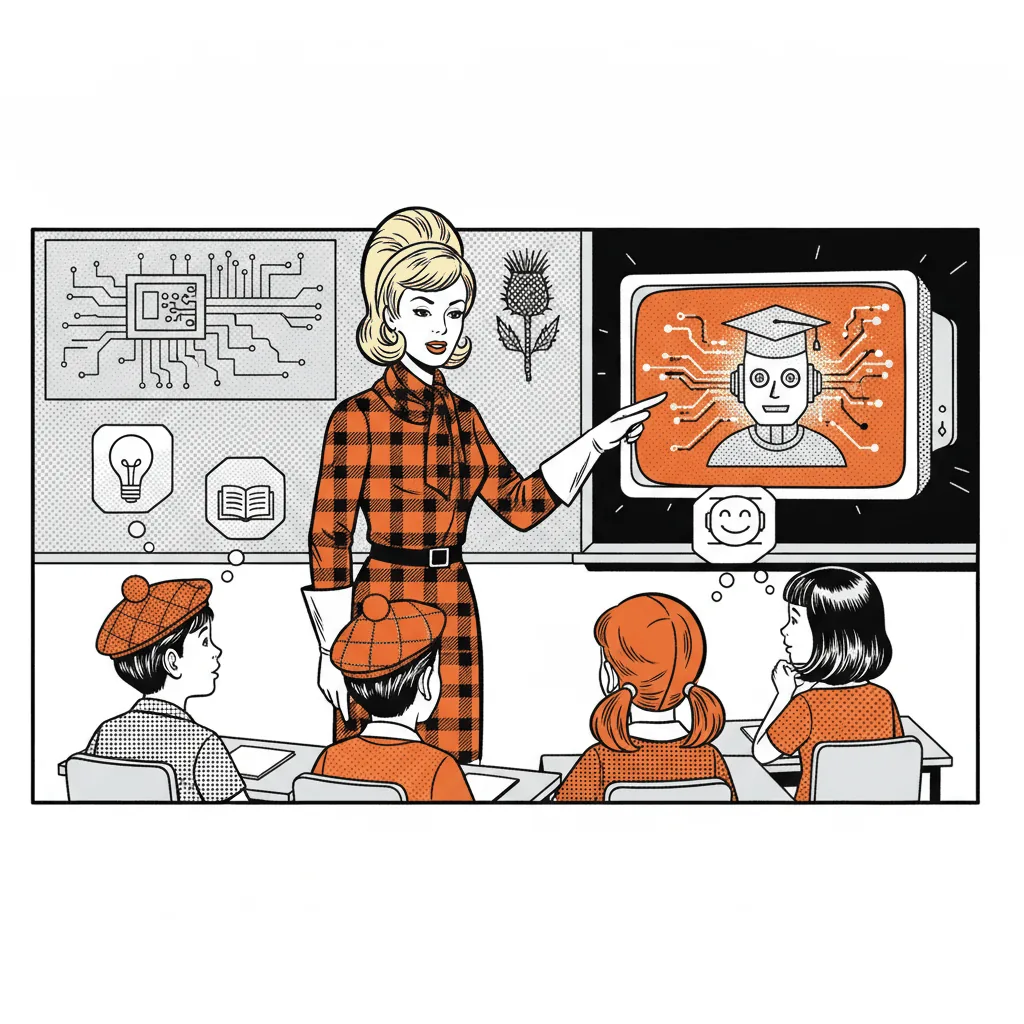
The instinct, when a powerful new tool appears, is to control it. Block it, ban it, write a policy that nobody reads. Schools did exactly that when AI chatbots arrived, and it cost them two years of progress. The institutions that moved faster, that built frameworks for use rather than walls against it, are now producing students who treat AI as a professional skill rather than a cheat code. That gap is widening, and it maps almost perfectly onto what is happening inside Scottish businesses right now.
MIT Technology Review's analysis of classroom AI adoption identifies a consistent pattern among schools that got it right: they stopped asking "should students use AI?" and started asking "how do we make sure they use it well?" That means teaching prompt quality, source verification, and critical evaluation of AI output, not as add-ons, but as core competencies woven into everyday work. According to research from the University of Edinburgh's Centre for AI in Education, learners who engage actively with AI tools under guided conditions develop stronger analytical skills than those who either avoid them entirely or use them without structure. The same principle applies when your staff member is 34 and trying to hit a quarterly target.
The practical shift is this: move from policy to protocol. A policy says "here is what you cannot do." A protocol says "here is how we do this well." Schools that adopted AI protocols rather than AI bans report, according to MIT's reporting, that students produce better first drafts, ask sharper questions, and spend more time on the parts of work that require human judgement. For a small business, that translates to fewer hours on routine tasks and more time on the decisions that actually move the needle. The Scottish Government's AI in Education guidance, published as part of the Digital Learning and Teaching Strategy, makes a similar point: digital tools succeed when they are embedded in practice, not bolted on as afterthoughts.
Where schools stumbled, and where businesses are stumbling now, is in assuming that access equals adoption. Giving your team a ChatGPT licence and expecting productivity gains is like giving someone a piano and expecting Chopin. The organisations seeing real returns are running short, structured sessions where staff actually practise prompting for their specific tasks, drafting client proposals, summarising meeting notes, generating first-pass marketing copy, building FAQ documents. According to McKinsey's 2024 State of AI report, companies that invest in structured AI onboarding see productivity gains roughly three times higher than those that deploy tools without training. Three times. That is not a marginal improvement.
For Edinburgh SMEs in particular, this is a competitive window that will not stay open. The larger firms are moving slowly, committees are forming, consultants are being hired. A 12-person accountancy practice or a 20-person care provider that builds internal AI fluency now will be operating at a fundamentally different speed within six months. The lesson from education is clear: the teachers who treated AI as a threat are still writing long policy documents. The ones who treated it as a tool are already doing half their admin in a third of the time. Your team is not so different from a classroom. Give them structure, give them practice, and then get out of the way.