

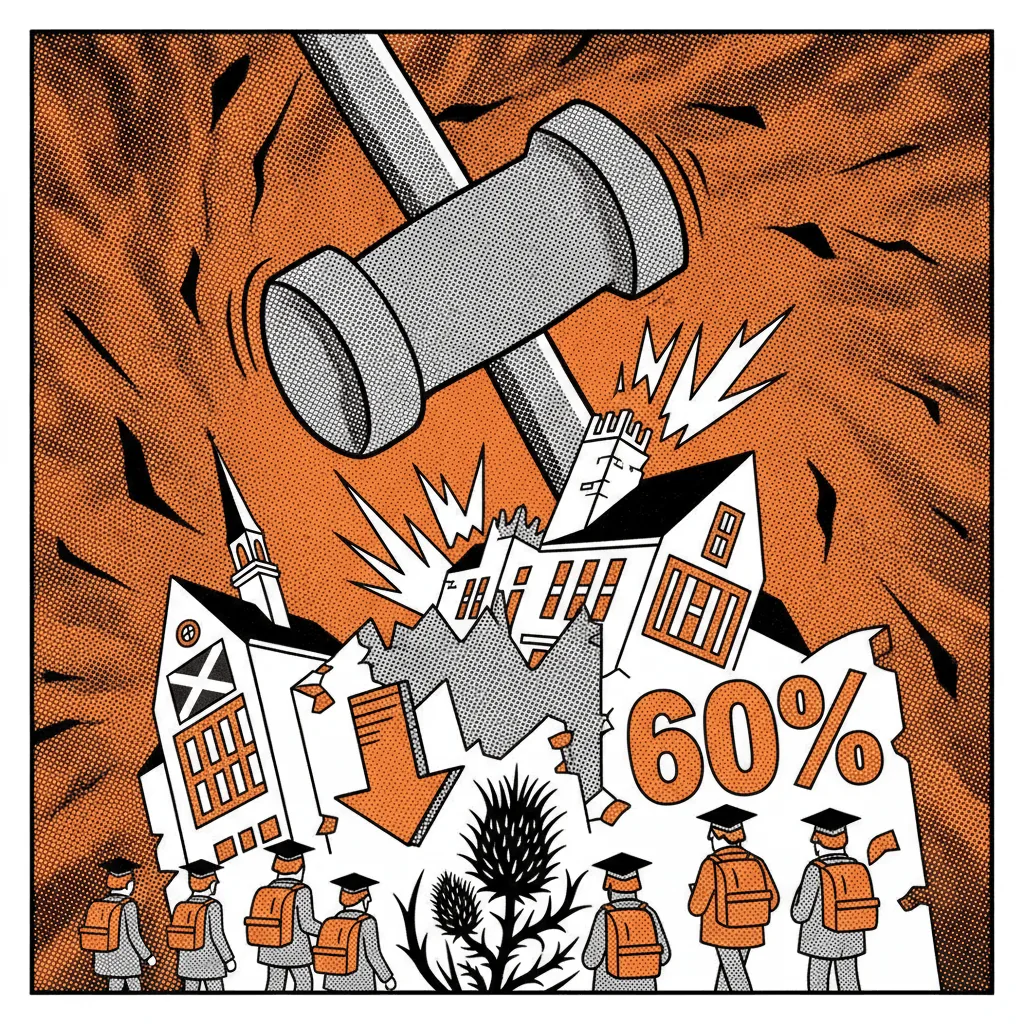
Scottish universities have seen EU student enrolments fall by 60% since Brexit removed the right of EU nationals to study in the UK at home-fee rates, according to reporting by The National. Where tens of thousands of European students once chose Edinburgh, Glasgow, and St Andrews, the numbers have cratered, replaced in part by higher-fee international students, but not nearly enough to fill the gap in bodies, spending, or civic energy those students brought with them.
The mechanism is straightforward. Before Brexit, EU students paid the same fees as Scottish students, effectively zero at undergraduate level thanks to the Scottish Government's free tuition policy. Post-Brexit, they became international students overnight, facing fees of £15,000 to £26,000 per year. Universities Scotland, the body representing the sector, has flagged the sustained financial and reputational damage this has caused, noting that Scottish institutions built decades of European research partnerships, Erasmus exchange programmes, and continental recruitment pipelines that have been systematically dismantled since 2021.
The Office for National Statistics and Higher Education Statistics Agency data show Scotland punched well above its population weight in attracting EU students before Brexit, partly because of free tuition and partly because of the global reputation of institutions like the University of Edinburgh, which consistently ranks in the world's top 20. That competitive advantage has been legislated away by Westminster policy, not by any failure of Scottish universities themselves. The Scottish Government has repeatedly called for the restoration of Erasmus participation or an equivalent bilateral arrangement, without success.
For Edinburgh specifically, the commercial consequences are tangible. A full-time EU student living in the city was typically spending on rent, food, hospitality, transport, and cultural events across a nine-month academic year. The Fraser of Allander Institute at the University of Strathclyde has previously estimated that each full-time international student contributes around £20,000 to the local economy annually. Multiply a 60% decline across Scottish universities by that figure and the scale of lost economic activity becomes significant, hundreds of millions of pounds that no longer circulate through the shops, cafés, landlords, and businesses that cluster around university districts in Edinburgh's Southside, Marchmont, and Newington.
There is no obvious short-term fix available to Scottish businesses. The UK Government controls immigration and fee classification policy, and there is currently no appetite in Westminster to reopen the Erasmus question or create a bilateral EU student mobility agreement. What Scottish universities can do, and some are doing, is aggressively recruit from markets that remain accessible: South Asia, North America, and the Gulf. But those students bring different settlement patterns, different spending habits, and often different accommodation preferences. The gap left by EU students is not simply a number; it is a specific kind of urban economic activity that Edinburgh was quietly dependent on and is now quietly losing.