

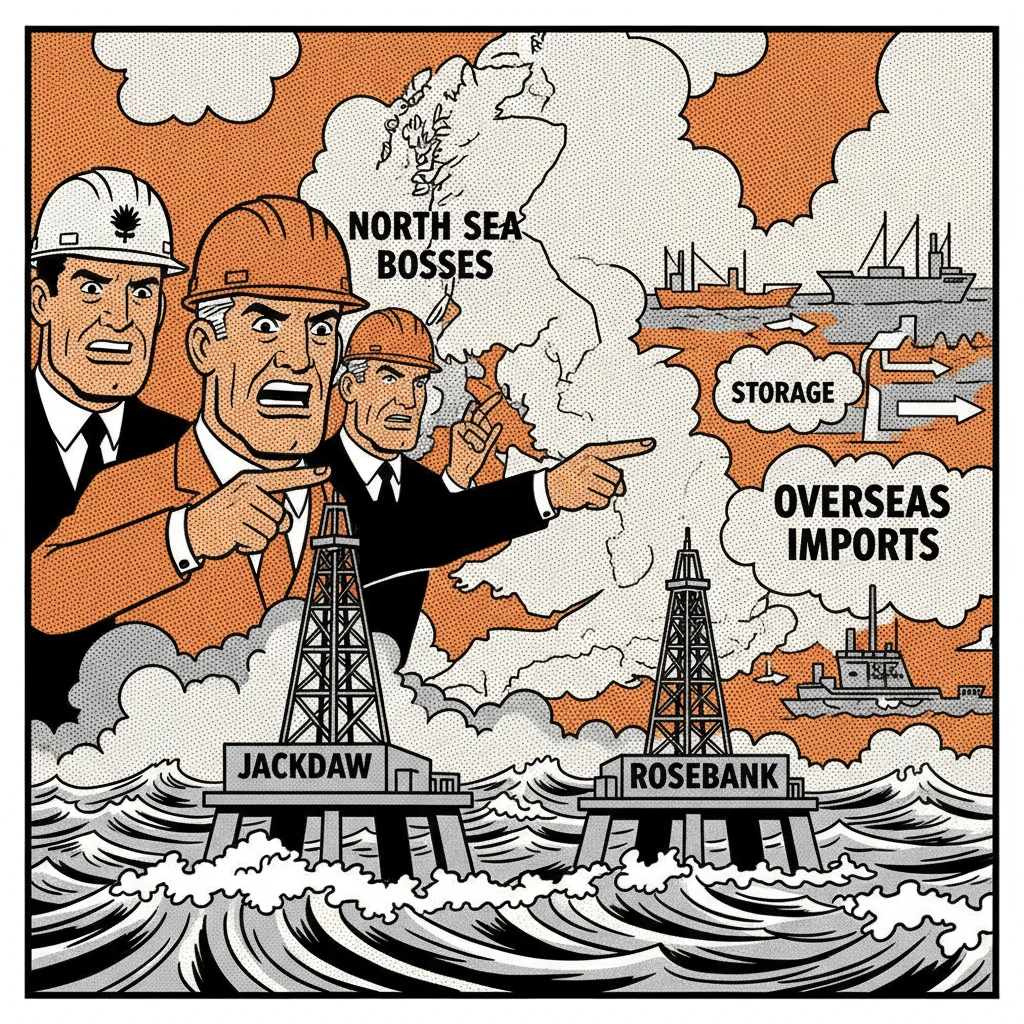
Senior figures across the North Sea oil and gas sector are using some pointed language about Westminster's current direction of travel. The specific word being deployed is 'defy belief': as in, it would defy belief for the UK Government to block development of the Jackdaw and Rosebank fields while simultaneously exploring how to import and store more oil and gas from overseas. A new industry report has surfaced evidence that Whitehall is actively examining overseas import logistics, even as domestically licensed fields sit undeveloped off Scotland's coast.
The economics here are not complicated. Rosebank, located west of Shetland, holds an estimated 300 million barrels of oil equivalent, making it the largest undeveloped field in the UK North Sea. Jackdaw, in the central North Sea, adds further reserves to the picture. According to Offshore Energies UK, the industry body representing offshore operators, domestic production generates significantly lower transport emissions than imported LNG from the United States or Qatar, and keeps supply-chain revenue, jobs, and tax receipts inside the UK economy. The Scottish Government has separately argued that blocking domestic development does not reduce global demand for hydrocarbons; it simply shifts where the money goes.
The UK Government's reluctance is bound up in its legally binding net-zero commitments and the political pressure that followed the Supreme Court's 2023 ruling on the Rosebank approval, which found that the regulator had not properly assessed downstream emissions when granting consent. That ruling, welcomed by environmental groups including Greenpeace, effectively sent Rosebank back for reassessment. Critics of the block, including Energy Voice and the Aberdeen and Grampian Chamber of Commerce, argue the ruling has created a regulatory limbo that is costing jobs and investment certainty across the Scottish supply chain without delivering any measurable climate benefit.
For Scottish SMEs, particularly those in construction, engineering, logistics, hospitality, and manufacturing, the downstream consequence of imported energy versus domestic production is a straightforward one: price. The International Energy Agency has consistently shown that domestically produced gas costs less to bring to market than liquefied natural gas shipped from overseas terminals, where liquefaction, shipping, and regasification all add cost before the product reaches the grid. Business energy contracts negotiated over the next 12 to 24 months will be priced against a market shaped, in part, by how this policy dispute resolves. According to Scottish Enterprise's latest energy cost guidance for SMEs, energy remains one of the top three controllable cost pressures facing Scottish small businesses through 2025 and into 2026.
The broader pattern is worth naming clearly. Traditional energy import infrastructure benefits established global commodity traders and overseas producers. Domestic North Sea development benefits Scottish workers, Scottish supply-chain firms, and the Scottish tax base. When the UK Government's approach appears to favour the former over the latter, it is worth asking who gains from that preference and whether Scottish business interests are being weighed with anything close to equal seriousness. The answer, based on the current trajectory, is that they are not.