

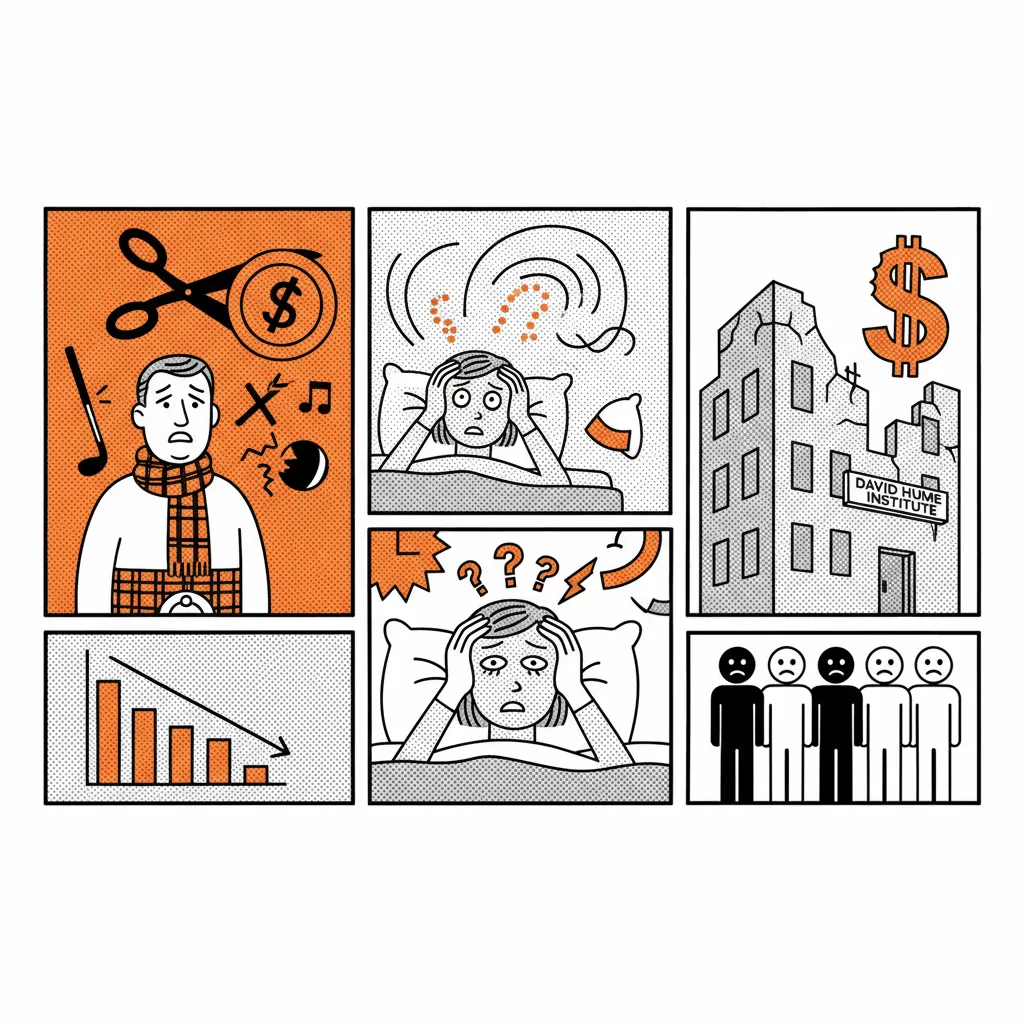
Half of all Scots have reduced their spending and cut back on leisure activities as the cost of living continues to press down on household budgets, according to the latest analysis from the David Hume Institute. More starkly, three in ten say financial worry has damaged their mental health or stolen their sleep. These are not soft, anecdotal observations. They are a measurable shift in how Scottish consumers feel, behave, and spend.
The David Hume Institute, one of Scotland's most respected independent research bodies, has been tracking public sentiment on economic pressures for several years. Their findings align with broader UK trends: the Office for National Statistics reported in early 2025 that real household disposable income remains below pre-pandemic trajectory for millions of working-age adults, even as headline inflation has cooled. The gap between falling prices on paper and the actual cost of running a life remains wide.
For Edinburgh SME owners, the numbers translate directly into footfall, basket size, and booking behaviour. Hospitality, retail, fitness, and leisure businesses, sectors that depend on discretionary spending, are facing a customer base that is making harder choices. People are not stopping life entirely; they are editing it. They are choosing fewer meals out, fewer impulse purchases, fewer non-essential appointments. The businesses that survive this edit are the ones that feel necessary, not optional.
The mental health dimension matters too, and not just for the empathetic reason. Research from the Money and Mental Health Policy Institute consistently shows that financially stressed consumers become more risk-averse, less likely to try new businesses, and more loyal to familiar, trusted options. Acquiring a new customer right now costs more, because trust is harder won. Retaining an existing one has never been more valuable. If you haven't contacted your customer list recently with something genuinely useful, that is the next thing you should do.
Scotland's economic position adds another layer. The Fraser of Allander Institute has noted that Scottish consumer confidence lags behind UK averages in some segments, partly reflecting higher energy costs in rural and northern communities and a public sector wage dynamic that differs from the private sector south of the border. The Scottish Government's ongoing work on cost-of-living support, including the Scottish Child Payment and fuel insecurity schemes, provides partial cushioning, but does not fully offset the squeeze on working-age adults without children in the household, a demographic that makes up a significant share of Edinburgh's spending population.
None of this is cause for paralysis. Plenty of Scottish businesses have adapted intelligently: tiered pricing, smaller entry-level offers, loyalty schemes that reward consistency rather than volume, and honest communication with customers about value. The businesses struggling most right now are often those still pricing and marketing as if it's 2022. The ones doing well have accepted the new baseline and built from there.