

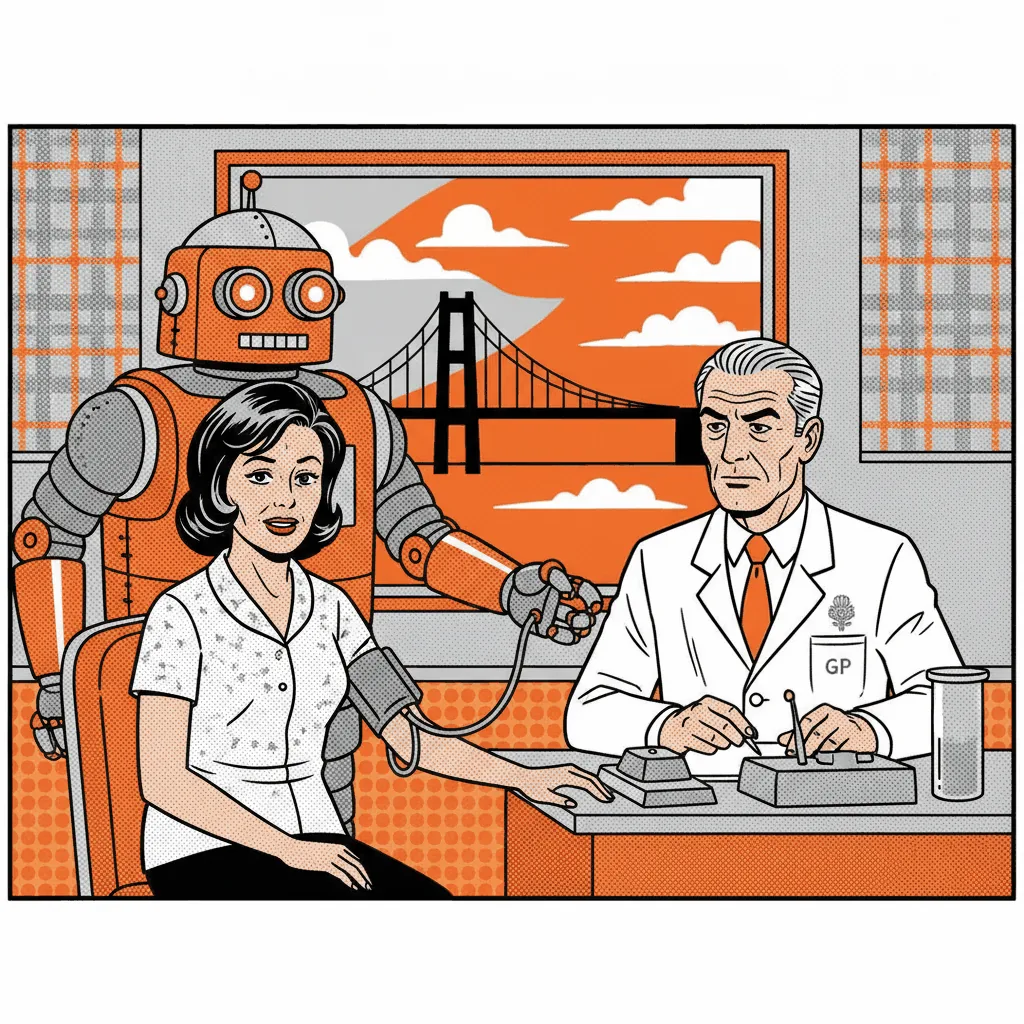
The robot sits in the waiting room, asks the questions, takes the readings, and hands the GP a completed picture before the consultation begins. That is the model being trialled at a Dundee general practice, where an AI-assisted health check robot is handling the routine data-gathering that has traditionally eaten into appointment time. The doctor still sees the patient. The doctor still makes the call. But the grunt work, the blood pressure cuff, the lifestyle questions, the BMI calculation, is done before the clinician walks in the door.
Scotland's NHS is under pressure that needs no dramatising. According to Public Health Scotland, GP practices recorded over 22 million patient contacts in 2022 to 2023, with demand continuing to climb and workforce numbers failing to keep pace. Every minute a GP spends reading a blood pressure monitor is a minute not spent on clinical judgement, diagnosis, or the kind of conversation that actually changes a patient's behaviour. Automated health checks do not replace that. They protect it.
The technology behind the Dundee trial draws on the same category of clinical AI that NHS England's NHSX innovation programme has been accelerating since 2021, tools that handle structured, repeatable tasks so that trained professionals can focus on complex, unstructured ones. The British Medical Association has acknowledged that reducing administrative and procedural burden is central to any credible workforce retention strategy. This is what that looks like in practice, not in a policy document, in a Dundee waiting room.
Patients, understandably, find it a bit odd at first. That is honest and worth sitting with. Healthcare carries trust in a way that, say, a self-service checkout does not. But the evidence from comparable deployments suggests that once patients understand the robot is not replacing their GP but preparing the ground for a better conversation with one, acceptance follows quickly. The tool is also consistent in a way humans are not: it does not rush, does not make assumptions, and does not skip a question because the waiting room is backed up.
For Scottish healthcare commissioners and practice managers, the question is no longer whether this kind of automation works. The Dundee trial suggests it does. The question is how quickly it can be evaluated, procured, and scaled. The Scottish Government's digital health strategy, published under the remit of Healthcare Improvement Scotland, has identified technology-enabled care as a core pillar of sustainable service delivery. A robot that buys a GP fifteen minutes per patient, across a full clinic list, is not a novelty. It is infrastructure.