

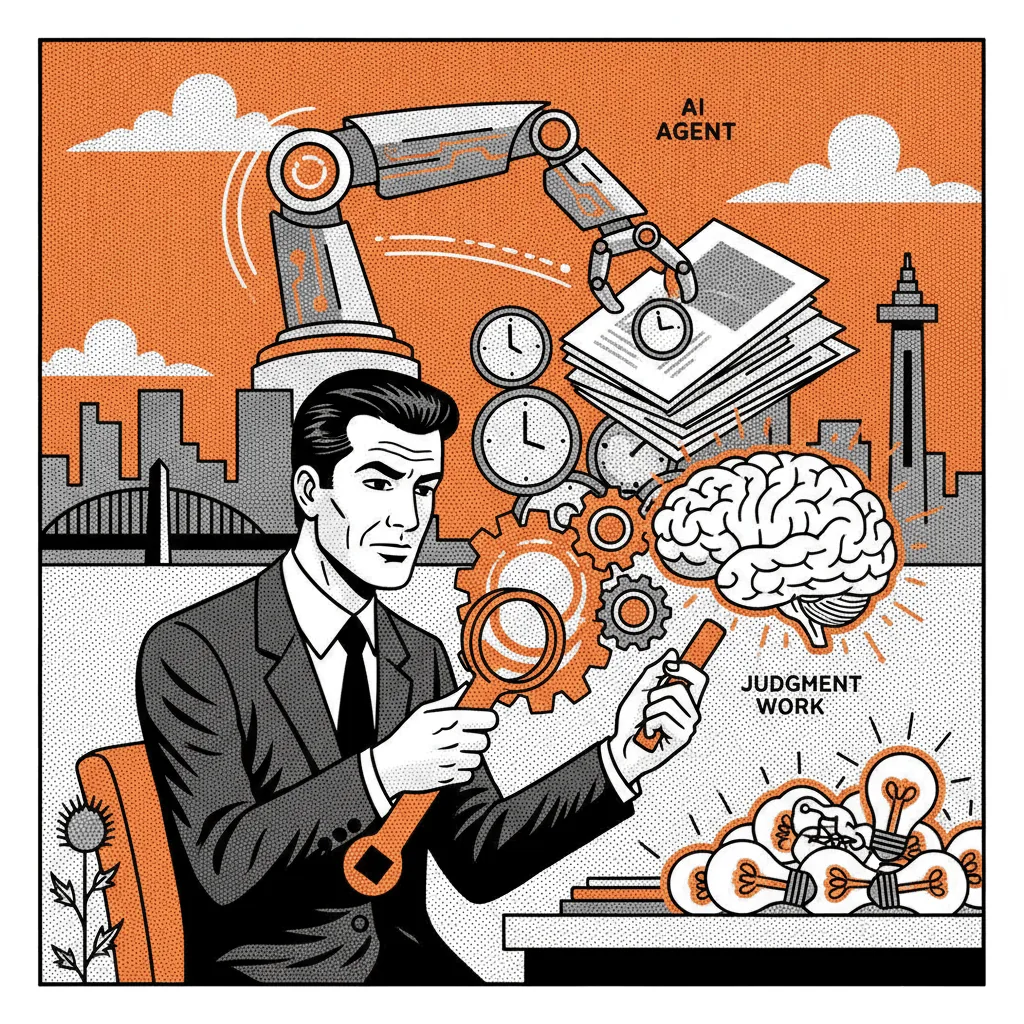
The productivity conversation around AI tends to fixate on volume: how many emails automated, how many reports generated, how many tasks off the list. But the founders actually gaining ground aren't measuring wins in tasks eliminated. They're measuring them in hours reclaimed and then deliberately reinvested into the decisions, relationships, and creative calls that only they can make.
This distinction matters more than it sounds. AI agents, tools like Zapier's AI automation layer, Make.com workflows, or purpose-built agents built on OpenAI or Anthropic's APIs, can now handle research, scheduling, first-draft copywriting, CRM updates, and basic client communications without a human in the loop. For a one-person operation or a team of five in Edinburgh's New Town or Leith, that is not a small thing. According to McKinsey's 2024 State of AI report, knowledge workers using AI tools are reclaiming between one and three hours per day on average. That is a working day every week, returned.
But here's the split that separates the founders who plateau from those who accelerate: what they do with those hours. Research from the Harvard Business School, tracking founders who adopted AI workflows in 2022 and 2023, found that the highest performers weren't the heaviest automators. They were the ones who used reclaimed capacity to double down on client relationships, product thinking, and market judgment, the irreducibly human work. The ones who simply automated more and then filled the gap with more task-level busyness saw modest gains. The ones who used AI to clear the decks and then thought harder saw compounding returns.
For Scottish SME owners, this is a reframe worth sitting with. The temptation when you pick up a tool like Claude, ChatGPT, or a no-code automation platform is to point it at your inbox or your invoicing and call it a win. Those are real wins. But the larger question is what you do at nine o'clock on a Tuesday morning when the AI has handled the first layer of your admin. Do you fill that space with more reactive work, or do you use it to have the strategic conversation you've been putting off for six months? According to Business Gateway Scotland's 2024 digital adoption research, the majority of Scottish SME owners who adopt automation tools report improved efficiency, but fewer than a third say they've meaningfully changed how they spend their highest-value hours as a result.
The founders getting this right are treating AI like a very good member of staff who handles everything that doesn't require their specific judgment. Client calls, product roadmap, pricing decisions, key hires, creative direction: that stays with the founder. Everything else gets a workflow. The result isn't just a less frantic week, it's a business that starts to move at a pace that a founder doing everything by hand simply cannot match. For an Edinburgh SME competing against larger agencies or national operators, that pace differential is the competitive edge. Not the automation itself. What you do when the automation runs.