

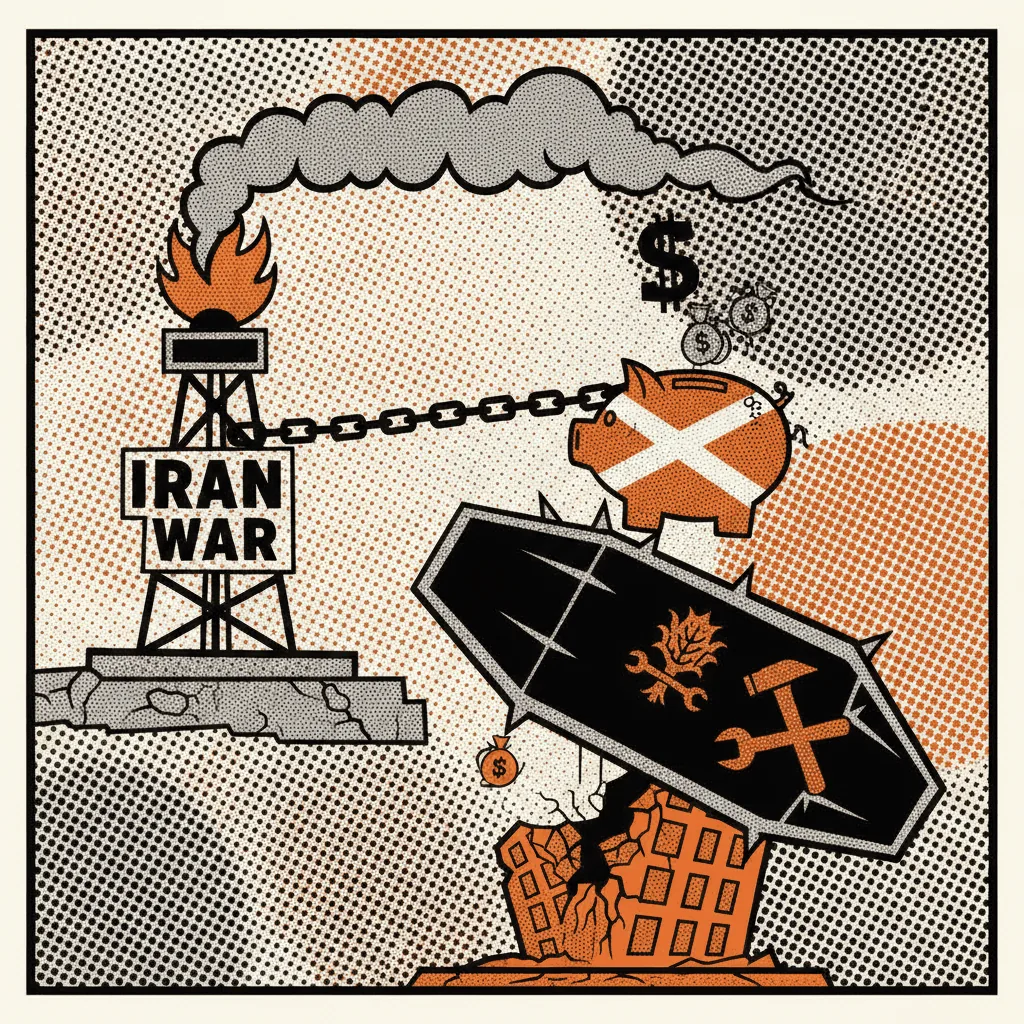
Scottish SMEs are paying more to borrow money right now, and the war in Iran is part of the reason why. Mark Barrie, Head of Debt Advisory at Azets, one of the UK's top ten accountancy firms, says the conflict is adding pressure to an already strained lending environment, and for businesses carrying significant debt, the timing could not be worse.
The mechanism is not complicated. Armed conflict in a major oil-producing region pushes up energy prices, which feeds into inflation expectations, which makes central banks more cautious about cutting rates. The Bank of England has been threading a needle between cooling inflation and supporting growth for two years. Every new source of global uncertainty makes that needle harder to thread. According to the Bank of England's Monetary Policy Committee, the base rate remains elevated as policymakers weigh persistent inflationary pressures against a softening domestic economy. Scottish businesses sitting on variable-rate loans feel every basis point of that caution.
For many Scottish SMEs, this comes on top of a brutal run. Energy costs, wage inflation driven by two consecutive National Living Wage increases, and the employer National Insurance rise announced in the October 2024 Budget have compressed margins to the bone. The Federation of Small Businesses Scotland has repeatedly flagged that cash flow, not ambition, is the binding constraint for most small businesses right now. When borrowing costs rise simultaneously, the pressure becomes structural rather than cyclical. You cannot trade your way out of it quickly enough.
Barrie's warning that this could be the final nail for some businesses is not hyperbole. The Insolvency Service reported a sustained rise in company insolvencies across the UK through 2024, with Scotland tracking that pattern. Construction, hospitality, and retail have been the hardest hit sectors, all of which are heavily represented in Edinburgh's SME base. A business that refinanced debt in 2021 at near-zero rates and is now rolling that debt over at current rates is facing a fundamentally different cost structure, and lenders are applying more rigorous stress-testing before approving facilities.
There is a harder truth buried in all of this. Geopolitical risk used to feel distant. It does not anymore. A conflict thousands of miles away now shows up in your monthly loan statement within weeks. Scottish businesses that treat their debt as a static line on the balance sheet, rather than an active liability to be managed, are the most exposed. The businesses that come through this are the ones that have already had the uncomfortable conversation with their lender, restructured where they can, and built a cash buffer however modest against the next shock.