

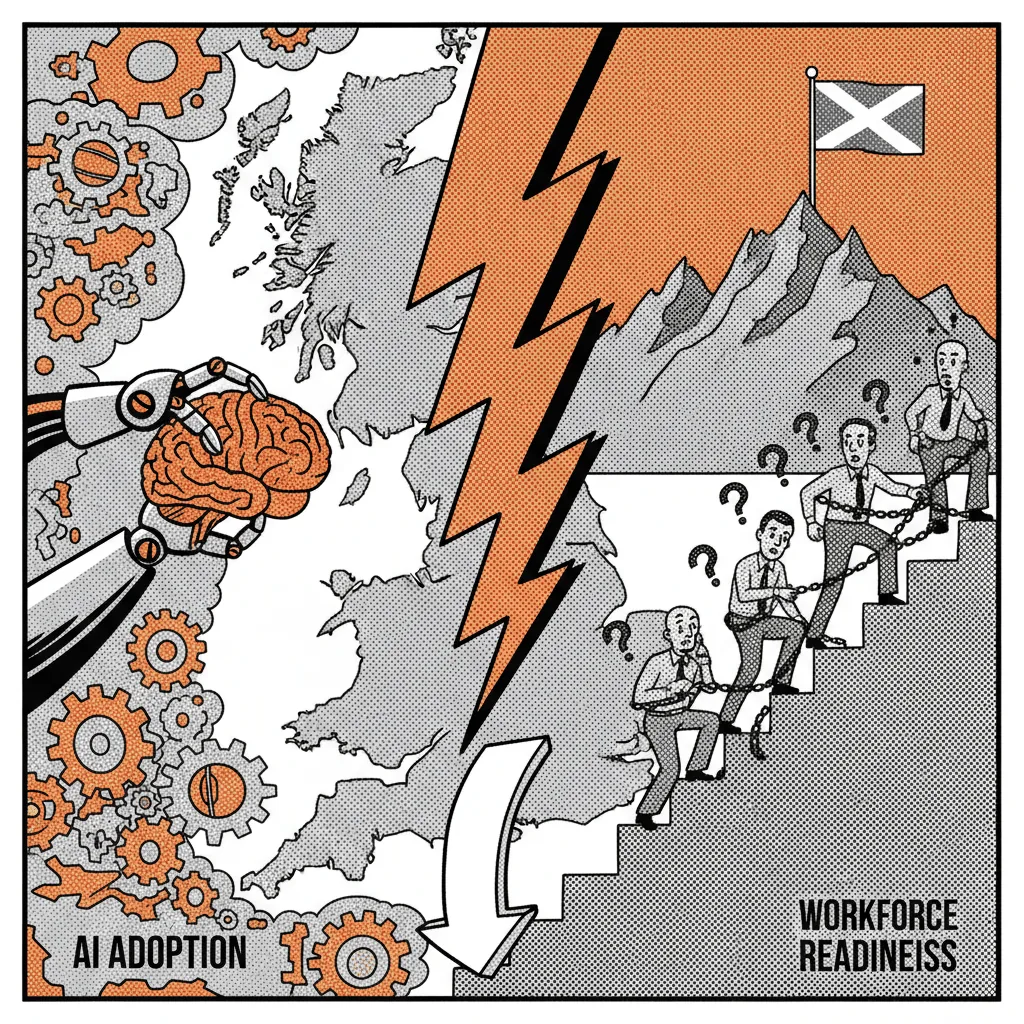
Nearly half of UK businesses have deployed AI tools in the last 18 months, but fewer than one in four employees say they have received any meaningful training to go with them. That is the central finding from QA, the UK's largest AI and digital training provider, whose latest workforce readiness report draws on data from over 1,500 UK organisations. The headline number is blunt: adoption is running approximately two years ahead of capability. Businesses are buying the tools. Nobody is teaching people how to use them properly.
The split between sectors is significant. Financial services, professional services, and tech firms are furthest ahead on both deployment and, to a lesser extent, training investment. Retail, hospitality, construction, and healthcare are deploying AI tools at pace, but with almost no structured upskilling behind them. According to the Confederation of British Industry's most recent skills outlook, more than 60 per cent of UK employers identify digital skills as a critical gap right now, with AI literacy sitting at the top of that list. For a Scottish SME owner running a team of five or fifteen, that gap is not abstract. It is the colleague using ChatGPT to draft client emails in a way that occasionally produces confident nonsense, or the practice manager who has adopted an AI scheduling tool but reverted to spreadsheets within a fortnight because nobody explained the workflow.
Scotland has particular stakes here. Scottish Enterprise's AI Strategy for Scottish Business identifies SME AI readiness as one of three economic priorities for the next decade, alongside clean energy and life sciences. The Highlands and Islands Enterprise board has pointed to digital upskilling as the single biggest lever available to rural businesses looking to compete with urban competitors. The opportunity is genuine and large. A sole trader or small team that genuinely understands how to use AI tools, not just which ones exist, can move faster, pitch better, serve more clients, and cut admin by hours every week. That is not aspiration; that is what is already happening in businesses that have done the training properly.
The QA report identifies three barriers SMEs consistently cite: cost of training, time away from the business, and uncertainty about where to start. All three are real, and all three are now easier to address than they were two years ago. The UK Government's Growth and Skills Fund, administered through the devolved structure in Scotland, includes AI literacy as a funded category. Business Gateway Scotland currently signposts several subsidised digital skills programmes, including short AI-for-business courses that can be completed in hours rather than weeks. Skills Development Scotland has also expanded its Digital Boost programme, which offers free expert consultations to Scottish SMEs on exactly this kind of technology adoption question. None of these require a training budget or a dedicated HR function. They require about an afternoon and a willingness to look.
The practical implication from QA's data is this: the businesses widening the gap right now are not the ones adopting AI. They are the ones adopting it without understanding it. A team that knows how to prompt well, verify outputs, integrate tools into existing workflows, and spot when AI is confidently wrong, that team has a durable edge. A team handed a ChatGPT subscription and left to it does not. Research from the University of Edinburgh's Bayes Centre supports this directly, showing that human oversight and contextual judgement remain the critical variables in whether AI delivers value or just generates more noise to manage. The tools are not the hard part. Understanding what they are actually doing is.