

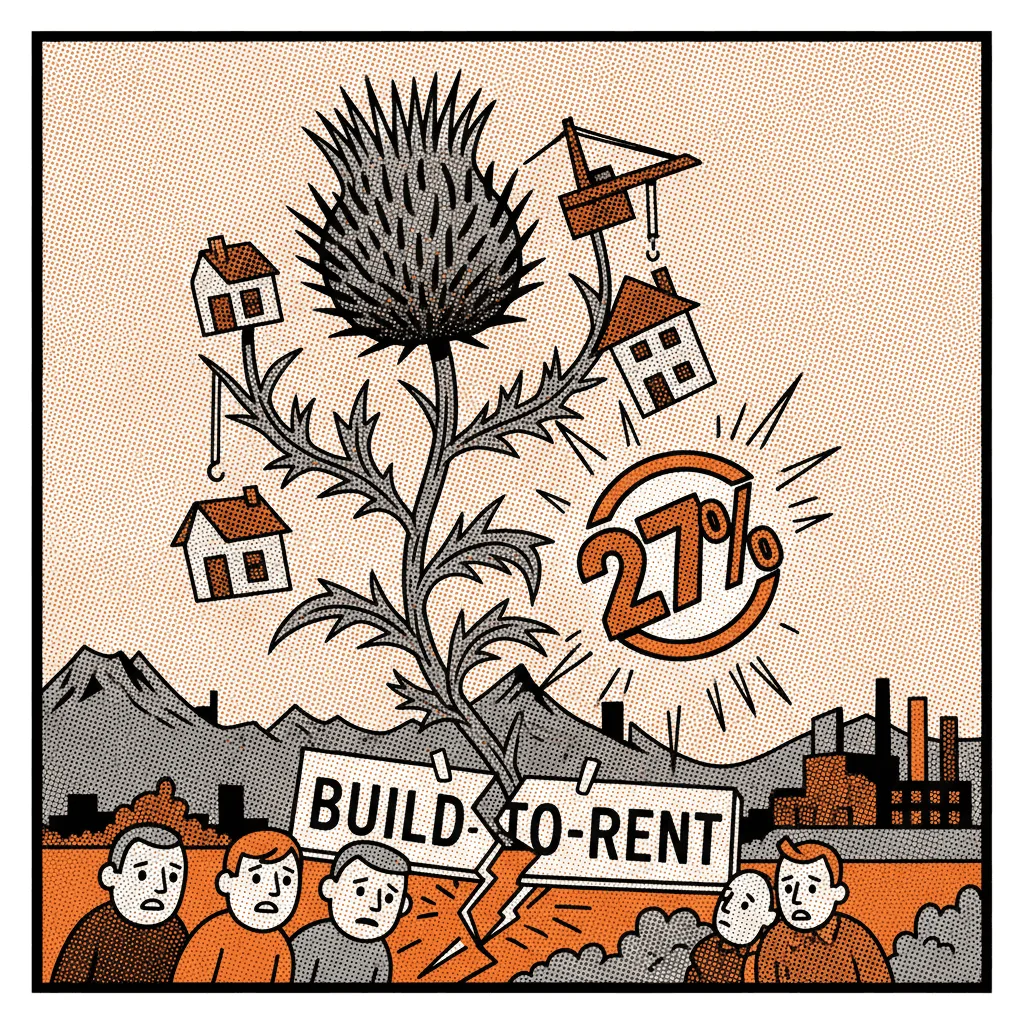
Scotland's build-to-rent sector shed 27% of its active construction pipeline in a single year, according to new analysis compiled by Real Estate Balance and reported by Scottish Business News. That is the steepest decline anywhere in the UK, at a moment when the Scottish Government has already declared a national housing emergency. The numbers are not abstract: fewer homes under construction now means a tighter rental market in twelve to eighteen months, with predictable consequences for rents, staff retention, and the ability of small businesses to attract people who need to move to take the job.
Build-to-rent, for the uninitiated, is purpose-built rental housing developed by institutional investors rather than private landlords. It has been one of the few mechanisms delivering new urban rental stock at scale across British cities. Glasgow and Edinburgh have both benefited from BTR developments in recent years, offering the kind of professionally managed, longer-tenancy rentals that suit incoming workers who are not yet ready or able to buy. A 27% construction slump now risks draining that pipeline just as demand is rising.
The Scottish Government's housing emergency declaration, made in 2024, acknowledged that supply had fallen critically short of demand. According to figures from Homes for Scotland, the industry body representing housebuilders, Scotland needs around 25,000 new homes per year to meet demand; current completions fall well short of that. Meanwhile, the Scottish Government's own statistics show that housing completions in the private sector dropped again in the most recent reporting period, compounding pressure on a rental market already stretched thin by rising mortgage rates pushing would-be buyers into renting for longer.
For SMEs, this plays out in practical, immediate ways. An Edinburgh tech consultancy recruiting a developer from Manchester, a healthcare practice trying to bring in a specialist from London, a hospitality group opening a second site and needing experienced floor managers from elsewhere: all of them are now selling a city where finding a flat at a reasonable rent has become a genuine obstacle. Research from the Chartered Institute of Personnel and Development consistently shows that housing costs and availability rank among the top five barriers to labour mobility in the UK. When the rental market tightens, candidate pipelines narrow with it.
The BTR collapse in Scotland has a policy dimension that deserves attention. Institutional investors have pointed to rent control legislation, introduced under the Cost of Living (Tenant Protection) (Scotland) Act 2022 and extended since, as a material factor in their decision to pause or redirect capital. The intention of rent controls is to protect existing tenants from sharp increases, and it does that. The unintended consequence, flagged by developers and by bodies including the Scottish Property Federation, is that it reduces the incentive to build new rental stock at all. That is a genuine tension, not a simple villain-and-victim story, and Scottish ministers are being urged to find a model that protects tenants without signalling to investors that Scotland is a market to avoid. Getting that balance right matters enormously for every business trying to grow headcount north of the border.
Edinburgh in particular faces an acute version of this squeeze. The city already has some of the highest rents relative to wages outside London, and its festival and tourism economy creates seasonal demand spikes that distort the year-round market. Short-term lets legislation has reduced Airbnb-style supply, pushing some of that accommodation back into the long-term market, but not nearly enough to offset the structural shortfall. For a small business owner in Leith or Gorgie trying to compete with the public sector and large employers for the same local talent pool, the absence of affordable rental housing is now a competitive disadvantage, not a housing policy question.