

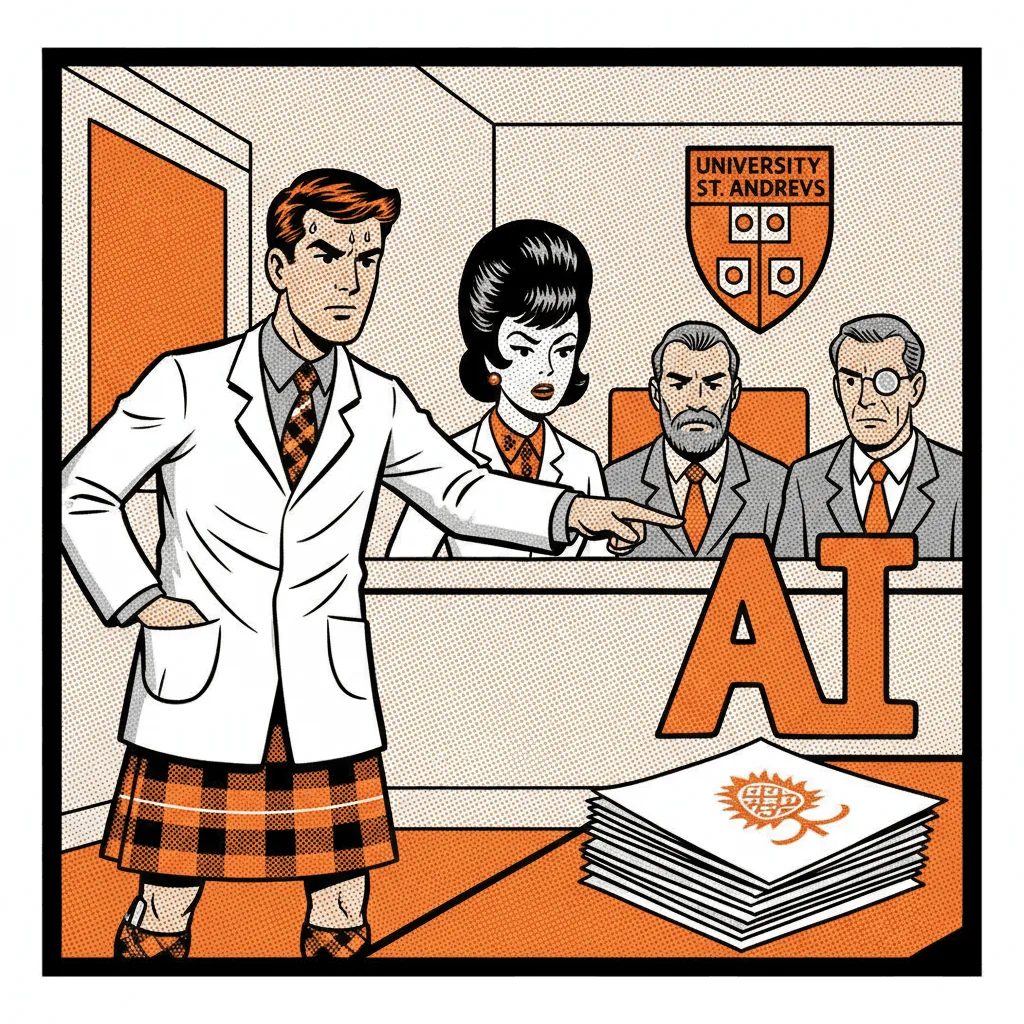
The student, a medical student at St Andrews, submitted a dissertation he had written entirely himself. An AI detection tool flagged it. He was called before a panel, asked to justify his own thinking, and placed under the kind of scrutiny that follows an accusation of academic dishonesty. He was eventually cleared, but the experience, by any measure, was a significant one for someone preparing to enter medicine. His case is not unique. Reports of false positives from AI detection software have been mounting across UK universities for the past two years, and the academic community is only beginning to reckon with what that means.
The detection tools most universities use, including products like Turnitin's AI writing detector, work by analysing statistical patterns in text: how predictable the word choices are, how uniform the sentence structures. The problem is that clear, precise, formally structured writing, exactly the kind a well-trained medical student is taught to produce, can look to an algorithm like something a language model generated. According to research published by Stanford University in 2023, AI detectors misclassify non-native English speakers' writing as AI-generated at alarming rates. The same pattern appears to apply to students who write in a disciplined, academic register. The tool cannot tell the difference between careful human writing and machine output.
Universities Scotland, the body representing Scottish higher education institutions, has acknowledged the challenges around AI in assessment, though sector-wide guidance on detection tool reliability remains limited. The Scottish Funding Council has called for institutions to review their AI policies, but there is no consistent standard for how flagged cases are handled, what evidence students must provide, or how appeals are conducted. A student at St Andrews faces a different process than one at Edinburgh, Dundee, or Glasgow. That inconsistency matters when the stakes include a medical career.
For Scottish SME owners and solopreneurs, the lesson here is not about universities. It is about the unreliability of AI detection as a category of tool. If you are commissioning written content, using AI to draft proposals, or producing any document that might face scrutiny, understand that detection tools do not work cleanly. They produce false positives. A client, a procurement body, a regulator, or an employer could run your work through one of these tools and receive a misleading result. The tool will not caveat its output. It will produce a percentage and a verdict, and many people will treat that as definitive when it is not.
The broader point is worth sitting with. We are at a moment where AI is being used to police AI, and neither side of that equation is reliable enough to carry the weight being placed on it. The answer is not to avoid AI tools; they remain genuinely useful, and the students and businesses getting the most from them are not going to stop. The answer is to understand the environment you are operating in, keep records of your process, be transparent where transparency is expected, and push back when a machine verdict is treated as human judgement. That St Andrews student was cleared because he could articulate his thinking. That is always the best defence.