

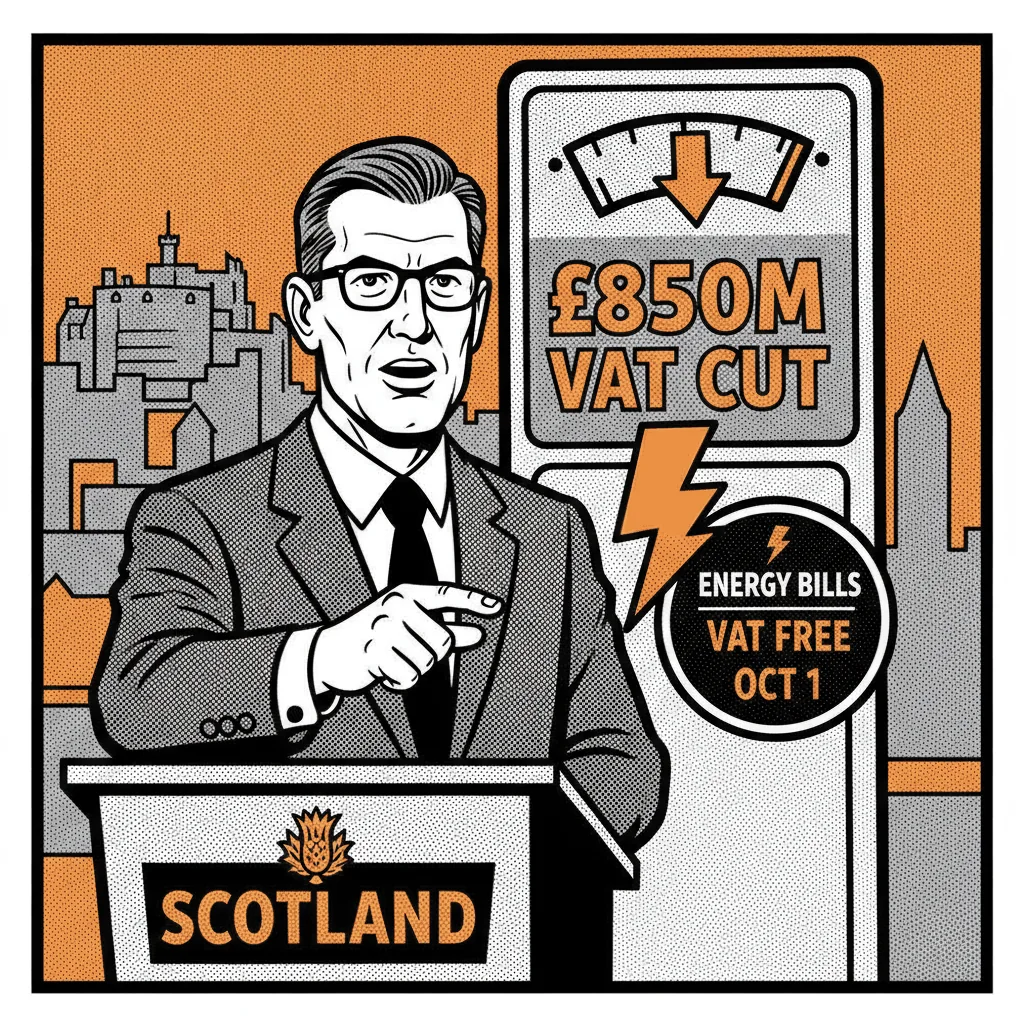
Andy Burnham, Mayor of Greater Manchester and recently declared Labour leadership contender, has announced plans to remove VAT on domestic electricity bills from 1 October, in a move he estimates will save households and businesses £850m collectively. The policy, framed as the centrepiece of what Burnham is calling a 'cost-of-living government' platform, would reduce electricity bills by five percentage points, the current VAT rate applied to domestic energy, overnight. For businesses on commercial tariffs, the immediate picture is more complicated, but the political pressure this creates is significant and likely to move quickly.
Context matters here. UK businesses on commercial electricity contracts currently pay 20% VAT, not the reduced 5% rate that domestic customers pay. Burnham's announcement targets the domestic rate, but the political framing of this as a cost-of-living intervention opens the door for pressure on commercial VAT rates too. The Federation of Small Businesses has repeatedly flagged energy costs as the single biggest overhead pressure facing small firms since 2022, and according to figures from the Office for National Statistics, energy costs remain the second-largest operational expense for UK SMEs after staffing. Any downward movement on VAT, domestic or commercial, changes the arithmetic for every business owner paying a quarterly electricity bill.
For Scottish SMEs specifically, the stakes are sharper. Scotland's energy-intensive sectors, including hospitality, food production, rural tourism, and manufacturing, have been absorbing elevated energy costs for three consecutive winters. Scottish Enterprise's most recent business sentiment survey noted that energy costs were cited as a top-three concern by 61% of Scottish SMEs surveyed. A VAT reduction that filters through to commercial tariffs, even partially, would represent the first meaningful structural relief in that cost base since the Energy Bill Relief Scheme wound down in March 2023.
There is, however, a structural tension worth naming clearly. Burnham's proposal is a Westminster-level policy announcement made in the context of a Labour leadership contest. The Scottish Government has limited direct levers on VAT, which is reserved to Westminster under the Scotland Act. That means Scottish businesses are reliant on UK-level decisions to see any benefit here, a reminder of the structural constraint that sits over Scottish economic policy. The Scottish Government's own energy strategy, which prioritises renewables and community energy, could complement a VAT cut by reducing underlying generation costs, but the VAT mechanism itself sits firmly in London's hands.
Burnham's announcement lands at a politically charged moment. With Labour under pressure to demonstrate economic credibility and the Conservatives offering little on energy costs, the proposal has traction. The Institute for Fiscal Studies has noted previously that removing or reducing VAT on energy is a blunt but effective tool for putting money back into household and business budgets quickly, though it comes with a significant Treasury cost. Whether this becomes law, and on what timeline, depends on the political landscape post any leadership contest. But the direction of travel is clear, and Scottish business owners should be watching closely.