

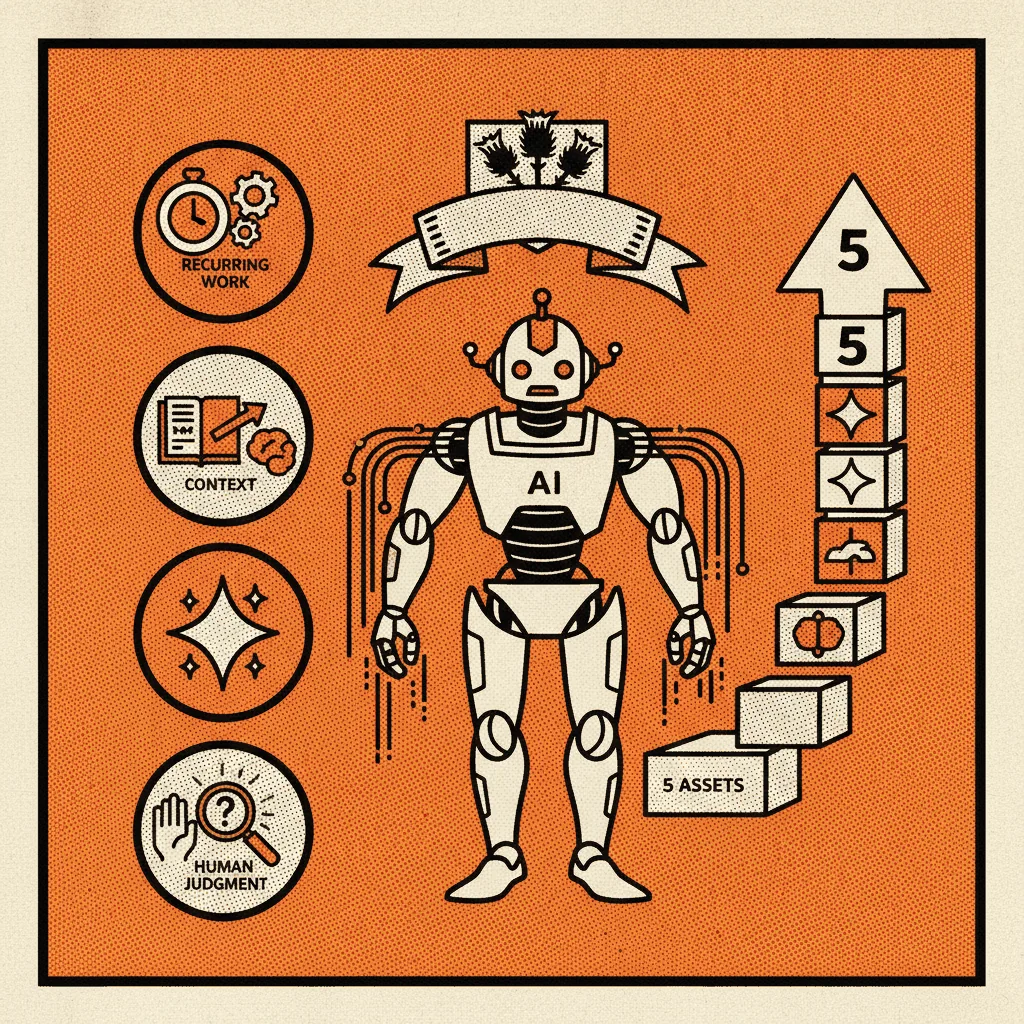
The single biggest reason AI agents underperform in small businesses is not the technology. It is the briefing. According to research published by McKinsey & Company, companies that see measurable productivity gains from AI tools are three times more likely to have invested in structured documentation and workflow design before deployment. The tool is not the bottleneck. The preparation is.
The first asset any business needs is a clear definition of recurring work: the tasks that happen on a predictable cycle, follow a recognisable pattern, and currently eat time without requiring fresh creative thought each time. Think monthly client reports, new enquiry responses, social post scheduling, invoice chasing, or staff rota updates. If you cannot write it down in a single paragraph, the agent cannot replicate it reliably. The Scottish Government's Digital Directorate, in its guidance on automation readiness for public bodies, uses almost identical language: document the process before you automate the process.
The second asset is context. An AI agent operating without business context is like a new hire on day one with no induction and no manager. It will fill the gaps with guesses. That context includes your tone of voice, your client relationships, your pricing logic, your brand sensitivities, and any background the agent needs to make decisions that sound like you made them. For an Edinburgh accountancy practice or a Leith-based design studio, that means a written brief, not a five-minute verbal handover. The third asset follows directly: a definition of quality. What does a good output actually look like? Not roughly, but specifically. Provide examples. Mark up what works and what does not. The agent learns from concrete illustration far better than from vague instruction.
The fourth asset is a decision map: a clear record of where human judgement is still required and where the agent can proceed independently. This is not a trust issue; it is a systems design issue. According to the Alan Turing Institute's 2024 report on AI deployment in UK SMEs, businesses that defined human-in-the-loop checkpoints before deployment reported significantly fewer costly errors than those who left decision boundaries undefined. For a healthcare administrator automating appointment reminders, the checkpoint might be any patient flagged as vulnerable. For a retailer automating supplier comms, it might be any order above a certain value. Draw the line before you need it, not after something goes wrong.
The fifth asset is a feedback loop. AI agents improve when they receive structured correction, not just occasional complaints. Build in a simple review step: a weekly ten-minute check where someone in the business looks at a sample of outputs, flags anything that missed the mark, and logs the correction in plain language. Over time, this becomes a living quality document that sharpens the agent's performance without requiring a technical intervention. For a small team in Edinburgh running lean, this is the difference between an agent that drifts and one that gets genuinely better. The businesses seeing the biggest return from AI right now are not the ones with the most sophisticated tools. They are the ones who did the unglamorous preparation work first.