

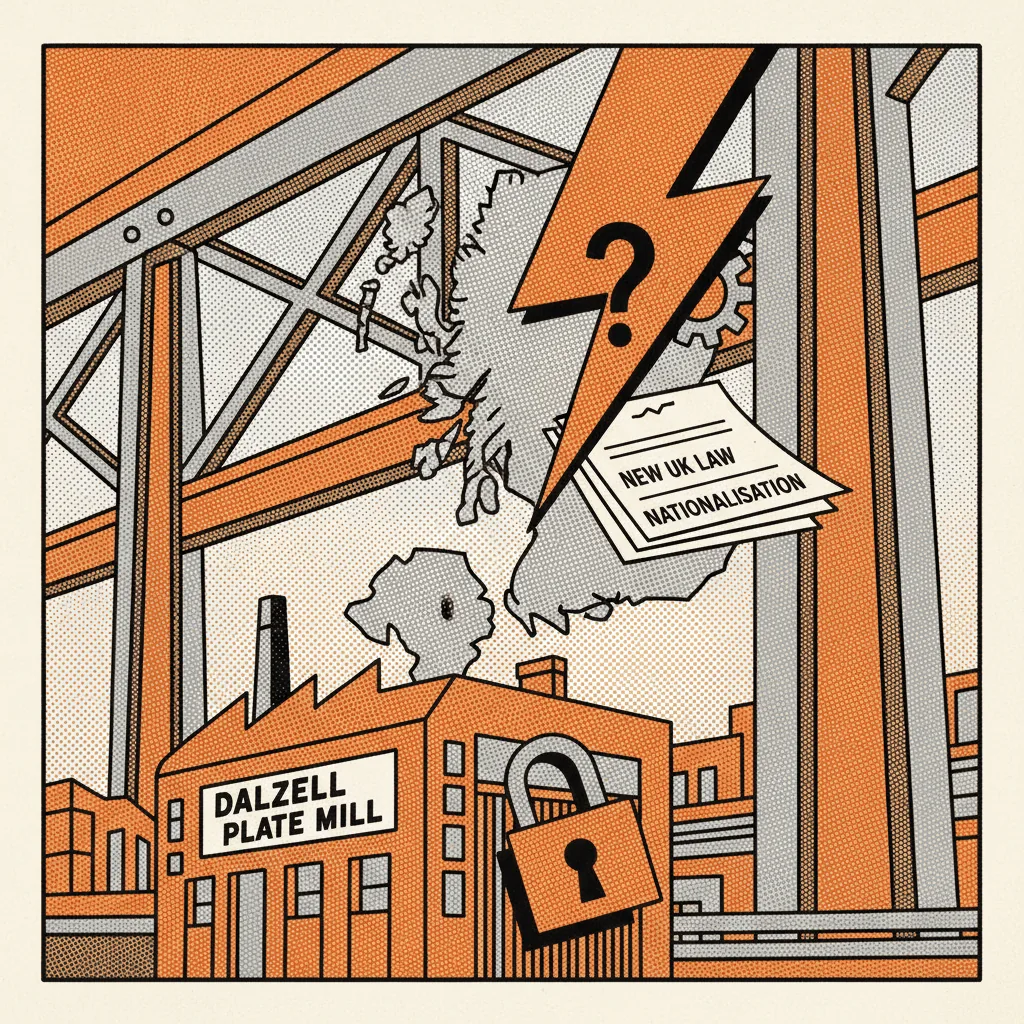
The Steel Industry (Nationalisation) Bill, now making its way through Westminster, hands the Secretary of State the legal power to bring any steel undertaking into public ownership. That sounds like a lifeline for struggling mills. For Dalzell in Motherwell, Scotland's last remaining plate mill, the reality is considerably less clear-cut.
Analysis published this week in High Growth Scotland points out that while the Bill creates the mechanism for state intervention, it does not create any obligation to use it north of the border. Dalzell, which produces heavy steel plate used in shipbuilding, construction, and energy infrastructure, has survived previous rounds of industrial rationalisation that wiped out most of Scotland's steel capacity. Its continued existence depends on decisions made in London boardrooms and Whitehall offices, not Holyrood.
The broader context matters here. According to UK Steel, the trade association for the British steel industry, the sector employs around 33,500 people directly and supports many more through supply chains. Scotland's share of that is concentrated and fragile. Lose Dalzell, and you lose not just a facility but an entire capability: the ability to produce domestic plate steel for offshore wind, naval contracts, and heavy construction projects that the Scottish Government is actively trying to grow.
The Scottish Government has consistently argued that decisions about Scottish industrial assets should involve Holyrood as an equal partner, not an afterthought. The SNP's economic development framework explicitly identifies advanced manufacturing as a priority sector. Yet the nationalisation Bill, as drafted, centralises decision-making power entirely with the UK Secretary of State. The Fraser of Allander Institute has previously noted that Scotland's manufacturing base is disproportionately exposed to UK-wide industrial policy decisions precisely because devolution does not extend to trade or industrial ownership powers.
For Scottish businesses that sit in the supply chain around heavy industry, including fabricators, logistics operators, engineering consultancies, and equipment suppliers across Lanarkshire and the central belt, the stakes are not abstract. If Dalzell's future becomes a Westminster bargaining chip rather than a Scottish industrial priority, those supply chains face a period of real uncertainty. The Bill is a tool. The question, as always, is who gets to use it, and for whose benefit.