
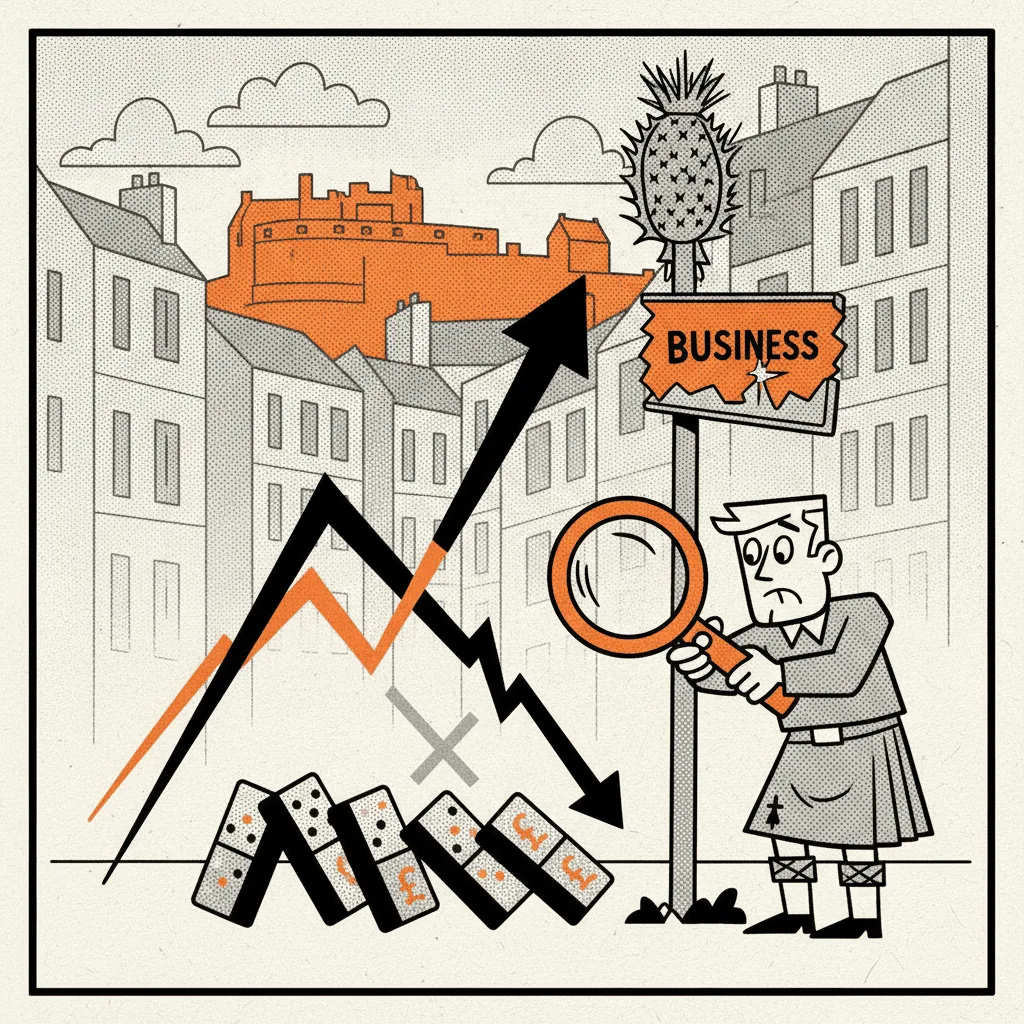
Thirty-nine businesses in Scotland entered administration between January and June 2026, according to analysis by national law firm Shakespeare Martineau, drawing on data from The Gazette Official Public Record. That compares to 31 in the first half of 2025, a 26% year-on-year increase. The figure sits just below the recent peak of 41 administrations recorded in the same period two years prior, which means the trend is moving in the wrong direction without yet hitting its worst point.
For context, administration is not the only measure of business distress. It is, however, one of the clearest: a formal insolvency procedure that typically signals a business has exhausted its options and brought in an independent practitioner to salvage what it can. The companies that reach this point are usually not small sole traders. They have staff, creditors, and supply chain relationships. When one goes down, it rarely goes down alone.
The wider UK picture offers little comfort. According to the Insolvency Service, company insolvencies across England and Wales remained elevated through 2024 and into 2025, with creditors' voluntary liquidations running at historically high levels. Scotland's numbers are smaller in volume but the directional pressure is identical: higher borrowing costs, squeezed margins, and a consumer base that is still cautious. The Bank of England's most recent Financial Stability Report flagged that smaller firms remain disproportionately exposed to refinancing risk as fixed-rate debt facilities mature.
For Scottish SME owners, the practical danger is not just your own balance sheet. It is the businesses around you. A client who owes you money and enters administration can leave you as an unsecured creditor, which in plain terms means you join a queue and rarely see full repayment. A supplier who goes under mid-contract can stall your operations overnight. Scottish Enterprise has published guidance on supply chain resilience, and Business Gateway offers free financial health checks for SMEs that want an independent read on their exposure. Both are worth using before you need them.
There is a structural argument here too. Scotland's business formation rate has been strong in recent years, with Companies House data showing consistent net growth in registered entities. More businesses means more exposure to the cycle. The question for any founder or owner right now is not whether conditions are difficult; they clearly are. The question is whether your cash position, your debtor book, and your supplier dependencies are stress-tested for a world where one or two of your closest trading partners might not make it to Christmas.
None of this is cause for panic. The 39 administrations recorded represent a fraction of Scotland's active business population, and the figure remains below the recent peak. But the direction of travel, combined with persistent cost pressures and a rate environment that has been punishing for leveraged businesses, means this is a moment to look hard at who owes you money, how concentrated your revenue is, and what your contingency looks like if a key relationship breaks. That is not pessimism. That is running a business properly.