

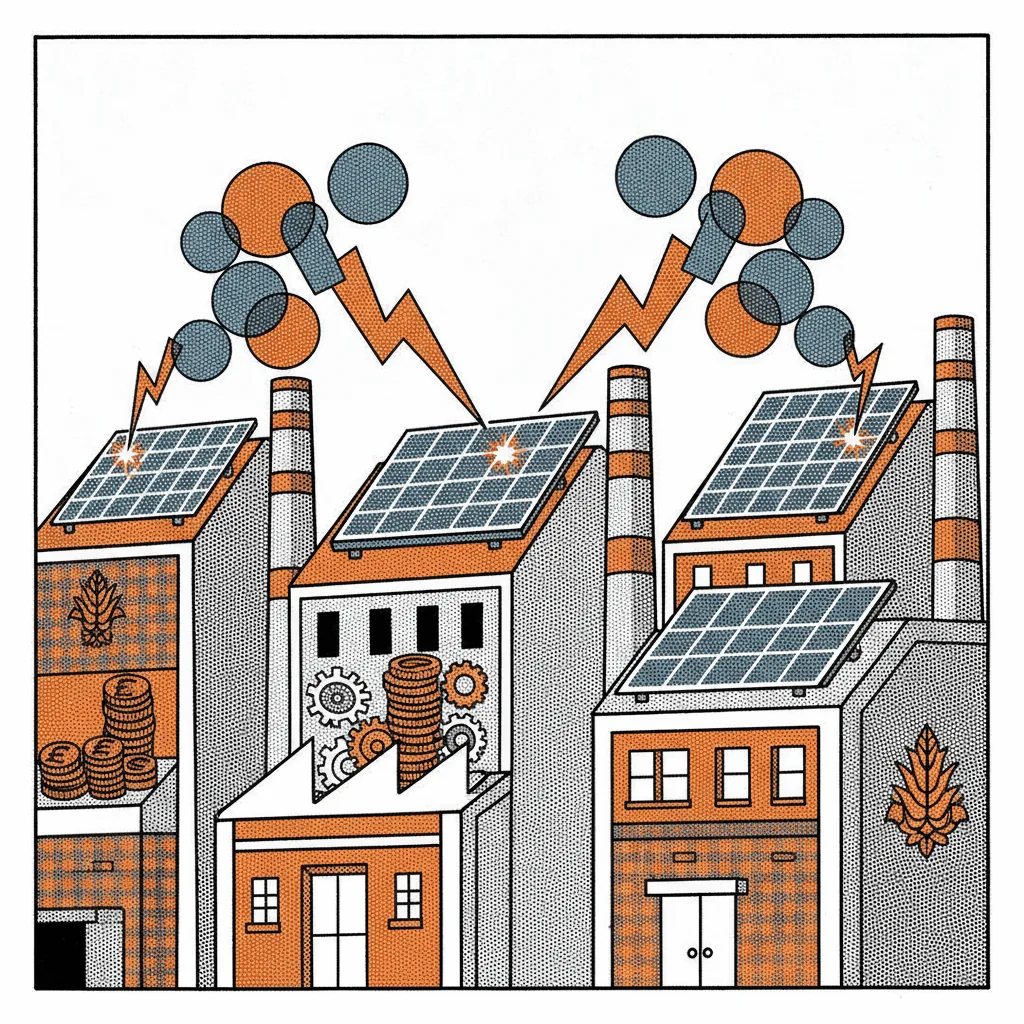
Three Scottish industrial businesses are now generating their own electricity without having spent a penny on the hardware to do it. Two Blues Solar completed more than 1.8 MWp of fully funded commercial solar installations across sites operated by Kanthal in Perth, and Lossie Seafoods and Ennovi in Arbroath. Total investment: approximately £1.64 million. Total capital outlay from the businesses themselves: none.
The fully funded model is the key detail here. Under this structure, a solar developer finances, installs, and owns the panels, then sells the electricity generated back to the host business at a rate below the grid tariff. The business gets cheaper power from day one. The developer recoups its investment over time through those electricity sales. No loan, no grant application, no board-level capital expenditure fight. According to Scottish Renewables, Scotland generated the equivalent of 113% of its electricity consumption from renewables in 2022, meaning the grid conditions for exactly this kind of distributed solar economics have never been better.
The three sites together are expected to produce around 1.39 GWh of electricity annually. To put that in practical terms, the Carbon Trust estimates that a typical medium-sized manufacturing facility uses between 0.5 and 2 GWh per year, so these installations are covering a substantial share of operational energy demand at each site. For energy-intensive businesses, particularly those in food processing and manufacturing like Lossie Seafoods and Kanthal, that is a direct reduction in one of their largest variable costs.
The timing matters. Business electricity prices in the UK remain elevated by historical standards. Ofgem data shows that non-domestic electricity unit rates, while down from their 2022 peak, are still roughly double pre-pandemic levels for many commercial consumers. Businesses that locked in longer-term contracts at peak rates are now looking hard at on-site generation as a hedge. Solar payback periods for commercial installations in Scotland typically run between seven and twelve years according to the Energy Saving Trust, but under a fully funded Power Purchase Agreement model, the payback question is largely the developer's problem, not the operator's.
Scotland's industrial base outside the central belt, firms in food and drink, manufacturing, logistics, cold storage, tends to operate on tight margins with large, predictable energy loads. That profile is precisely what makes the fully funded solar model attractive, and Two Blues Solar appears to be building a pipeline of exactly these clients. Scottish Enterprise has identified energy cost reduction as a direct competitiveness lever for Scottish manufacturers, and the Scottish Government's Heat in Buildings Strategy signals continued policy pressure toward decarbonising commercial energy use. Three sites completed. The model is proven. The question for any Scottish business owner with a south-facing roof is simply whether they have called anyone about it yet.