

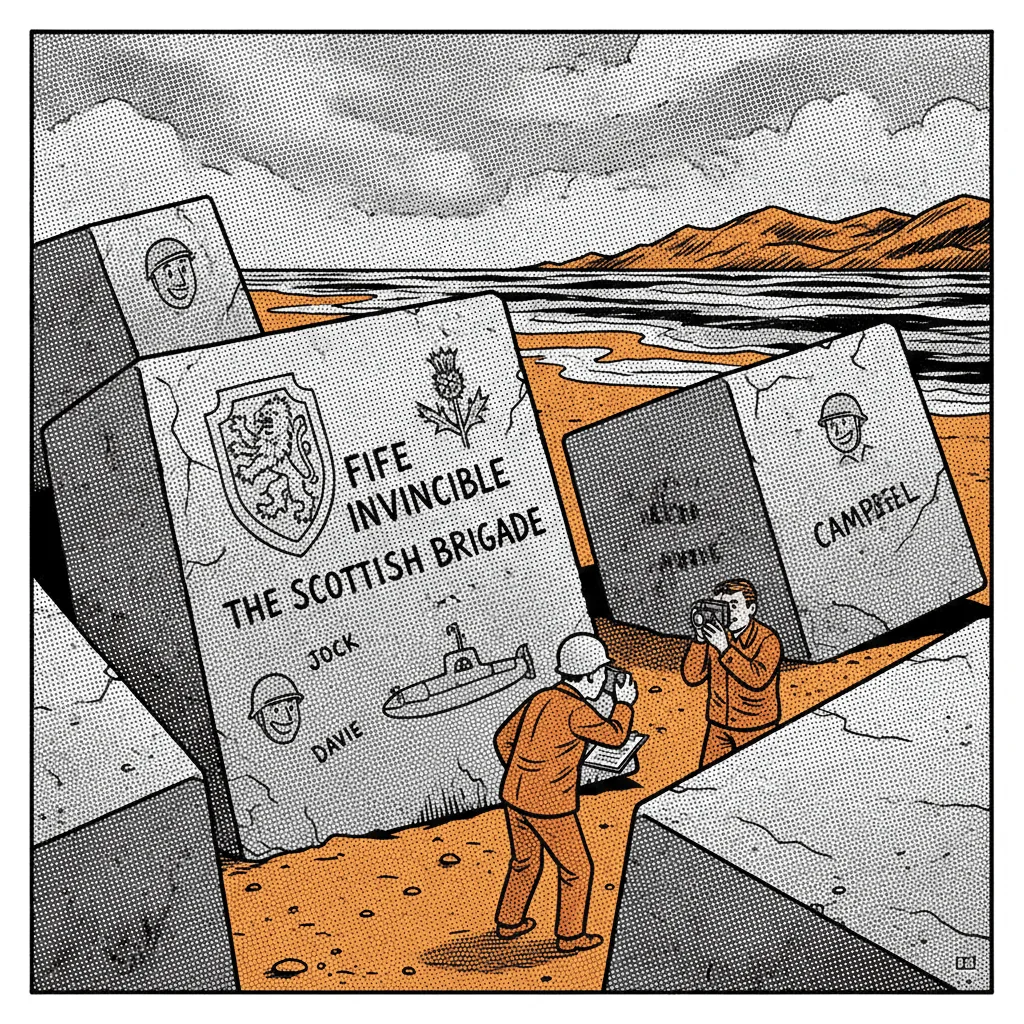
Somewhere on the Fife coastline in the early 1940s, a soldier picked up something sharp and carved his name into a concrete block. He was probably cold, probably bored, possibly scared. He almost certainly had no idea that archaeologists would be photographing his handwriting eight decades later.
That is exactly what has happened at Tentsmuir, where a team recording the area's wartime anti-tank defences has found a series of personal markings left by the men stationed there: names, an intriguing slogan, and at least one cartoon. Historic Environment Scotland, which supports the recording of such sites as part of its broader commitment to Scotland's built and cultural heritage, considers this kind of incidental human evidence among the most valuable finds a dig can produce. The concrete blocks were designed to stop German tanks. Nobody designed them to hold memory. They did it anyway.
Anti-tank cubes of this type were installed in their thousands along Scottish and British coastlines as part of the wartime coastal defence network, a programme documented extensively by the Pillbox Study Group and by researchers at the University of St Andrews, whose proximity to Tentsmuir makes it a natural partner in local heritage work. Most of those structures are now crumbling, obscured by dune systems, or simply unremarked upon by the dog-walkers and families who pass them on weekends. The carvings change that. They turn infrastructure into biography.
What makes the Tentsmuir find particularly resonant is the cartoon. Graffiti is old, but cartoon-style drawing in this context suggests someone with a sense of humour, a moment of levity pressed permanently into wartime concrete. The slogan, which archaeologists describe as intriguing, has not been fully publicised yet, which is itself a reason to follow the project as it develops. Historic Environment Scotland's canmore.org.uk database is the place to watch for updates as the site record is completed.
Scotland has more recorded WW2 defensive structures per kilometre of coastline than almost anywhere else in Britain, a legacy of its strategic position during the conflict. Many of those sites remain under-documented. The work at Tentsmuir is a reminder that recording them is not just an academic exercise. It is an act of retrieval, pulling individual human stories back from the edge of permanent erasure before the concrete finally goes.