

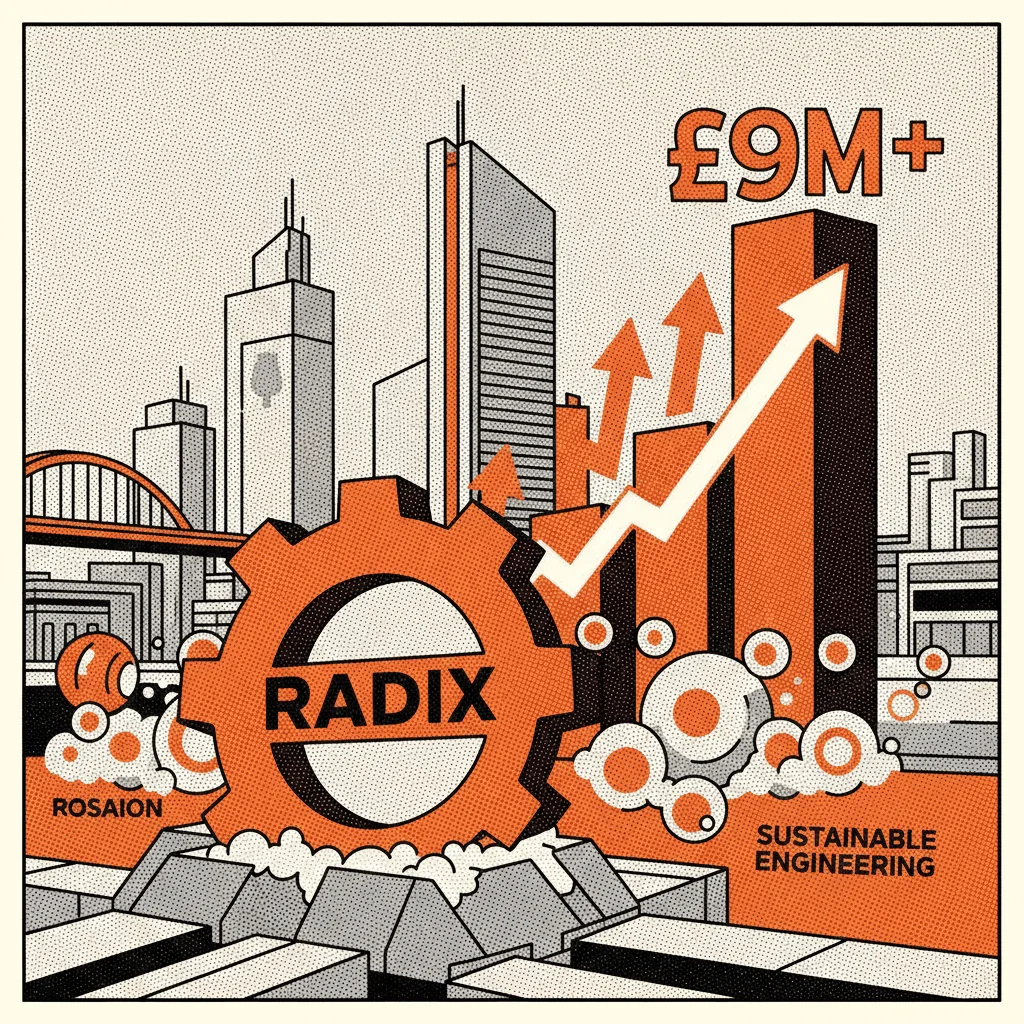
RADIX, the Dundee-based screw pile and ground screw foundation specialist founded by Callum Milne in 2019, has surpassed £9 million in turnover after posting 33% year-on-year revenue growth. That is not a rounding error. That is a company doubling in commercial weight roughly every two to three years, in a sector, sustainable construction, that sceptics still occasionally dismiss as niche.
The business designs and manufactures low-carbon foundation systems: screw piles and ground screws that displace traditional concrete footings. Concrete is responsible for around 8% of global CO2 emissions, according to the Global Cement and Concrete Association, so anything that legitimately replaces it at scale carries real environmental weight. RADIX's systems are faster to install, generate less waste, and are fully removable at end of life, a procurement argument that is landing with clients across construction, renewables, and infrastructure.
The growth is not accidental. Scotland's construction sector is under sustained pressure to decarbonise, with the Scottish Government's Heat in Buildings Strategy and its net-zero by 2045 commitment driving specifiers and developers toward lower-embodied-carbon solutions. According to the Scottish Government's infrastructure investment plan, public capital spending on construction will exceed £6 billion over the next five years, a significant proportion of which must demonstrably reduce carbon to meet procurement criteria. RADIX is positioned squarely in that current.
The company has also built an international footprint from its Dundee base, supplying markets beyond the UK. That export dimension matters: Scottish Enterprise has consistently flagged construction tech and cleantech as priority sectors for international trade support, and RADIX is exactly the kind of scale-up those programmes exist to back. For a business not yet six years old, reaching nine figures in turnover while operating globally is the kind of trajectory that should be making noise well beyond Tayside.
What RADIX also demonstrates is that the commercial case for low-carbon construction no longer needs to be argued on ideological grounds. Net-zero legislation, embodied carbon benchmarks in planning policy, and increasingly carbon-literate clients have turned sustainability from a nice-to-have into a procurement filter. Firms that treated green engineering as a future concern are now catching up to companies like RADIX that treated it as a business model from day one.