

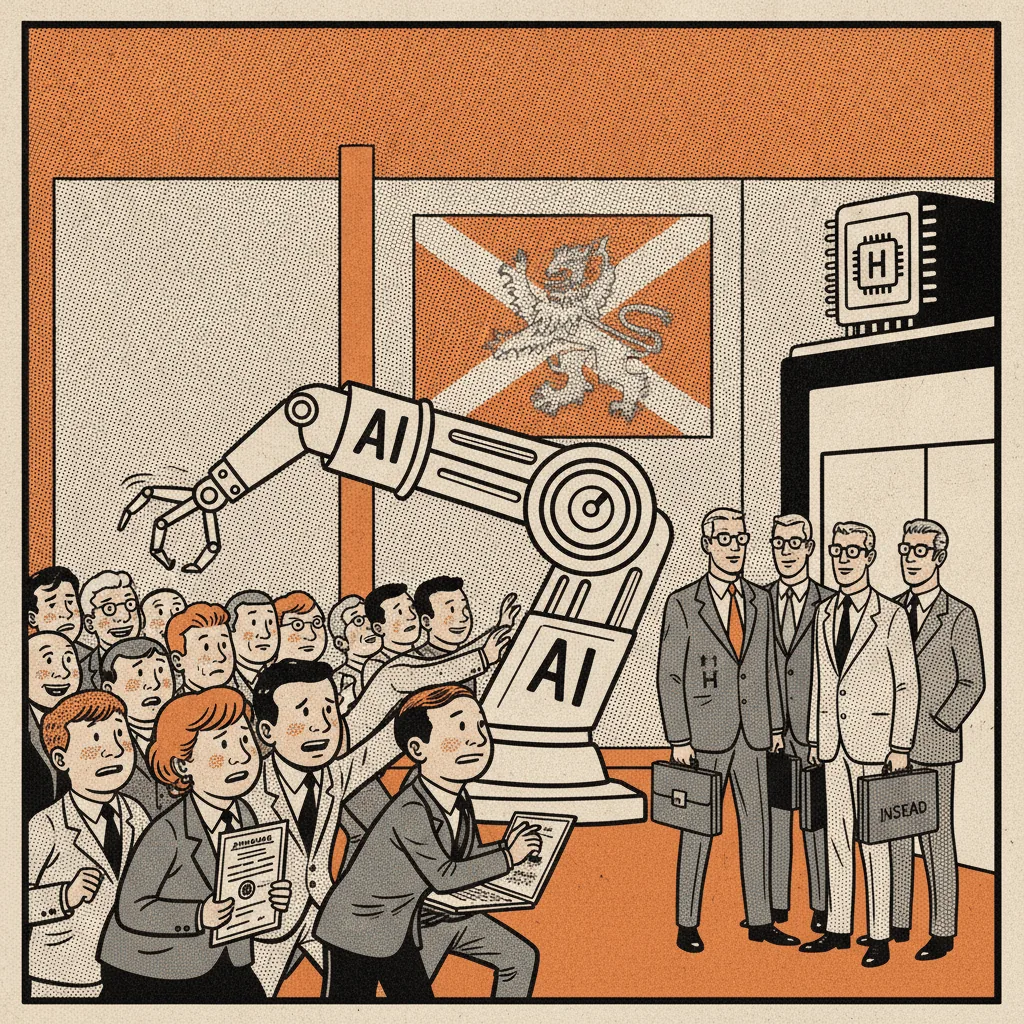
Researchers Rembrand Koning and Hyunjin Kim examined Y Combinator startups from 2020 to 2024 and found a consistent pattern: companies built natively around AI tools don't hire the same way as traditional startups. They're leaner at the bottom of the org chart and more concentrated at the top. Junior roles, the ones that once served as the engine room of any growing business, are being skipped entirely.
The reason isn't hard to find. AI tools handle the work that junior hires used to do: first-draft research, data formatting, routine comms, basic code, customer query triage. A senior developer or strategist armed with the right AI stack can now produce what previously required two or three people beneath them. The researchers describe these firms as "flatter", and that flatness is a structural choice, not a staffing accident.
This isn't purely a Silicon Valley story. According to the UK's Office for National Statistics, small businesses with fewer than 50 employees account for 99.2 per cent of all private sector businesses in the UK. The hiring decisions those founders make in the next 12 to 24 months will shape the shape of Scottish enterprise for a decade. Research from the University of Edinburgh's Centre for Technomoral Futures has consistently noted that AI adoption in SMEs tends to lag larger firms by two to three years, meaning the structural shift visible in AI-native startups today is arriving at the desks of Scottish founders tomorrow.
There's a genuine tension here worth naming. Fewer junior hires means fewer entry points into the workforce. That matters for communities, for skills pipelines, and for the kind of broad-based economic growth that Scotland's enterprise bodies, from Scottish Enterprise to Highlands and Islands Enterprise, have championed for years. Business Gateway has invested significantly in employability and skills programmes across Scottish regions. If the businesses those programmes are meant to serve are structurally moving away from entry-level hiring, that conversation needs to start now, not when the pipeline is already dry.
But for the SME owner reading this on a Tuesday morning, the more immediate question is simpler: are you hiring to fill gaps that AI could close instead? The founders in the Harvard and INSEAD study aren't doing this to be clever or cruel. They're doing it because a small team with excellent tools moves faster, costs less, and compounds its capabilities over time. That logic applies just as cleanly to a ten-person Edinburgh agency or a Dundee-based SaaS company as it does to a Y Combinator cohort. The great equaliser isn't just available to tech startups. It's available to you.