

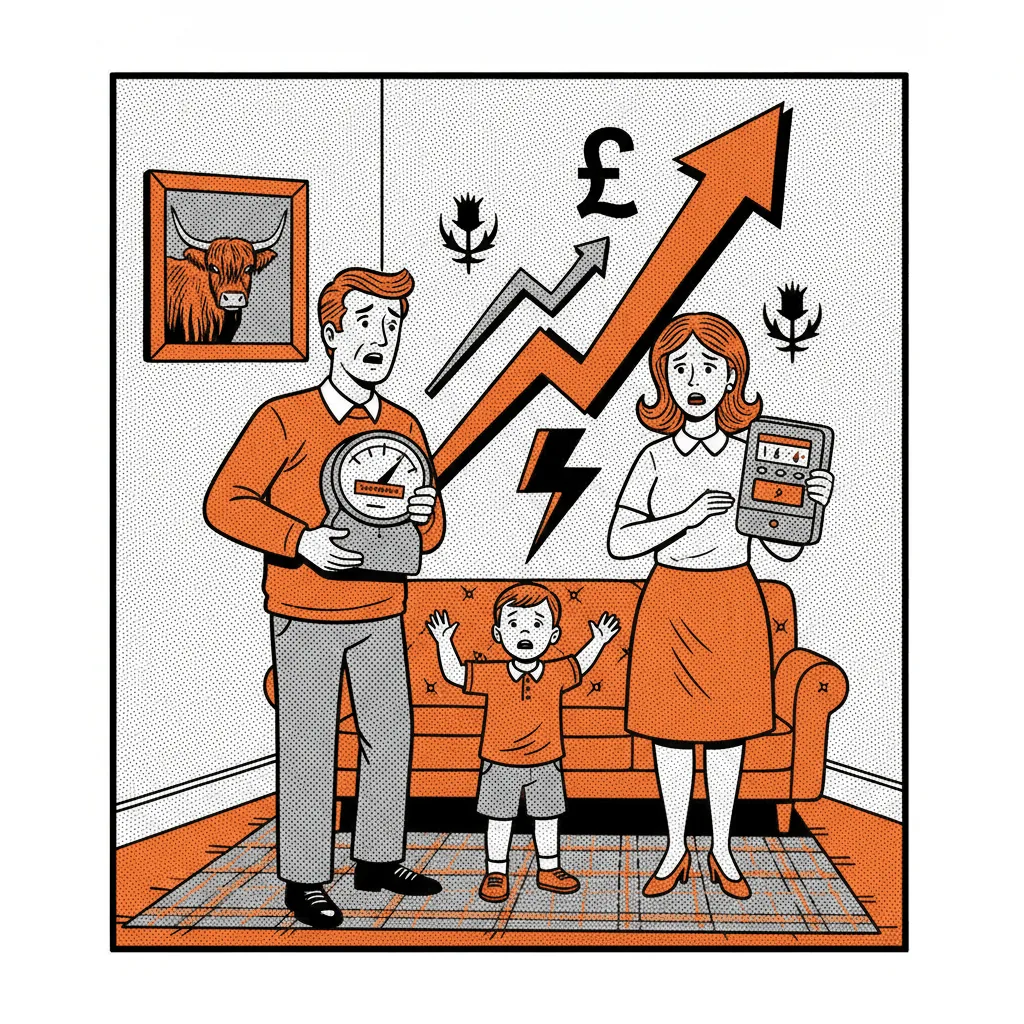
From today, Wednesday 1 April, Ofgem's revised price cap means the average UK household pays £1,862 a year for gas and electricity, a 13% increase on the previous quarter. That figure gets the headlines. But it is the number that does not appear in the headlines that matters more to Scottish SME owners: businesses are not covered by the price cap at all. Commercial energy contracts sit entirely outside Ofgem's consumer protections, which means your costs move with the wholesale market, your supplier's terms, and whatever deal you signed last.
The cap rise matters for business owners in two ways. First, if your premises are on a domestic-style supply, common for very small outfits, sole traders working from home, or micro-enterprises on flexible tariffs, you feel this increase directly and immediately. Second, the broader cap movement signals where wholesale energy prices are heading, and that feeds into business contract renewals. According to Cornwall Insight, the analysts whose modelling Ofgem largely uses to set the cap, energy prices are expected to remain elevated through 2025, with Q3 showing little sign of meaningful relief.
The Scottish Government's energy guidance, available through Business Gateway Scotland, reminds SMEs that switching supplier or renegotiating a commercial contract at renewal is the single most effective lever most small businesses have. Yet research from the Federation of Small Businesses consistently shows that a significant proportion of UK small firms roll over onto out-of-contract rates rather than actively renegotiating, a habit that can add hundreds or thousands of pounds a year in avoidable costs. With bills already rising, that passivity is expensive.
There are practical steps available right now. The Carbon Trust's SME energy efficiency programme offers free audits and advice to qualifying businesses in Scotland, and Scottish Enterprise has previously co-funded energy efficiency upgrades for eligible premises through its resource efficiency support. LED lighting, smarter heating controls, and building insulation are not glamorous, but they are the boring infrastructure that cuts consumption before the unit rate even comes into it. A 10% reduction in energy use offsets a significant portion of today's price rise without touching your supplier contract.
One angle worth watching: the same wholesale energy conditions driving domestic bills upward are also the economic case for accelerating Scotland's renewable energy buildout and, critically, the pairing of AI data centre infrastructure with district heating networks. Scotland's surplus renewable capacity and cold climate make it an ideal location for compute infrastructure that generates heat as a by-product, heat that can warm business premises, schools, and homes at near-zero marginal cost. That is not a distant theoretical. Stockholm has run data centre waste heat through its district network for years. Edinburgh and other Scottish cities could do the same. The energy cost crisis is, in part, a distribution and infrastructure story, and Scotland has the geography and the grid to solve it differently.